
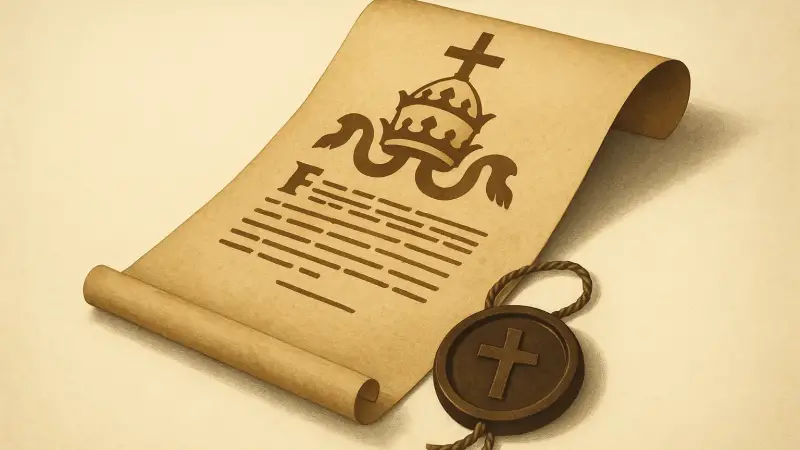
People treat old documents like they carry their own authority. Wax seal, formal Latin, a pope’s name at the top, and suddenly it feels safer to stop asking questions. That’s the trick behind a famous medieval fake: the Donation of Constantine. It claimed that Emperor Constantine handed vast power and territory to Pope Sylvester I, back in the 4th century. The text was actually written centuries later, but it circulated as if it were an ancient decree. By the time rulers and bishops were citing it in disputes, the paper itself had started to steer real politics, even when the story inside it was wrong.
What the document said it was
The Donation of Constantine reads like a legal memory. Constantine is portrayed as grateful to the pope, sometimes linked to a story of healing and conversion that made the gift feel morally earned. Then comes the big move: Constantine supposedly grants the bishop of Rome high authority, honors, and control over key territories in the West. It is not a modest donation. It is a blueprint for why popes could claim more than spiritual leadership.
The overlooked detail is how practical the writing is. It is full of the kinds of administrative language that decide who outranks whom. It cares about titles, precedence, and what counts as legitimate rule. That’s why it traveled so well. It gave church lawyers something they could quote in arguments that were already happening.
Why medieval Europe found it believable
Medieval Europe didn’t have a single filing system where anyone could check an “original.” Texts moved by copying, excerpting, and bundling into collections. The Donation survives because it fit into that world. It aligned with what many people already assumed: that Rome had ancient, special status, and that the early Christian emperors had endorsed it.
It also benefited from the distance of time. Constantine was a remote figure by the early Middle Ages, and the 4th century was hazy ground for most readers. When a claim sits in a foggy past, it is easier to accept, especially if it supports an existing power structure. A forged document doesn’t need everyone to believe it blindly. It only needs enough influential readers to treat it as usable.
How it got used in real power fights
The Donation became a weapon in conflicts between popes and secular rulers. It helped justify papal claims to rule or oversee territory, and it strengthened the idea that emperors owed a kind of deference to Rome. When a pope and an emperor clashed over who had the right to appoint bishops, control lands, or set boundaries, a text like this could be dropped onto the table like a trump card.
A concrete example is how it was later cited in the long tradition of papal-imperial disputes that included the Investiture Controversy in the 11th and 12th centuries. The document didn’t start that conflict, and it didn’t end it. But it could tilt the tone of debate. It made certain papal demands sound like restorations of an older order rather than new grabs for leverage.
Where it likely came from, and why that mattered
Scholars generally place its creation in the 8th or 9th century, not the 4th. The exact author is unclear. What is clearer is the environment: the papacy was trying to secure its position amid shifting powers in Italy and Western Europe. A document that “proved” ancient imperial support for papal rule would be extremely handy during negotiations, territorial disputes, and questions of rank.
It also mattered because it could be copied into larger collections of church law and political writing. Once it sat beside authentic texts, it could borrow their credibility. People rarely encountered it alone. They met it as part of a stack, and the stack felt authoritative.
How it was shown to be fake, and why it kept echoing
By the 15th century, the humanist scholar Lorenzo Valla analyzed the Latin and argued that it could not be from Constantine’s time. The language gave it away. It used terms and styles that belonged to later centuries. That kind of argument sounds obvious now, but it was a sharp new tool then: dating a text by its words, not by its claims.
Even after strong doubts spread, the Donation didn’t evaporate overnight. Institutions don’t instantly rewrite themselves when a supporting document collapses. The habits it helped shape—how people talked about papal authority, how they framed older “rights,” how they imagined the transfer of power from emperors to popes—had already been rehearsed for centuries, and that momentum didn’t depend on everyone continuing to believe the parchment.
Related reads
- Why people keep tiny useless mementos for decades
- Why certain gestures instantly make us trust someone
- The inflatable decoys, fake radio traffic and artists who fooled German reconnaissance in WWII
- A village that counts pets as official residents to boost its population
- Why your hands tremble before a big moment
- How tiny bedtime rituals quietly prepare your brain for sleep