
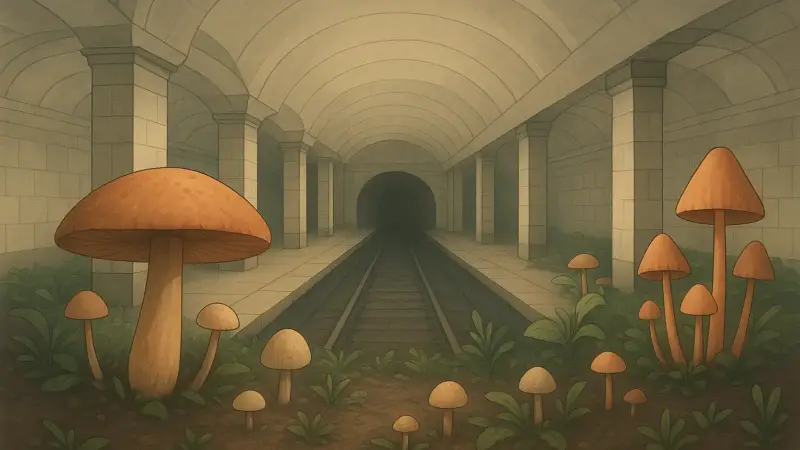
How an abandoned platform becomes a grow room
People assume a closed subway station is just dead space. But the moment trains stop, the tunnels don’t stop behaving like tunnels. Air still moves. Water still seeps. Dust still settles. In places like the New York City Subway’s former City Hall station, the lights may be off, but humidity and airflow keep doing their quiet work. A “secret mushroom garden” isn’t usually one intentional farm hidden behind a locked gate. It’s more often small patches of fungi that appear where the underground accidentally gives them what they need.
The core mechanism is simple. Spores are everywhere, including on riders’ shoes, maintenance gear, and the moving air a train used to shove through the system. When service ends, temperature swings soften, and disturbed dust starts to lie still. If there’s a steady damp surface and a bit of organic material, mushrooms don’t need permission.
Water is the real architect underground
The underground is rarely “dry” in the way people picture it. Groundwater pressure, old masonry, cracked grout, and utility penetrations create persistent leaks. Transit agencies spend serious effort pumping, channeling, and sealing, but older stations still collect moisture in predictable places: at the base of walls, in cable troughs, beneath stair landings, and around drainage sumps. That constant dampness is the difference between a bare platform and a place where fungi can hang on.
One overlooked detail is where the water pauses. Not the dramatic drip from the ceiling, but the thin film that forms on dusty concrete where air is cooler—especially near vents, fan rooms, or dead-end corridors. A surface that stays just slightly wet can support small mushroom flushes even when the rest of the station looks dry at a glance.
Food shows up in unglamorous ways
Mushrooms don’t grow out of concrete. They grow from organic matter that ends up on concrete. In abandoned stations, that “food” can be a mix of paper fibers, wood scraps from old formwork, rotting timbers, plant debris washed in through grates, and the fine, greasy dust that builds up in rail systems. Even if cleaners once kept the area spotless, closure changes the equation. No daily foot traffic means no constant disturbance, and material can accumulate in corners for years.
Rodents and insects also matter, even when people would rather not think about them. They drag in nesting material. They leave droppings. They die in hidden gaps. That adds nutrients in places that are sheltered from airflow and light, which is exactly where fungal growth tends to take off.
Why it feels “secret,” even when it isn’t planned
Most people never see closed infrastructure up close, so any life down there reads as a discovery. A station can be physically near active service and still be effectively invisible. Look at City Hall station again: it sits on a loop that trains still pass, but the platform itself is closed off. That kind of proximity makes stories travel fast. Someone glimpses something from a window, or a worker mentions it, and suddenly it sounds like a hidden project instead of a normal ecological response to damp space.
Light is another reason the idea sticks. Mushrooms don’t need sunlight, so the growth can look “wrong” to someone who expects plants. A pale cluster pushing out of a seam near a service door feels like it belongs to a different world. In reality, it’s just the underground doing what basements do, scaled up and stretched across miles of concrete.
What usually limits the mushroom patches
Even a damp station isn’t automatically a mushroom paradise. A lot of abandoned platforms are too windy. Ventilation shafts, pressure changes from nearby active lines, and fan systems can dry surfaces quickly. Chemical residues also matter. Rail dust can include metal particles and brake debris, and some areas get treated with cleaners, sealants, or pest control products that make conditions harsher for fungi.
Access changes everything too. If maintenance crews still enter regularly, the “garden” gets erased without anyone making a big deal of it. A flush of mushrooms can appear after a wet week, then disappear after a single inspection and cleanup. That cycle—brief growth, quiet removal, and long stretches of nothing—is part of why accounts vary so much depending on who saw what, and when.
Related reads
- Why people smile more in photos than in person
- Why brief eye contact can feel thrilling or threatening
- A neighborhood that silences car horns by installing rooftop chimes
- The cafe where every receipt prints a stranger’s advice
- The calming effect of repetitive tapping and what it does to your brain
- How loose clothing alters risk taking and mood