
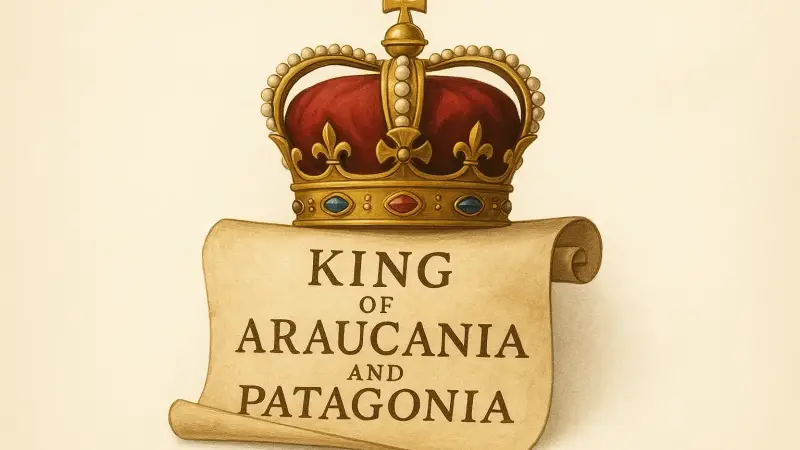
It’s easy to assume that “king” is a title that only exists where a state already exists. Then you run into a strange corner of the 1860s, when a French lawyer named Orélie-Antoine de Tounens sailed to southern Chile and tried to do the reverse. He declared a kingdom first, on paper, and treated recognition as something he could coax into being later. The place names were real—Araucanía, Patagonia, and Mapuche territory—and the timing mattered. Chile and Argentina were still consolidating control in the south. In that gap, de Tounens tried to turn a personal adventure into a crown.
A Frenchman with a plan and a stamp
De Tounens wasn’t a soldier of fortune in the usual sense. He had legal training, and the project had the feel of a legal fiction made physical. He arrived in Chile in 1860, traveled south, and wrote proclamations declaring himself “King” of Araucanía and Patagonia. He also drafted a constitution, because a constitution is one of the easiest props of statehood to manufacture. Flags, seals, decrees, titles—those can all exist before anyone agrees they matter.
The overlooked detail is how administrative he tried to be. This wasn’t just a grand announcement. He produced paperwork meant to look official to outsiders, especially European officials who were used to recognizing entities through documents and diplomatic form. That choice shaped everything that followed, because it pushed the scheme into the world of courts, petitions, and arguments over legitimacy instead of the world of battles and occupations.
Why Araucanía and Patagonia looked “available” in the 1860s

Calling the region “available” was the fantasy, but the political conditions were real. In the mid-19th century, the southern frontier of Chile was not the same thing as full state control. Mapuche communities maintained autonomy in large areas, and Chilean authority was uneven beyond certain lines of settlement and forts. Argentina, too, had not yet imposed the later, sweeping control associated with its southern campaigns.
That mix—indigenous sovereignty on the ground, expanding republics nearby, and European observers who didn’t always understand local power—created room for a person like de Tounens to imagine a third option. He tried to frame himself as a monarch allied with the Mapuche against annexation. How much support he truly secured is unclear and varies by account, but he acted as if a few relationships and a few signatures could stand in for broad consent.
Recognition: the thing he needed and couldn’t force
A self-declared kingdom is just ink until someone with power treats it as real. De Tounens aimed for recognition from established states, and he behaved as if Europe might back a “new” monarchy in the south as a counterweight to Chile or Argentina. But recognition is not a reward for boldness. It’s usually a calculation about trade routes, security, and whether acknowledging a new state will cause more problems than it solves.
Chile’s response shows the basic limit of these projects. Authorities arrested him, treated him as a destabilizing figure, and he ended up expelled rather than taken seriously as a head of state. The pattern here is common: when a claim threatens territorial control, governments tend to treat the claimant as a criminal, an impostor, or someone mentally unwell, because that framing strips the claim of political status.
The “kingdom” that survived as a story and a succession
Even after de Tounens failed to establish control, the idea didn’t die in the tidy way most failed adventures do. The kingdom persisted as a kind of paper institution. Later supporters in Europe treated the claim like a hereditary or appointive title, and “successors” appeared who said they inherited the crown. That’s easier to sustain than a real state because it only requires internal agreement among believers, not borders, taxes, or an army.
It also lasted because it could be reshaped to fit different motives. For some, it was romantic monarchism. For others, it was a vehicle for talking about Mapuche rights and the violence of later state expansion in the south. Those are very different agendas, and they don’t always sit comfortably together. But the same invented crown could be used to gesture at both.
What tends to get missed when people retell it
The story often gets told as a joke about a delusional Frenchman. That misses how strategic the timing was, and how much he relied on the tools of modern bureaucracy. A constitution, decrees, a courtly style—those weren’t decorations. They were an attempt to speak the language of legitimacy that European governments and newspapers recognized, even when the facts on the ground didn’t match.
It also flattens the Mapuche into a backdrop, which is convenient for a quirky anecdote but inaccurate to the period. The region wasn’t empty, and it wasn’t waiting for a king. De Tounens inserted himself into an existing conflict over land and authority, and then tried to convert that conflict into an internationally legible monarchy, as if the right stationery could turn a frontier into a throne.

Related reads
- How prairie dogs shape rivers by digging
- The lichen that eats airborne metals in mining towns
- How mantis shrimp detect polarized light
- Why names are harder to recall than faces
- The Paris baker whose 1817 substitution sparked a week of bread riots
- A streetlight that has blinked in perfect Morse for decades