
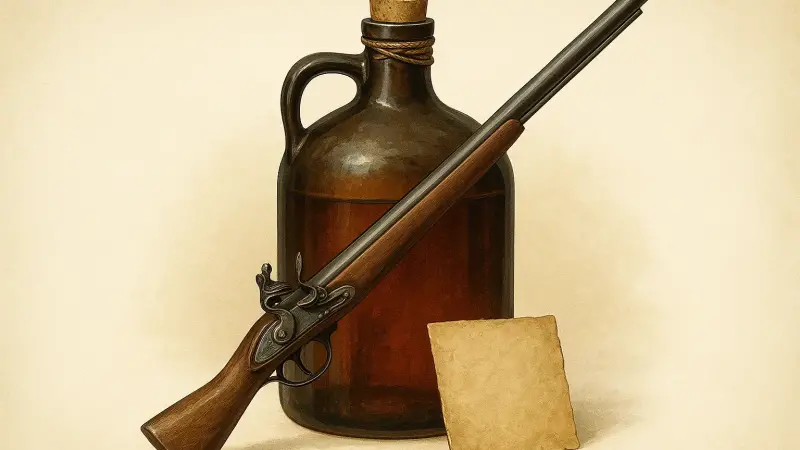
If you live far from the seat of government, a tax can feel less like a policy and more like a stranger showing up at your door. That was the friction in western Pennsylvania in the early 1790s, when the new federal government tried to collect an excise tax on distilled spirits. Whiskey was not just a drink there. It was a way to turn bulky grain into something easier to store, sell, or trade. When collectors arrived, people argued about fairness, paperwork, and distance. Then arguments turned into threats, burned property, and armed crowds, until President George Washington decided the question could not be left to county courts alone.
Why whiskey mattered on the frontier
On the Appalachian frontier, grain was common and cash was scarce. Farmers could not easily haul corn or rye over bad roads to eastern markets, especially across the mountains. Distilling made the same harvest compact and valuable, and it could function as a kind of local money. That practical role is easy to miss if you picture “whiskey” only as a luxury item.
The tax hit that system at its most sensitive point. It was an excise, collected through federal procedures, with requirements that felt built for merchants near big towns. Even when rates varied by still size and method, the bigger problem for many small distillers was the hassle: registration, measurements, and the presence of officials whose job was to inspect and report.
The tax was also a test of federal power
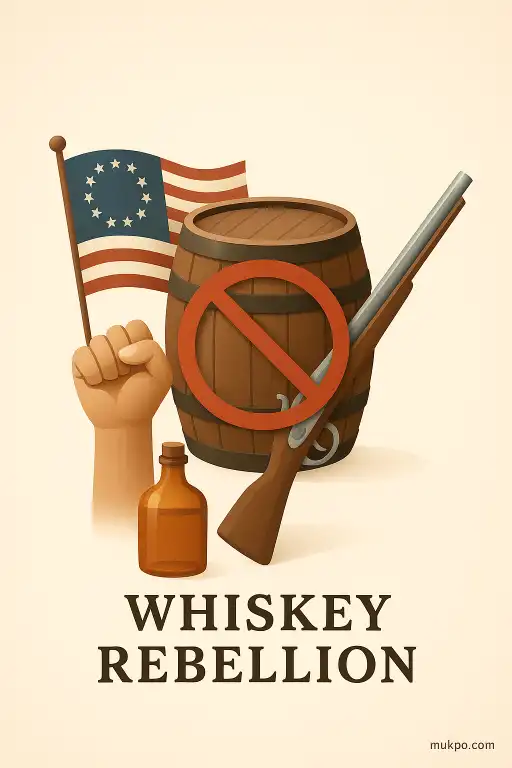
After the Constitution, the United States was trying to prove it could raise revenue without falling apart. Treasury Secretary Alexander Hamilton backed the spirits tax in 1791 as part of a plan to stabilize national credit and fund federal obligations. On paper it was a straightforward way to collect money from a widely produced commodity.
On the ground, it raised an older fear: that distant lawmakers would treat frontier communities as a source of cash, not as equal partners. Many residents had fresh memories of arbitrary authority from the colonial era. They also knew the new government was watching. If the law could not be enforced in one region, it suggested the federal state might be optional everywhere.
How resistance escalated into an uprising
Resistance did not begin with open battles. It began with intimidation. Tax collectors were threatened, shunned, or attacked. Some were tarred and feathered. Others resigned or avoided the job. Local meetings and committees sometimes framed this as community self-defense rather than rebellion, but the pressure tactics were meant to stop federal enforcement outright.
A concrete turning point came in 1794 around the home of General John Neville, a federal tax inspector near Pittsburgh. A confrontation at his property spiraled, and Neville’s house was eventually burned. Around the same time, armed groups gathered and marched, and the atmosphere began to resemble a mobilization rather than a protest. One overlooked detail is how much of this depended on geography: scattered settlements, long travel times, and limited reliable communication made rumors powerful and official response slow.
Washington’s response was unusually direct
President Washington chose a response that was meant to be unmistakable. The federal government organized a militia force drawn from several states, and Washington personally took part in the mobilization before turning command over to others. The size of the force is often described as overwhelming for the region, which was part of the point. It was designed to show that federal law would not be negotiated under armed pressure.
When the militia moved west, much of the rebellion dissolved rather than fighting a pitched battle. Some leaders fled. Others were arrested. The government eventually secured convictions for treason, and Washington issued pardons. The sequence mattered as much as the outcome: a national law, challenged by local force, met by federal force, then folded back into courts and formal clemency.
What people argued about after the smoke cleared
To supporters of the administration, the episode showed that the republic could enforce its laws without becoming a monarchy. To critics, it looked like a powerful government using military muscle against its own citizens. Both views could point to real evidence. The uprising had included violence and coercion. The response had included a massive show of force and broad suspicion of entire communities.
The whiskey tax itself did not become beloved. It remained politically toxic and was later repealed in the Jefferson era. But the deeper dispute did not disappear with it. It lingered as a question about where legitimacy comes from when the practical costs of a law land hardest on people living far from the capital, and when the state’s only reliable way to prove itself is to show up in person.
Related reads
- Why your name grabs attention in a crowded room
- How brief goodbye routines steady anxious minds
- The beach that sings when you walk on it
- The 1835 newspaper hoax that convinced readers the moon teemed with strange creatures
- The hill where cars mysteriously roll uphill
- The secret assay that kept monarchs honest: the Trial of the Pyx in Tudor England