
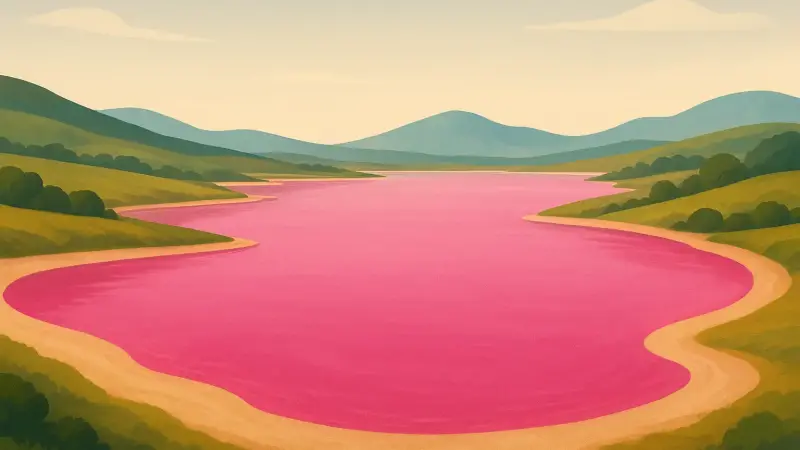
You can stand by a lake for months and it looks ordinary, then one week it goes candy-bright pink and everyone starts asking if someone dumped dye into it. This isn’t one single lake. It happens in a few salty lakes around the world, and the timing varies. Lake Hillier in Western Australia is a famous example, and Australia’s Lake Tyrrell can tint pink during hot, dry stretches. A similar shift shows up at Las Coloradas in Yucatán, Mexico. The color change is usually a biological response to stress: high salinity, strong sun, and the right temperature push certain microbes and algae to make red pigments that can turn the whole water body pink.
Where the pink comes from
The main players are salt-loving microorganisms. One is Dunaliella salina, a green microalga that can crank out beta-carotene when the water gets salty and bright. Another is haloarchaea (often grouped under “halobacteria” in casual talk), which contain reddish pigments that help them handle intense light and salt. When their populations spike, the water can flip from clear or pale green to pink, then to deeper rose or even reddish tones.
The overlooked detail is that the water itself isn’t always uniformly pink. Wind can push the pigmented organisms into streaks. Shallow edges can look neon while deeper sections look muted. Even the time of day matters because low sun angles change how the surface glare hides or reveals the color.
Why it only happens for a short window

The “few days each year” pattern usually comes from a narrow set of conditions that don’t last. A lake can concentrate quickly when evaporation outruns inflow. Salinity rises, the water level drops, and the organisms that tolerate salt suddenly have less competition. A hot spell can also warm shallow water fast, which speeds growth for some microbes and changes how pigments accumulate.
Then the window closes. A rain event can dilute the salinity and spread the organisms out. Cooler weather can slow growth. Strong winds can mix the water column and change how much light reaches the microbes. The lake didn’t “stop being pink” so much as the balance shifted again.
Salt, sunlight, and chemistry working together
Pink lakes tend to be hypersaline, but salt alone isn’t enough. Sunlight matters because many of these pigments are protective. They help organisms deal with intense radiation and oxidative stress. That’s why some lakes look most vivid under clear skies after long, bright days, especially when the water is shallow and light can penetrate easily.
Chemistry adds another layer. Different salts and minerals affect clarity and how light scatters in water. In some lakes, suspended salt crystals can make the color look milky-pink rather than transparent. In others, the water stays clear and the pink looks like it’s coming from within the lake, not sitting on the surface.
What it looks like on the ground
At Lake Tyrrell in Victoria, Australia, the shallow brine can tint pink and the salt crust can reflect it, so the whole horizon looks washed with color. At Las Coloradas, the pink often shows up in rectangular evaporation ponds, which makes the shift look abrupt because each pond can be at a different salinity. Lake Hillier is famous because it can hold a pink tone more consistently than many other sites, though the exact reasons it stays pink are still discussed and likely involve a stable mix of microbes in a very salty system.
The color people remember is often the surface view from above, but the experience at the shore can be less dramatic. Foam lines, ripples, and salt crust can hide the hue. Sometimes the strongest pink is visible only where the water is a few centimeters deep along the edge.
Why the same lake can look different year to year
These lakes are sensitive to small shifts in weather and water management. A slightly wetter season can keep salinity below the threshold where pigments ramp up. A longer heatwave can push it past that point. If there are inflows from groundwater or channels, their timing can matter as much as total rainfall because they change salinity in pulses, not smoothly.
Even the microbial community can vary. If a bloom of one organism dominates, the lake may skew orange-pink. If another dominates, it can look magenta or red-brown. That’s why photos from the same place, taken in different years—or even different weeks—can look like they were shot at entirely different lakes.

Related reads
- Why coral polyps expel algae during warming
- How subtle timing makes or breaks a joke
- The split-second familiarity that tricks you into thinking you know someone
- Why a new password can vanish from memory by bedtime
- The museum that celebrates the worst paintings ever made
- The postman who delivers mail by zipline in a mountain village