
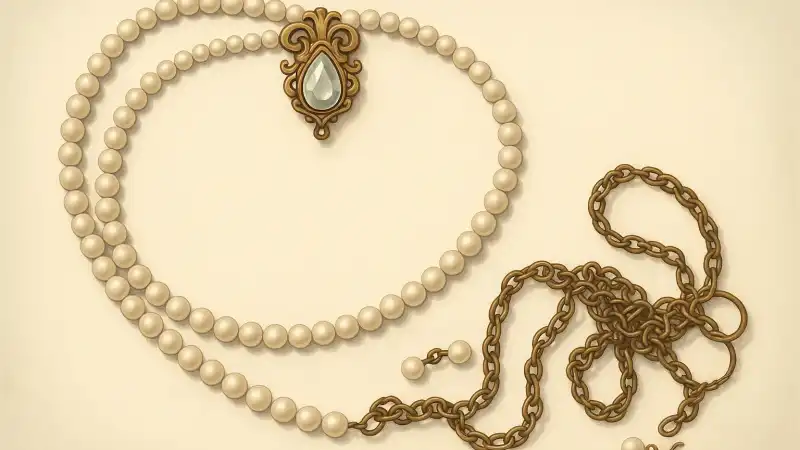
It’s hard to picture a whole monarchy wobbling because of a piece of jewelry, but that’s basically what happened in Paris in 1785. The Affair of the Diamond Necklace worked because it didn’t need Marie Antoinette to do anything at all. It only needed people to believe she would. A few letters, a convincing impersonation, and the right social resentments did the rest. Once the story started moving through salons, pamphlets, and court gossip, it became a machine that converted suspicion into certainty. The queen’s denials were treated like another layer of deceit, not a correction.
A necklace built for a different queen
The necklace itself was real, and that mattered. Court jewelers Charles Auguste Boehmer and Paul Bassenge had assembled an absurdly expensive diamond necklace, originally hoping to sell it to Louis XV’s mistress, Madame du Barry. Louis XV died in 1774 before the purchase happened, and the jewelers were left holding a glittering financial problem. They spent years trying to sell it, including attempts aimed at Marie Antoinette.
She refused. The reasons were practical and political. The price was enormous, and the court already blamed her for spending. That refusal is a specific detail people often overlook, because the scandal’s later version makes it sound like the necklace was her obvious temptation. In the real timeline, the jewelers’ desperation came first, and it created an opening for anyone willing to weaponize their need to believe a buyer existed.
The mechanism: credibility laundering through rank

The plot leaned on borrowed legitimacy. Jeanne de la Motte, a minor noble with big ambitions, positioned herself as someone who had access to the queen. She targeted Cardinal Louis de Rohan, a senior churchman who desperately wanted to regain royal favor after falling out with Marie Antoinette. His status made him believable to other elites, and his longing made him easy to steer.
Forged letters did most of the work. They suggested the queen secretly wanted the necklace but needed discretion. The secrecy angle was crucial. It made the story feel plausible to people who already assumed court life ran on private deals and hidden motives. Rohan’s role then “laundered” the claim. If a cardinal believed he was acting for the queen, others could suspend their doubts.
One night in the gardens and a woman in costume
The scheme needed a moment that felt like proof. It got one in the gardens of Versailles. A woman who was not Marie Antoinette met Rohan in a staged encounter, playing the queen’s part just long enough to seal his belief. Accounts vary on small details, but the core point is stable: the meeting wasn’t about resemblance under good light. It was about atmosphere, darkness, and a man primed to accept what he wanted to be true.
This is where the scandal shows how social perception works. The queen was a public figure, but most people never got close to her. Even many courtiers only saw her at a distance, through ceremony. That gap between image and contact made impersonation easier than it sounds, especially when the people involved were already trained to treat appearances, whispers, and tokens as meaningful signals.
Arrest, trial, and the queen as a character in the story
When the payments collapsed and the jewelers demanded their money, the affair exploded into the open. Louis XVI chose a public move: Cardinal de Rohan was arrested in a dramatic scene at Versailles in 1785. It looked like decisive royal justice. It also guaranteed maximum attention. The case went to the Parlement of Paris, where it became less a question of fraud and more a referendum on who deserved trust.
Rohan was acquitted, which stunned the court. Jeanne de la Motte was convicted and punished, but the acquittal did something deeper than decide guilt. It implied that high authorities were either incompetent or compromised, and it let the public keep the queen in the center of the story even when evidence didn’t support her involvement. A person can be innocent and still lose control of their public identity.
Why it hit so hard in pre-Revolution Paris
The affair landed in a city already saturated with printed rumor and political frustration. Pamphlets and gossip networks could turn a court dispute into a moral drama overnight. Marie Antoinette was an especially vulnerable target. She was foreign-born, highly visible, and already associated—fairly or not—with extravagance. So the necklace story didn’t need to persuade people from scratch. It only had to attach itself to beliefs already circulating.
One overlooked part is how the scandal damaged the idea of the court as a place where truth could be verified. If jewelers could be tricked, a cardinal could be fooled, and judges could produce an outcome that satisfied almost no one, then royal institutions looked like theater. By the late 1780s, as financial crisis and political conflict sharpened, that kind of reputational collapse didn’t stay confined to gossip. It became part of how ordinary Parisians talked about legitimacy at all.
Related reads
- A mural that reveals hidden directions whenever it rains
- Why people cling to ‘lucky’ routines long after they stop working
- How forcing a smile can shift your mood in minutes
- The tiny mental skip that makes a face feel strangely familiar
- That strange moment when your hand feels like it’s not yours
- Why we say sorry for things that don’t need apologizing