
How this shows up in real life
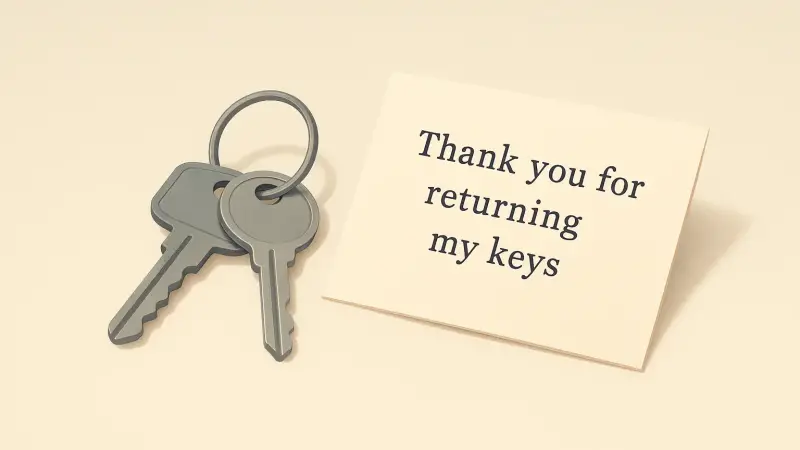
Every so often, a small kindness lands on a doormat in a strangely formal way: a set of keys in an envelope, and a typed note that says thank you. It isn’t one single town tradition or one famous incident. You see versions of it in apartment buildings in New York City, rowhouse blocks in London, and condo corridors in Singapore, and the details vary. The core mechanism is simple. Someone finds keys, figures out where they belong, returns them, and adds a note that feels “official” even though it’s just a neighbor. The typing is the part people notice, because it’s extra work and it changes the tone.
Why a typed note feels different from a handwritten one
A typed note reads like it came from a workplace. It borrows the language of receipts, memos, and “just so you know” messages. That matters in a hallway where people share space but don’t share much conversation. Handwriting can feel intimate, and that can be uncomfortable between near-strangers. Typing keeps the message warm but slightly distant. It signals, “I’m being careful,” without asking for a relationship back.
There’s also a practical reason. Typed text is easier to read quickly, especially if the finder is trying to include small details like where the keys were found or what time. That’s a detail people overlook: the note is often doing quiet documentation. Not in a legal sense, but in a “here is what happened” sense, so the recipient doesn’t have to wonder if the keys were copied, swapped, or handled by several people.
The little decisions that make the return possible
Returning keys sounds straightforward until you picture what the finder actually has to decide. If there’s a tag with an apartment number or a building fob, it’s easy. If it’s only a couple of keys and a car remote, it gets murkier. Some people try the simplest path first: the nearest lobby desk, a building manager, a front office, a mailroom. If none of that exists, the keys may come back only because there’s one identifying clue, like a gym tag, a library card, or a distinctive keychain that matches a neighbor’s backpack.
The typed note is often the last step in a chain of small, cautious choices. People choose an envelope so the keys don’t scratch a door. They choose tape so the envelope doesn’t slide under the wrong unit. They choose to leave it at a predictable time, like early evening, to reduce the chance someone else grabs it. These choices are boring on purpose. The goal is to return the item without creating a new problem.
What the note is trying to prevent
A lot of neighbor-to-neighbor friction comes from uncertainty. Keys are high-stakes because they imply access. When a stranger returns them, the recipient’s first thought can be relief, but the second can be suspicion. A typed note pushes against that second thought by making the situation legible. It can include the exact location—“on the stairwell between the 2nd and 3rd floors”—or a small description—“two silver keys and a blue fob”—so the recipient recognizes them without opening the door to a conversation they didn’t plan to have.
It also helps the finder manage their own risk. If they knock and nobody answers, leaving the keys without a note can look like someone is trying to lure the resident into opening up. A note makes it clear it’s a return, not a baiting gesture. The typing, again, reads as measured. It’s the same reason some people add their apartment number but not their name, or add a first name only. The amount of identity shared varies, and it’s usually intentional.
A concrete hallway example
Picture an apartment building where the mailboxes are inside the lobby, but the stairs are accessible from the street. Someone finds keys on the first landing. There’s no ID, just a building fob and three keys. The finder can’t test them without doing something that looks wrong, so they don’t. Instead, they wait until they see the fob works on the front door, which is a clue that the owner lives inside. They slip the keys into an envelope, type a short note, and tape it to the inside of the lobby door where residents will see it but passersby won’t.
The overlooked detail in scenes like this is placement. People don’t just “leave it somewhere.” They choose a spot that balances visibility and privacy: inside a vestibule, behind a second door, near a noticeboard, sometimes under the recipient’s doormat only if the floor layout makes that hard to miss. The typed note is part of that same balancing act. It makes the return readable at a glance, without turning a simple errand into an awkward doorstep meeting.
Related reads
- How photorespiration makes hot days harder for crops
- How backyard compost heaps generate heat and reduce food waste
- Why names disappear mid-conversation
- Why you sometimes freeze when a joke lands on you
- An old radio that plays broadcasts from distant towns at random
- What happens in your body in the seconds before you speak up