
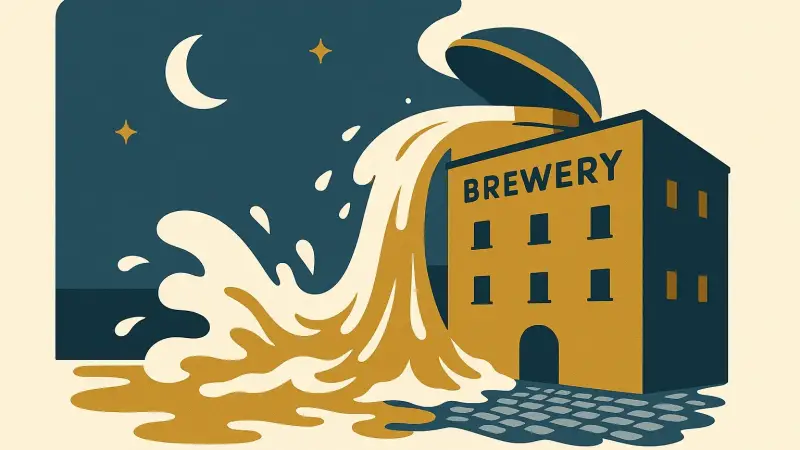
How a brewery can turn into a flood
People think of a brewery as pipes, steam, and a warm smell. Not as something that can burst like a dam. But in Victorian London, it did. In October 1814, at the Meux & Co brewery near Tottenham Court Road, a huge porter vat failed and triggered a chain reaction. The mechanism was blunt: a container holding an enormous weight of liquid beer suddenly lost its strength, and gravity did the rest. The beer didn’t “spill.” It behaved like a moving wall, finding low ground, forcing its way through anything weak, and carrying debris with it as it went.
The night it happened in St Giles

The neighborhood was St Giles, an area with crowded courts and narrow passages. When the first vat burst, other vessels in the brewery were damaged, and more beer came out. Contemporary reports describe a wave that ran into nearby streets and cellars. A detail that’s easy to miss is where the beer went: it didn’t only spread across the surface. It dropped into below-ground rooms. Basements and cellars were common living and working spaces in parts of London then, and they filled fast because they were already the lowest point.
It also wasn’t clean water. It was porter, dark and heavy, loaded with suspended material. That matters because it churns into foam and carries broken wood and brick like a slurry. People at street level could see it coming. People down steps or behind thin walls often had no warning at all.
Why the vats were so dangerous
London porter was produced at an industrial scale by then, which meant storage at an industrial scale. The big vats were made of wood and held together with iron hoops. A single vessel could contain thousands of barrels’ worth of beer. Even if the brewery wasn’t “pressurized” in the way a boiler is, the forces were still extreme. A very tall, very wide container creates strong outward pressure at the lower staves, simply because the liquid column is heavy.
The overlooked part is how a small failure can escalate. A hoop loosening isn’t dramatic on its own, and breweries expected some movement in timber. But the moment a seam gives way, the initial rush can knock out supports, batter adjacent vats, and turn one leak into multiple ruptures. It’s a domino effect driven by mass and momentum, not by flames or explosions.
The streets around it weren’t built for a wave
St Giles had tight courts, low doorways, and buildings that weren’t designed to resist lateral impact. A fast-moving liquid load hits a wall differently than wind or a crowd. It pushes low and hard. Brickwork can crack at the base. Timber partitions can fold. Once a wall fails, the flow doesn’t stop at the threshold. It enters the room and uses the room itself as a channel.
Another practical detail is drainage. London had sewers, but they weren’t sized for sudden surges like this, and many areas still relied on open channels and uneven street grading. Beer doesn’t vanish into cobbles. It pools, it backs up, and it keeps pressing into whatever openings it can find—stairs, cellar hatches, gaps under doors, and broken windows.
Aftermath: damage, casualties, and paperwork
People died in the beer flood. Accounts commonly describe victims in basement rooms and crowded dwellings close to the brewery. The brewery itself also took damage, because the force originated inside its storage area. There were injuries, destroyed furniture, collapsed walls, and streets left slick with a residue that made footing unreliable long after the main surge passed.
Then came the official side of it: inquests, statements, and arguments over what counted as an “accident” versus negligence. Big vats failing wasn’t supposed to be normal, but breweries did deal with wood movement, hoop maintenance, and the limits of materials. The uncomfortable fact was that an everyday product had been stored in a way that made it capable of acting like a local natural disaster, and the neighborhood next door was built in a way that gave it nowhere safe to go.

Related reads
- An elevator that stops on unmarked floors and leaves sticky notes
- The mental habit behind checking the stove twice
- Plants that fling seeds: the mechanics of botanical catapults
- How whales feel the Earth’s magnetic ripples
- The bacterium that cements sand into rock
- When fireflies flash together: the physics of synchronized light