
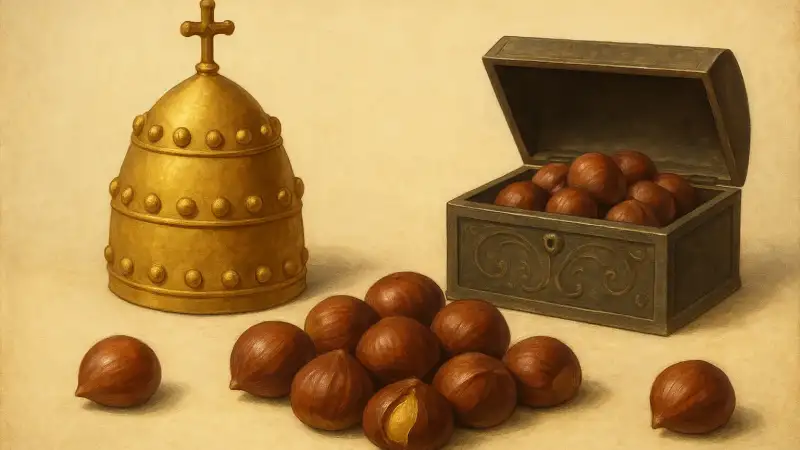
People rarely ask how a rumor becomes “history.” In Renaissance Rome, the gap could be small. A dinner in the Apostolic Palace in 1501, linked to Pope Alexander VI and the Borgia circle, gained a name that still sticks: the Banquet of Chestnuts. The core mechanism is simple. One insider account gets repeated. It travels through enemies, pamphlets, and later historians. Over time, the story stops being a report and turns into a symbol of corruption. Even the basic facts—what happened, who was there, whether it unfolded exactly as described—stay unclear. But the way the tale was used is easier to track.
What the “Banquet of Chestnuts” is, and why the source matters
The most cited description comes from Johann Burchard, the papal master of ceremonies, who kept a diary of court life. He was close enough to record small details of ritual and schedule, which is why later writers treat him as unusually “inside.” But a diary entry is not a court transcript. It is one person’s note, shaped by what he heard, what he chose to write down, and what he thought was worth preserving.
A specific overlooked detail is how much Burchard’s job encouraged him to notice breaches of decorum. His whole role was choreography: who stood where, who entered first, what was permitted. That makes him valuable, but it also means scandal would stand out. When modern retellings skip that context, they make his voice sound neutral in a way no court insider really is.
How the story fits the politics of Alexander VI’s Rome

Alexander VI’s papacy sat inside a city where families fought like states. The Borgias made alliances, handed out offices, and married into power. That created real enemies, not just moral critics. In that environment, a sexual scandal was never only about sex. It was also a way to suggest a ruler could not govern himself, so he could not govern Rome.
There’s a reason the story is often told with names that already carried baggage: Cesare Borgia, Lucrezia Borgia, and courtiers who moved between church and palace life. Even when specific attendance is disputed, the cast list signals what listeners were meant to feel. The charge lands because it fits an existing picture of a court that treated sacred office as family property.
Why “excess” was a public language, not just private behavior
Rome in 1501 was not a place where clergy lived like monks and everyone expected it. The city ran on patronage, displays, and festivals. Banquets, masques, and gift-giving were not side entertainment. They were how rank was performed. That is part of why a lurid banquet story could feel plausible to contemporaries even if the details were exaggerated.
The scandal also plays on a contradiction people at the time already talked about: a court that preached restraint while living amid wealth. Even critics who benefited from the system could still use “excess” as a weapon. It worked because it didn’t require proving a complicated policy failure. It offered an image anyone could repeat.
What historians can and can’t say about what happened that night
Most modern caution comes down to evidence. The Banquet of Chestnuts is not backed by multiple independent, detailed eyewitness reports. It is a famous account that later writers amplified. Some elements sound like set-piece satire: a moral fable designed to be retold. That doesn’t mean nothing happened. It means the most extreme version can’t be treated like a courtroom fact.
Even if an event resembling it took place, specifics are hard to pin down: who hosted, who watched, and whether the pope himself was present in the way later summaries imply. Renaissance courts also produced “black legend” material on purpose. Once an enemy camp had a story that stuck, it could outlive the original fight and become the default portrait of an entire reign.
How one scandal became a shorthand for a whole era
The banquet story endured because it compresses several anxieties into one scene: clerical power, sexual transgression, money, and spectacle. It also arrives at a convenient moment in hindsight. Later reform movements could point backward and say, “This is what needed fixing,” without spending time on the slower realities of administration, diplomacy, or war.
That’s why the Banquet of Chestnuts keeps resurfacing in popular history. It is not just remembered as a night in 1501. It is remembered as an accusation that Renaissance Rome had stopped recognizing limits, and that everyone nearby had learned to live with it until someone decided to write it down.

Related reads
- The apartment with a hidden garden growing beneath a stairwell
- A tiny island where locals deliver mail by canoe and exchange homemade maps
- Why crying can feel identical for joy and grief
- When memories fill in details that never happened
- The supermarket scanner that rang up free produce for random shoppers
- A vivisection in Edwardian London that ignited the Brown Dog riots