

A flower that smells like an insect
People don’t usually think of orchids as having anything to do with moths. But some orchids don’t just attract pollinators with nectar or bright color. They imitate a female moth so closely that male moths try to mate with the flower instead. This isn’t one single place or one famous event. It’s a strategy seen in different orchid groups across regions, including parts of the Mediterranean (where Ophrys orchids are known for insect mimicry) and Australia (where sexual deception orchids are well studied). The core trick is chemical. The flower releases specific scent molecules that match a female’s sex pheromones closely enough to fool a male’s antennae.
How the mimicry works at the molecule level
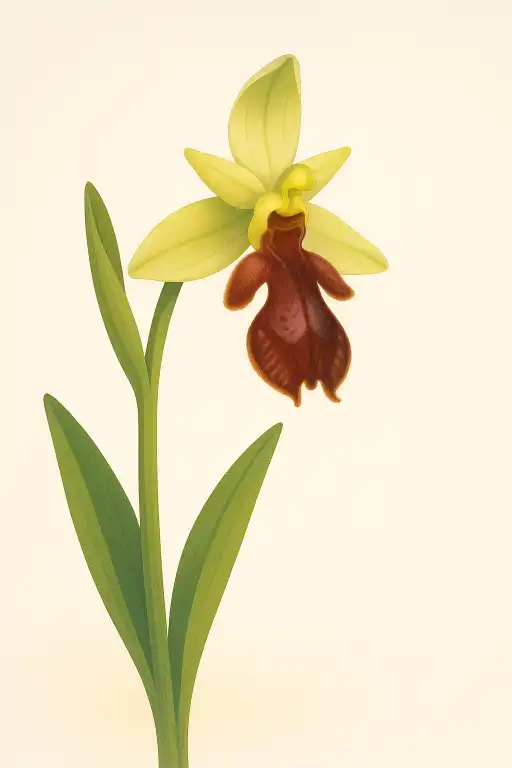
Moths don’t “like” a smell in a vague way. They detect a blend. Often it’s a precise ratio of compounds, released at the right intensity, at the right time. For a male moth, that blend can be the difference between ignoring a plant and zigzagging straight toward it. In these orchids, the scent profile overlaps with the female moth’s pheromone blend, sometimes down to very similar hydrocarbons and other volatile chemicals. The match doesn’t have to be perfect for humans to notice it. It has to be perfect for a moth’s sensory system, which is tuned to a narrow chemical target.
One detail people overlook is timing. Many sexually deceptive orchids emit their key scents most strongly when the target insect is active and receptive. That might mean evening for moths that fly at dusk or night. It can also mean a narrow window in the flowering period. The plant’s goal is not “smell good.” It’s to hit the same chemical signal a male is already primed to follow.
What the male moth does with that information
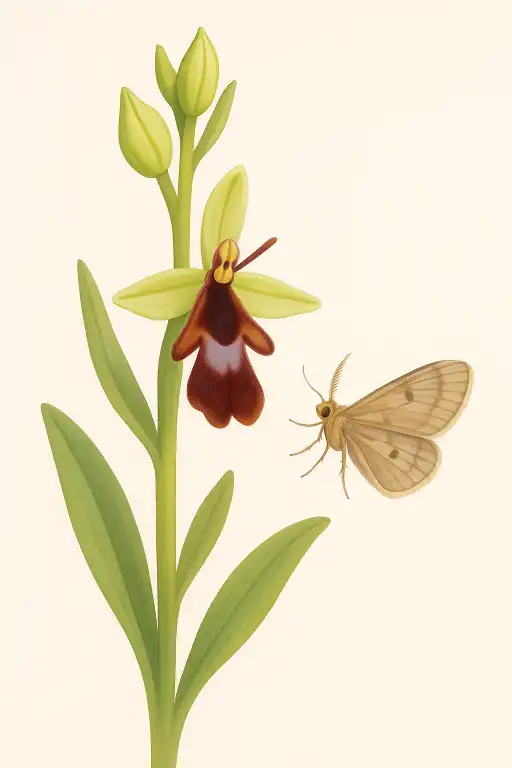
When the scent hits, a male moth often shifts into courtship behavior automatically. He approaches, lands, and attempts to copulate with the flower. That behavior has a name in pollination biology: pseudocopulation. The orchid’s structure matters here, because scent alone doesn’t move pollen. The flower tends to position its pollen packets (pollinia) where they will attach to a specific body part, like the head or abdomen, during the mating attempt.
A concrete scene is easy to picture even if the exact species varies by region. A male moth follows a pheromone trail at dusk, finds a “female,” lands, and curls his abdomen into position. Instead of mating, he bumps against the sticky pad that holds the pollinia. When he leaves—often quickly, because the “female” doesn’t behave correctly—he carries the pollen away. If the next orchid triggers the same mistake, the pollen gets placed where the flower can accept it.
Why this doesn’t need nectar or a reward
Most flowers pay pollinators. Nectar costs energy, but it buys repeated visits. A sexually deceptive orchid takes a different route. It exploits a male’s reproductive drive, so it can sometimes get pollination without offering food. That can be a big deal in habitats where nectar production is expensive or where reliable food-seeking pollinators are scarce at the right time of year.
There’s also a built-in limiter that keeps the system from collapsing immediately. After being fooled, a male may avoid that exact flower or scent for a while. That sounds bad for the plant, but it can help spread pollen farther. If the moth doesn’t keep returning to the same bloom, the next attempt might happen on a different plant, which increases outcrossing.
The tight relationship between one orchid and one insect
This strategy can get extremely specific. Some sexually deceptive orchids mainly target one pollinator species or a small set of closely related species, because the scent blend is so particular. That specificity can drive rapid divergence in orchid populations. Small changes in scent chemistry can shift which insect gets fooled. Over time, that can contribute to new species forming, because pollen gets moved only among plants that appeal to the same insect.
It also makes the orchids vulnerable. If the local moth population changes, or if climate shifts alter when moths fly compared to when orchids release their strongest scent, pollination can drop sharply. The flower can still bloom and look fine. The failure happens in the air, in molecules drifting at the wrong hour, when no antenna is listening for them.
Related reads
- How electric eels prevent self-shock while stacking thousands of volts
- The bacterium in subway tiles that glows under blue light
- How electric fish create private radio channels underwater
- The ant species that farms aphid livestock across fields
- Why alpine plants curl their leaves at night
- Why bioluminescent plankton pulse when ships pass