
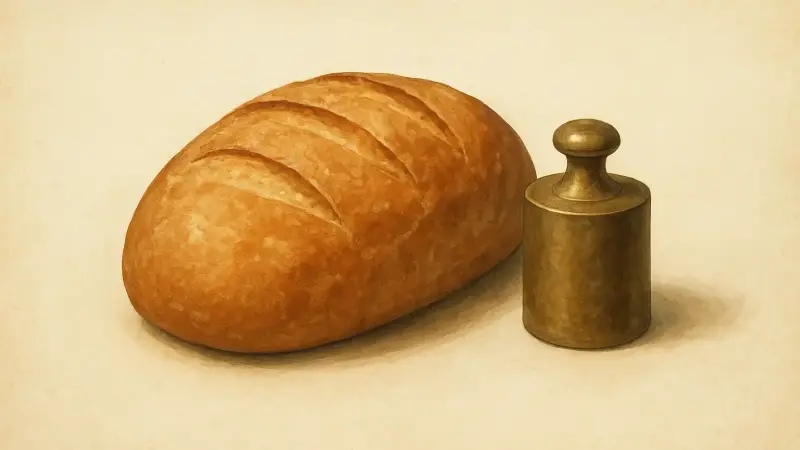
A loaf that wasn’t quite a loaf
People don’t usually think of bread as something that can be “swapped out” without anyone noticing. But in Paris in 1817, bread was so tightly bound to daily survival that small changes could turn into public trouble fast. The story attached to that year is a bakery substitution—stretching wheat flour with other ingredients—followed by days of anger that spilled into the street. The specific baker is hard to pin down with certainty in surviving accounts, and details vary depending on who retold it later. What is clear is the mechanism: when the staple food is scarce and closely watched, even a quiet change in the loaf can look like fraud.
Why bread quality was political in 1817 Paris

In early 19th-century France, bread wasn’t just one food among many. For a lot of working households, it was the bulk of calories. That makes “bad bread” feel less like a disappointing purchase and more like a direct hit to the day’s budget and energy. Paris also had recent memory working against it. The Revolution wasn’t ancient history, and bread prices had been an accelerant before.
1817 sits in the Bourbon Restoration, after Napoleon’s final defeat. France had gone through years of disruption, demobilization, and uneven harvests. The year before, 1816, is often discussed as a crisis year across Europe because of abnormal weather and poor crops. When wheat is tight, bakers are squeezed from both ends. Customers expect a certain loaf, but ingredients get expensive or hard to obtain.
What “substitution” could look like at a bakery
Substitution doesn’t have to mean something exotic. It can be as plain as mixing wheat flour with cheaper flours or fillers to keep loaves coming out of the oven. Depending on the moment and the bakery, that might mean rye, barley, bean flour, bran-heavy flour, or other additions that change texture and taste. Some mixtures were used openly in hard times. Others were viewed as deceit, especially if the price stayed the same while the loaf got darker, denser, or smaller.
A detail people overlook is that a “worse” loaf can behave differently before anyone even tastes it. The crumb can be gummy. The crust can crack in odd ways. The loaf can stale faster. Buyers often judged with their hands first. If a market regular feels the bread and it doesn’t spring back the usual way, the suspicion can start right there at the counter.
How a shop complaint turns into a street crowd
Bread riots rarely begin with a grand plan. They start with a cluster of small interactions that all point in the same direction. A buyer complains. The baker argues. Someone else says they were cheated too. A few people insist the flour must be being “cut” or diverted. The scene draws attention because it’s already a place where people line up and watch each other spend money.
In Paris, these flashpoints could migrate quickly. If one bakery is accused, customers may head to another shop, or to a miller, or to a grain seller, looking for the “real” source of the problem. Rumors move faster than facts when the product is daily and perishable. A week of unrest doesn’t require constant fighting. It can be a pattern of repeated confrontations—morning queues, arguments over weights, accusations of hoarding, and occasional scuffles when officials try to restore order.
Why punishment and inspections didn’t calm people down
Authorities had tools: inspections, fines, and the power to make examples of bakers accused of selling underweight or adulterated bread. But that can backfire when the crowd believes the system is protecting insiders. If the inspector is seen chatting with the baker, or if enforcement looks inconsistent from one neighborhood to the next, trust collapses. People stop interpreting a bad loaf as an accident and start treating it as proof of a scheme.
There’s also the simpler problem that enforcement can’t conjure wheat into existence. If the underlying issue is scarcity and price pressure, cracking down on one shop doesn’t fix the day’s meal. It just shifts the anger to whoever seems closest: the person behind the counter, the official with a seal, or the wagon carrying sacks that look like they’re going somewhere else.

Related reads
- A streetlight that has blinked in perfect Morse for decades
- Why singing sand dunes howl when wind sweeps them
- The tiny fossil pollen that rewrote a desert’s past
- Why a brief compliment can lift your mood for days
- How crows use cars to crack nuts
- How a 14th-century Florentine guild staged a mock funeral to settle a trade dispute