
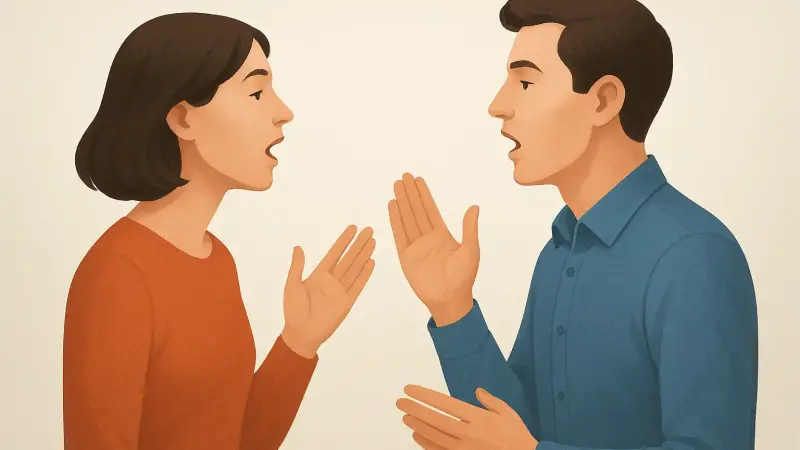
You’re in a Zoom meeting, or you’re standing at a café counter, and it happens. Two people start talking at the same time. Then there’s that tiny pause. One voice fades out, the other keeps going, and nobody says out loud how the decision got made. This isn’t one single “rule” from one place. It shows up in lots of settings, and it can look different in the U.S., Japan, or Germany, and even between different friend groups in the same city. The mechanism is mostly micro-timing: people hear overlap, predict whether it will continue, and make a fast call about whether to compete for the floor.
How overlap gets detected so fast
People notice overlap earlier than they think. It’s not just the words. It’s pitch, loudness, and how “committed” the other person sounds in the first syllable or two. If the incoming voice launches with a strong onset and steady volume, listeners often treat it as intentional rather than accidental, even when it is accidental.
A detail most people miss is that the pause isn’t always silence. Often it’s a tiny stretch of sound: a cut-off vowel, a half-laughed exhale, a swallowed consonant. That’s one way someone signals yielding without needing to say “go ahead.” You can hear it clearly on phone calls because you lose the visual cues and rely more on these audio scraps.
Why one person yields and the other doesn’t
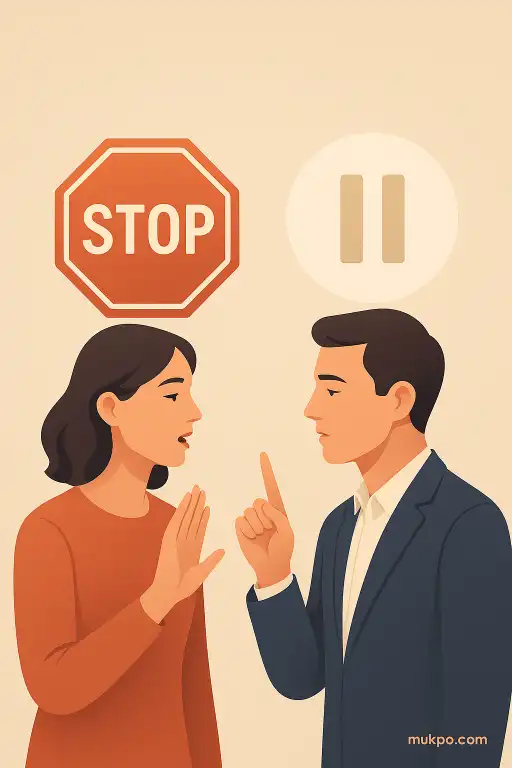
Yielding is partly about how “complete” the speaker’s thought seems. If someone was finishing a sentence and the other person jumped in, the first speaker is more likely to push through the last few words. If both were starting fresh, the one with the weaker launch often drops out. That weakness can be real hesitation, but it can also be strategic uncertainty: the person senses they might be interrupting and backs off before it turns into a contest.
Status and roles matter, even when nobody admits it. A meeting chair, a teacher, or the person telling a story usually gets more tolerance to continue through overlap. Friends also carry invisible “speaking rights.” If one person has been quiet for a while, others may yield more easily when they finally start, because the group is tracking participation without naming it.
The tiny signals that decide it
Right after overlap begins, both people often do a quick repair move. One speeds up slightly to finish a phrase. The other might insert a brief marker sound like “uh—” or a sharp intake of breath and then stop. Those markers work like a flag: “I had something, but I’m giving it up.”
Eye behavior can decide it when people are in the same room. The person who maintains gaze, or looks toward the group instead of down, tends to be treated as holding the floor. The overlooked part is that the yielding person often looks away first, not as a sign of shame, but as a coordination tool. Looking away reduces the chance of re-entry and makes the other person’s continuation feel smoother.
What changes on Zoom and on the phone
Video calls create overlap more easily because timing is unreliable. Small delays mean each person hears themselves as starting “on time,” while the other person hears an interruption. That makes the pause longer and more awkward, because both wait for evidence that the other has stopped, and that evidence arrives late.
A concrete example is a typical Zoom team call: two colleagues respond to a question at once, both stop, then both restart because the restart is also delayed. In person, a glance or a slight hand movement can break the tie. On Zoom, people lean on louder audio, clearer diction, and explicit turn markers like beginning with someone’s name, because those cues survive lag better than subtle timing.
How groups silently set “normal” overlap
Some groups treat overlap as engagement, not rudeness. You can hear this in lively dinner tables where listeners offer short supportive interjections while the main speaker continues. Other groups treat any overlap as a problem to fix, so people stop quickly and re-offer the floor. Neither pattern is universal, and it can vary by region, workplace culture, language, and even the topic.
Once a group has a default, people adapt fast. If overlap is common, yielding becomes less about politeness and more about efficiency: whoever has the clearer claim or stronger momentum continues. If overlap is rare, the pause stretches because both people feel responsible for repairing it. That’s when you hear the slightly too-simultaneous “sorry—no, you—” that repeats until somebody finally commits to a full sentence.
Related reads
- The town that held an election where a dog outpolled a human candidate
- The French adventurer who declared himself king of Araucania and Patagonia in the 1860s
- How prairie dogs shape rivers by digging
- The lichen that eats airborne metals in mining towns
- How mantis shrimp detect polarized light
- Why names are harder to recall than faces