
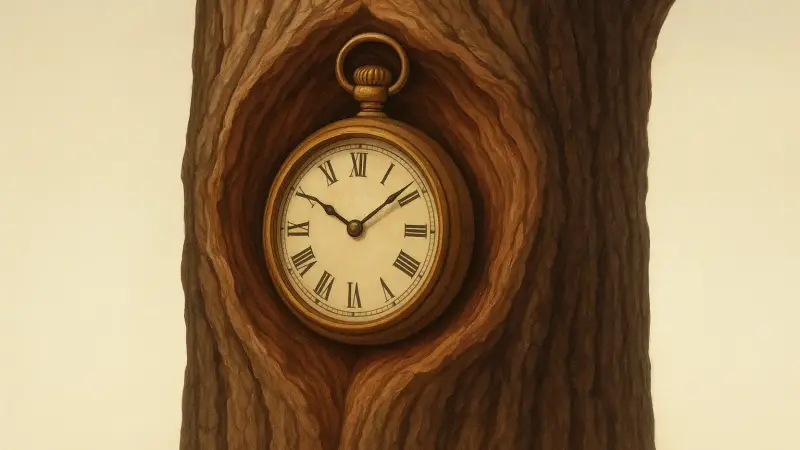
People rarely ask how a hard object can end up inside a living tree without anyone noticing. When someone says they found a pocket watch fused into an oak’s heartwood, the core mechanism is usually slow growth, not sudden swallowing. Trees don’t “pull” things inward. They grow around them. The problem is that stories like this aren’t tied to one famous, verifiable oak in one named town. Details vary, and the original watch is often not available to inspect. Still, the same kind of find has been reported with fence wire in rural North America, nails and signs in British park trees, and even old bullets in European forests.
How an object ends up inside wood
For a watch to end up “inside” an oak, it almost always started on the outside. A watch can be wedged in a crotch where two limbs meet, pressed into a wound, or trapped under bark that’s already loosened. As the tree adds new layers, it can cover the object. That new wood becomes part of the trunk, and years later it looks like the watch was born there.
The part people picture as “heartwood” is also easy to misread. Heartwood is older, darker interior wood that forms as inner sapwood changes over time. An object can be fully enclosed by newer growth and still end up near what looks like the “heart” when the log is cut. The cut surface makes everything feel central.
What “fused” usually means in these stories
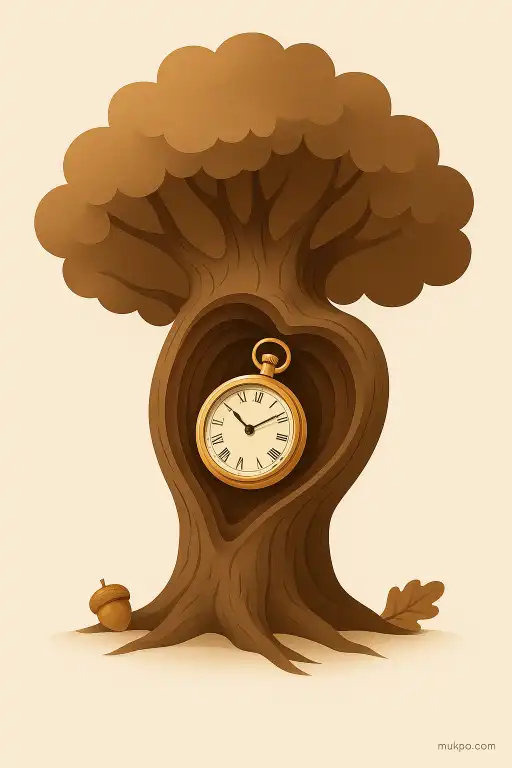
“Fused” tends to mean stuck so tightly that it takes chisels or a saw to get it out. That tightness comes from compression as the tree grows and from the way wood swells and shrinks with moisture. Metals also corrode. Rust expands and bites into surrounding fibers, especially if moisture gets trapped against the case.
One overlooked detail is how bark behaves over time. Bark isn’t a neat, sealed wrapper. It cracks, flakes, and shifts. That creates little pathways for water and grit. If a watch is enclosed while the bark is still thickening and moving, tiny openings can keep feeding moisture to it for decades. That’s why an enclosed object can be both tightly gripped and badly degraded at the same time.
Why a pocket watch is an odd but plausible object
A pocket watch is heavy, smooth, and easy to drop. It also has a ring and chain attachment that can snag on a branch. If someone rested it on a limb while working, or if it fell into a cavity or a notch, it could stay put long enough for the tree to start growing over it. Oaks are especially good at this because they can form callus tissue around wounds and edges.
The complication is time. Trees grow outward, not quickly inward. A watch that appears deep in a thick trunk implies either a long period of growth after the watch was trapped, or that it wasn’t as deep as it looked when discovered. People often see a watch in a cut log and assume it must have been “at the center.” The growth rings, knots, and wound wood can make the geometry deceptive.
What the wood can and can’t tell you
In the best case, the wood holds clues. Growth rings can show roughly when the tree grew over the object. If the watch sits right at a scar line or a band of darker wound wood, that’s a hint it was trapped during healing. Sometimes you can even see distorted rings bending around the object, like the tree detoured around it year after year.
But “best case” is rare in casual finds. When a log is cut for firewood or milled quickly, the context is lost. The watch is pried out, the slab is tossed, and the only remaining evidence is a photo and a story. Without the original piece of wood showing ring patterns and the exact position, it’s hard to say whether it was truly enclosed for decades or simply lodged under bark for a shorter time.
How these finds get exaggerated
There’s a social pattern to these stories. Someone hears “found in a tree,” and it becomes “found in the heartwood,” then “fused in the center.” Each step makes it sound rarer and older. Another common leap is assuming the watch’s date of manufacture is the date it entered the tree. A watch can be carried for years, repaired, or reused long after it was made.
Even when the object is real, the timeline is often unclear. Oaks can live for centuries, but they can also put on a lot of diameter in a few decades, depending on conditions. A thick trunk doesn’t automatically mean the object has been inside since the 1800s. If the watch face is readable, the hands and numerals draw attention, but the overlooked parts—the case back, hinge pins, and the bow—often show the most corrosion and give the best hint about how water was getting in while the tree kept growing.
Related reads
- The tiny hesitations that make someone come across as more trustworthy
- Why the face in the mirror can look like a different person after a haircut
- The river that briefly runs neon green after a festival dye washout
- Why we cling to useless belongings: the surprising psychology of sentimental clutter
- Why certain minerals glow under ultraviolet light
- How wood frogs survive freezing solid