
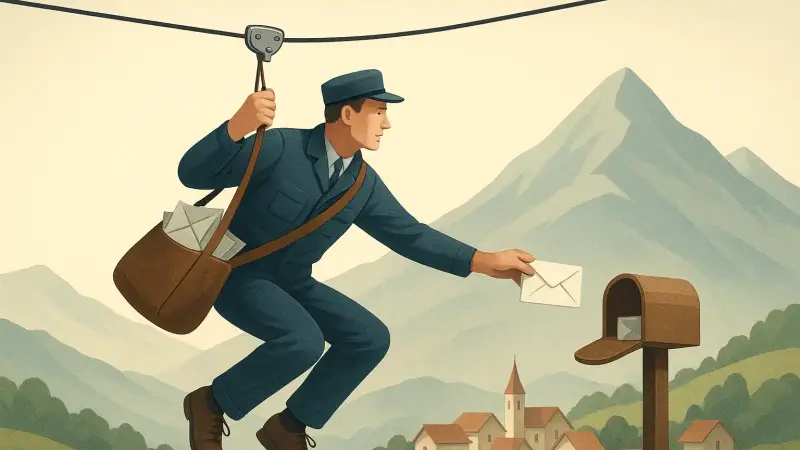
A normal letter, a not-normal route
You don’t usually think about the path a letter takes once it leaves the road. But in some mountain villages, the road ends early and the cliff starts immediately. That’s where a zipline shows up as basic infrastructure. The best-known example is in Hawaii at the village of Halawa on Molokai, where mail has been sent across a steep valley by a wire line when access is limited. The core mechanism is simple: the post is strapped into a bag or box, clipped to a pulley, and sent along a tensioned cable from one side to the other. The “carrier” is gravity, not a truck.
Why a zipline beats a road in steep places
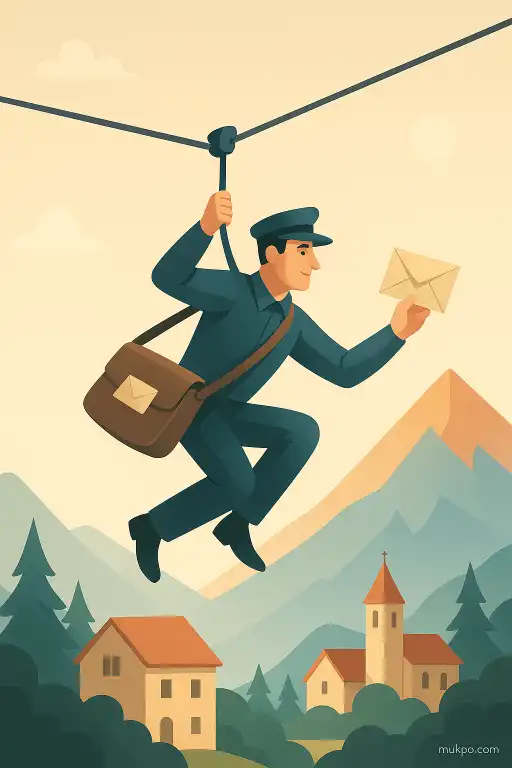
A zipline delivery only makes sense when the alternative is worse. In mountain terrain, “worse” can mean hours on foot, river crossings that change by season, or a vehicle route that’s so expensive it never gets built. Cable crossings are old technology in these settings. Some are built for people, some for supplies, and some end up moving mail because it’s light, regular, and socially important. The details vary by place, and in many cases the setup isn’t officially advertised, because it’s just the practical solution locals have kept using.
It also helps that mail has predictable constraints. It arrives in small batches. It doesn’t need refrigeration. And it can tolerate a few minutes of waiting for the right moment, like a lull in wind. If the terrain creates a single hard barrier—a gorge, a landslide zone, a river channel—one cable can remove the hardest part of the trip while the rest is still walked or driven.
What the setup looks like up close
The hardware is rarely fancy. A steel cable is anchored on both sides, and a trolley or pulley rides on it. The mail goes into a tough bag, sometimes inside a rigid container so it doesn’t get crushed if it bumps the line or the landing. The launch can be as simple as a hand release, but there’s usually some way to control speed—friction on the rope, a brake line, or a second line used to pull the load back after it crosses.
A detail people overlook is the landing. Getting the bag across is only half the job. You need a clean capture point so it doesn’t slam into a post, bounce, or drop into brush. That often means a short “catch zone” with padding, a person waiting to grab the trolley, or a receiving hook that guides the pulley into place. If the mail includes small parcels, that controlled stop matters more than the ride itself.
How the postman fits into it
“Postman” in these places can mean a formal postal worker, a contractor, or a local carrier doing a route that blends road, footpath, and a single cable crossing. The zipline doesn’t replace the human role. It changes where the work happens. Instead of trudging through the most dangerous stretch, the carrier spends time securing the load, checking that the line is clear, and coordinating with whoever is on the far side. If there’s no one waiting, the system needs a way to retrieve the trolley so the line isn’t stuck on the other end.
Timing becomes part of the job. Wind can push a bag sideways and make it spin. Rain can change friction on braking lines. After storms, debris can snag the cable, and the first crossing may be more like a test run than a delivery. Even when the zipline works perfectly, someone still has to manage the handoff so letters don’t get wet, torn, or mixed with other loads.
What gets tricky, even when it works
Mail is supposed to be routine, and a zipline is routine only when maintenance is steady. Cables stretch over time. Anchors shift. Pulleys wear. A small change in sag can change the speed and the landing point, which is why these systems often develop informal rules about weight limits and packaging. A letter is easy. A box of medicine might need extra wrapping. A stack of catalogs might need to be split into two loads so it doesn’t arrive like a swinging brick.
There’s also the quiet question of responsibility. If the line is community-built, upkeep might be shared. If it’s tied to an official route, standards can be stricter, but the terrain still calls the shots. Either way, the moment the bag leaves the platform, the delivery depends on a thin piece of metal stretched across a gap, plus the person who knows exactly how it behaves on a gusty day.
Related reads
- The pocket watch found fused inside an old oak’s heartwood
- The tiny hesitations that make someone come across as more trustworthy
- Why the face in the mirror can look like a different person after a haircut
- The river that briefly runs neon green after a festival dye washout
- Why we cling to useless belongings: the surprising psychology of sentimental clutter
- Why certain minerals glow under ultraviolet light