
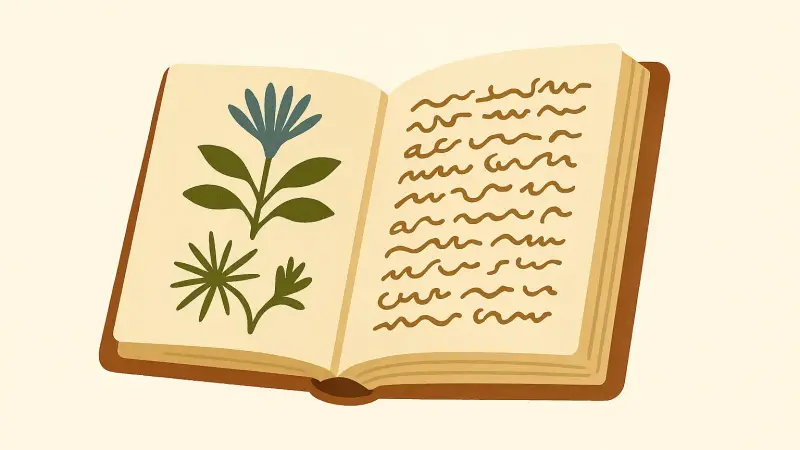
A book that refuses to behave like a book
People rarely ask what a “library treasure” looks like when it can’t be read. The Voynich Manuscript forces that question. It sits in Yale University’s Beinecke Rare Book & Manuscript Library today, cataloged and boxed like other rare books, yet it doesn’t function like one. The pages are filled with neat lines of script no one has convincingly translated, plus drawings of plants, star-like charts, and strange bathing scenes. Even its age is both settled and unsettling. Radiocarbon dating places the parchment in the early 15th century, but who wrote the text, and why, is still unclear.
What it is on the page, not in the legends

Physically, it reads like a carefully planned codex. The handwriting is consistent, and the layout looks intentional, not frantic. Several sections feel like they’re “about” something even if the words won’t open up: herbal-style pages with single plants, circular diagrams that resemble zodiac charts, and clusters of small nude figures arranged in tubs or channels. The overlooked detail is the folding. Some sheets are large foldouts, meant to open wide and reveal big diagrams, which suggests the maker expected the reader to study structure and relationships, not just lines of text.
The script itself has patterns that keep pulling experts back in. Certain “words” repeat, and some clusters show up where headings might be. At the same time, it avoids things most European texts show without thinking, like obvious punctuation systems or familiar abbreviations. That combination keeps two instincts alive at once. It feels both engineered and evasive, which is why it has been pitched as everything from an unknown natural language to an artificial cipher to elaborate nonsense.
The early trail: Prague, letters, and shifting ownership
The manuscript’s path becomes visible only in fragments, and the gaps matter. One of the earliest strong anchors is Prague in the 1600s, where it was associated with Emperor Rudolf II, a collector with a reputation for chasing rare and curious objects. Some accounts say he bought it for a large sum, but the details of that purchase are not fully documented. What is documented is later correspondence that treats the book as a serious puzzle. Letters tied to figures like Johannes Marcus Marci and the Jesuit scholar Athanasius Kircher show people already trying to recruit the best-known “decoder” of the day.
That correspondence also shows why the book baffled institutions even before modern cryptography. A royal or court library could catalog a Latin Bible quickly. Here, they couldn’t even name the language family. They also couldn’t match the drawings to a known herbal tradition with confidence. So the manuscript moves like a problem that no one wants to discard, but no one can comfortably absorb. It becomes an object passed to individuals who have time, contacts, and a taste for riddles, rather than something a library can simply shelve under a subject heading and move on from.
How it escaped neat classification in royal libraries
Royal libraries and court collections depended on naming. Even a “curiosity cabinet” needed labels to justify why something belonged there. The Voynich Manuscript fights that system in several ways at once. The text doesn’t yield a title or author. The illustrations look familiar in style but refuse to line up cleanly with known plants, known constellations, or known medical diagrams. The result is bureaucratic discomfort: it can be prestigious to own, but awkward to describe. A librarian can record “an unreadable book with plants,” but that’s not the same as placing it into a credible scholarly lineage.
There’s also the practical issue of access. If a court owns a book that only a handful of specialists might interpret, it becomes dependent on those specialists. That’s why the manuscript repeatedly gets linked to high-status “solvers” like Kircher. Even when the attempt fails, the act of sending it to a famous mind rebrands it as worthy. It’s less about cracking it once and more about keeping it in a category of objects that “deserve” attention, which is an institutional survival mechanism.
From Voynich to Yale: a modern home for an unreadable text
The name it carries now comes from Wilfrid Voynich, a rare book dealer who acquired the manuscript in 1912 after it surfaced from a Jesuit collection. His role matters because dealers treat puzzles differently than libraries do. A dealer can present an unreadable book as an event, with a story attached, and that story can travel faster than any proven interpretation. Voynich promoted it, circulated images, and pushed competing theories. The manuscript’s modern fame is tied to that shift from quiet custody to public challenge.
Its later move into an institutional setting with long-term preservation resources changed the problem again. At the Beinecke, it can be stabilized, digitized, and studied without someone having to “solve it” to justify the shelf space. That’s why the same pages that defeated older catalog systems now thrive in a place built for anomalies. The odd foldouts, the consistent handwriting, the early-15th-century parchment date, and the still-unknown text can all be treated as data points, even when they refuse to become a readable book.

Related reads
- The night massive brewery vats burst and flooded a Victorian London neighborhood with beer
- An elevator that stops on unmarked floors and leaves sticky notes
- The mental habit behind checking the stove twice
- Plants that fling seeds: the mechanics of botanical catapults
- How whales feel the Earth’s magnetic ripples
- The bacterium that cements sand into rock