

A river that changes color for a few hours
People don’t usually expect a river to look fluorescent. Yet it happens, briefly, when a festival ends and the cleanup starts. In Chicago, the Chicago River is famously dyed a bright green for St. Patrick’s Day, and the color can drift and pool in surprising places depending on wind and flow. Other neon-green moments are less planned: a street washdown after a color-throwing event, or rinsing dyed fabric and decorations, can push a concentrated slug of dye into storm drains that discharge straight to a river. It looks dramatic because the dye arrives all at once, not because the whole river has “turned green.”
How the dye gets from streets to water
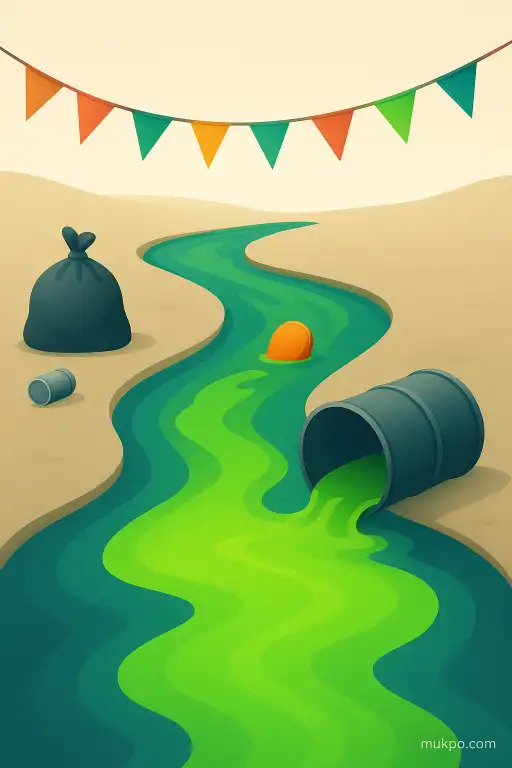
The path is usually boring and very fast. Water used to rinse pavement, booths, and equipment runs to gutters. From there it often enters stormwater systems, which are designed to move rain quickly, not to treat it. In many cities storm drains do not go to a wastewater plant. They go to the nearest creek or river through an outfall pipe. If a festival site sits close to water, that distance can be short enough that a spill at noon becomes a bright patch downstream before people have even packed up.
One detail people overlook is timing. The most intense color often shows up after the first heavy rinse or the first rain after the event, not during the celebration itself. Dyes can sit on asphalt and in curbside grit for hours. Then a sudden flush strips the thin film off the surface and delivers it in a concentrated burst.
Why it looks neon instead of just “greenish”
Human eyes are very sensitive to green, and some dyes are designed to stay vivid even when diluted. A small amount can tint a large volume of water, especially if the dye fluoresces in sunlight. Fluorescent dyes absorb ultraviolet and blue light and re-emit it as visible green, which makes the color seem to glow. That effect is strongest in bright midday sun and in shallow water where light can bounce off the bottom and back through the dyed layer.
Rivers also don’t mix instantly. A dye pulse can travel as a ribbon along one bank, or as streaks that twist around each other. Eddies behind bridge piers and along bends can trap colored water and make it look like a stationary pool of paint, even while the main current is already clearing.
What controls how long it lasts
Duration depends on flow, not just the amount of dye. If the river is high and fast, the color can pass in minutes and be gone downstream. In low flow, the same load can hang around longer because the dye has less water to disperse into and more time to collect in slow zones near the bank. Wind matters too. It can push the dyed surface layer into corners and marinas where it lingers.
Sunlight and chemistry work on the color once it’s in the river. Some dyes break down under UV light. Others bind to fine sediment and end up looking less neon as they attach to suspended particles. If the washout includes soap, foam, or fine dust, the river can look brighter because those materials change how light scatters at the surface, even when the dye concentration is already dropping.
Planned dyeing versus accidental washout
Not every green river is an accident. Chicago’s St. Patrick’s Day dyeing is deliberate and controlled, and the exact formulation has changed over time. Even then, the visible effect still depends on conditions that day, like cloud cover and current. Accidental washouts are different. They tend to be uneven, sometimes streaky, and tied to cleanup timing. They can also involve a mix of colorants rather than one known dye.
When people see a sudden neon stretch, they often assume it must be industrial discharge because it looks so artificial. But festivals concentrate pigments in one place and then remove them with lots of water in a short window. Add a direct storm-drain route to the river, and the result can look like someone poured a highlighter into the current, then watched it fade as the plume spreads out of sight.
Related reads
- Why we cling to useless belongings: the surprising psychology of sentimental clutter
- Why certain minerals glow under ultraviolet light
- How wood frogs survive freezing solid
- How hermit crabs choose shells using chemical cues
- How photosynthetic bacteria thrive in boiling hot springs
- A rainforest bat that farms figs by planting seeds