
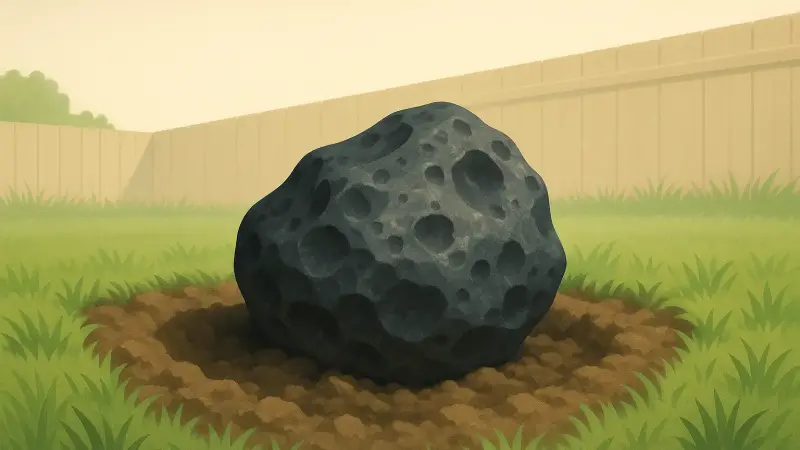
A rock that doesn’t fit the rest of the yard
Most backyard rocks are only interesting because they’re heavy. Then one day someone notices the odd one doesn’t look like the others. It has a dark skin. Or little thumbprint dents. Or it pulls toward a magnet. This isn’t one single famous “backyard meteorite” story, because finds like this happen in lots of places. The American Midwest has had several well-publicized discoveries, Australia has a long trail of “paddock meteorites,” and Sweden’s Muonionalusta meteorite pieces have turned up far from any dramatic crater. The core mechanism is plain: a small piece of space debris survives the atmosphere, lands quietly, and gets treated like ordinary stone until something about it nags.
What people notice first (and what they miss)

The first clue is often the outside. Fresh meteorites can have a thin fusion crust, a glassy coating made when the surface melts during the fall and then freezes. It can look like dark paint. That crust weathers off. So older pieces can be brown, rusty, or dull, which is why so many get ignored for years. Shape misleads people too. Movies teach “meteorite” as a perfect black lump. Real fragments can look broken, uneven, and plain.
A detail people overlook is how the surface changes at corners. Fusion crust often thins or chips there, showing lighter rock underneath. Another overlooked detail is density. Many meteorites are noticeably heavier than a similar-size Earth rock because of metal content. And the magnet test is tricky: plenty of Earth rocks are magnetic, and plenty of meteorites are only weakly attracted. The “weirdness” usually comes from a cluster of small cues, not a single dramatic one.
How it gets confirmed without guesswork
Confirmation is less about someone’s eye and more about lab work. The common path is classification by a university geology department, a museum, or a national meteorite program, depending on the country. The goal is to show it has meteoritic minerals and textures. That can mean cutting a small slice and polishing it into a thin section for a microscope. It can mean chemical tests for iron, nickel, and trace elements. Nickel matters because many natural Earth irons don’t carry the same nickel patterns as meteorites.
For iron meteorites, one classic check is the Widmanstätten pattern, a crisscross structure revealed after polishing and etching. It forms only with extremely slow cooling in space, over millions of years, inside a larger body. For stony meteorites, labs may look for chondrules, tiny round grains that formed early in the Solar System. A backyard rock can look plain on the outside, and still show those little spheres inside once it’s cut.
What the meteorite can reveal once it’s real
Once a specimen is confirmed, it stops being “a strange rock” and becomes a record. Its chemistry can tie it to a broad meteorite group, like ordinary chondrites or iron meteorites. That grouping isn’t just taxonomy. It hints at where it came from: a primitive, never-melted body, or a differentiated one that separated into metal core and rocky mantle. Sometimes scientists can estimate how long it traveled as a small object in space by measuring cosmic-ray exposure ages, which track how long the meteorite was bombarded after it broke off a parent body.
The timing on Earth is harder and varies. A backyard find might be a recent fall, or it might have sat for centuries. If it’s a witnessed fall, there may be reports, security camera footage, or recovered fragments across a strewn field, and that can anchor the date. If it’s an old “yard rock,” dating depends on weathering, soil context, and sometimes radionuclides that decay after landing. Often it remains unclear exactly when it arrived, even when everything else about it becomes precise.
Why it ends up in a backyard at all
Most meteorites don’t land where anyone sees them. They fall into oceans, forests, deserts, and ice. A backyard becomes the stage because people move rocks around. Landscaping stones get hauled in from quarries. Farmers pick stones from fields and pile them near buildings. A meteorite that fell into a field can get collected with ordinary rocks decades later and end up edging a garden bed.
There’s also the simple visibility effect. In a yard, the ground is walked and looked at. A rock sits in the open instead of under leaf litter. It gets bumped, moved, and noticed under different light. The “revelation” is rarely a single cinematic moment. It’s usually a slow shift from “that’s odd” to “this doesn’t behave like the other stones,” followed by the quiet, technical process that turns a backyard object into a piece of early Solar System history.

Related reads
- How touch-me-not plants fling seeds with a springy snap
- How gut microbes change after a course of antibiotics
- The bacteria discovered chewing plastic in ocean gyres
- How hummingbirds hover by twisting their wings
- Why weeds often sprout between sidewalk cracks
- How pitcher plants dissolve insects with acid and enzymes