
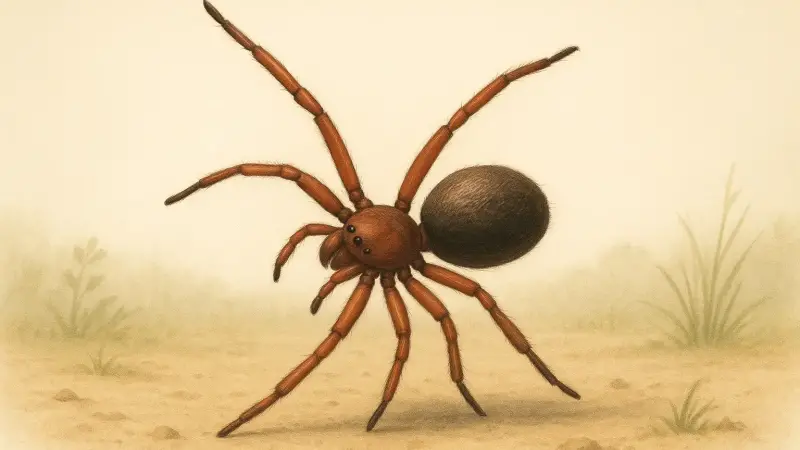
You don’t expect a spider to roll away like a gymnast. But some do. This isn’t one single species, and it isn’t tied to one place. It’s been described in desert and dune habitats like Morocco’s Sahara fringe, Namibia, and parts of the Middle East. When the threat feels close enough, the spider doesn’t just sprint. It tucks its legs, shifts its weight, and turns its whole body into a wheel. The ground does the rest. A slope, a gust, or a shove of momentum can carry it several body lengths in a second, fast enough that a lizard or wasp loses the clean line of attack.
Which spiders do this, and where it happens
The behavior is best known from a few desert-dwelling spiders that live in loose sand, including the so‑called “wheel spiders” reported from North Africa. Different accounts point to different species, and the exact taxonomy can vary depending on who observed it and when. What stays consistent is the habitat: open ground, sparse cover, and lots of sloped sand where running in a straight line doesn’t always beat a fast predator.
You might also see the idea discussed alongside other “rolling” arthropods, but not all of them do the same thing. Some spiders roll only downhill when they’re knocked loose. The cartwheeling spiders do it deliberately as a getaway move, not as an accident of losing footing.
What the cartwheel looks like up close

It usually starts from a standstill or a short burst of running. The spider lowers its body, pulls in some legs, and pushes off so its center of mass tips past the point of balance. Then it commits. Instead of trying to regain a normal stance, it keeps rotating. On sloped sand it can become a continuous series of flips, like repeated forward somersaults, with brief moments of contact that keep the rotation going.
A detail people overlook is how little of the spider is “on the ground” during the fastest part. The contacts are quick taps rather than a steady grip. That matters because the sand is loose. Trying to claw for traction can waste time. Tapping and rolling lets the spider use the surface without fighting it.
Why rolling can beat running in sand
On firm ground, eight legs are great for acceleration and quick turns. On soft dune sand, each step can sink and slip. Rolling changes the physics. The spider turns gravity and slope into speed, and it reduces the need for repeated push-offs that would dig into the sand. If the terrain drops away even slightly, the spider can cover ground with fewer “effortful” contacts.
There’s also a pursuit problem for the predator. A straight run is predictable. A rolling body changes height and direction in tiny ways with each rotation. A lizard or hunting wasp can misjudge the timing of a strike because the spider isn’t presenting the same target shape from one instant to the next.
What seems to trigger it
Observers usually report it as a last-second response. The spider is approached, touched, or crowded. Then it switches tactics. It’s not a casual travel method. It’s a burst option, used when the spider thinks it has seconds. The trigger can be direct contact, a sudden shadow, or rapid vibrations in the sand, though what matters most is how close and fast the threat is.
One concrete situation that shows why it helps is a spider on a dune face with a predator coming from above. Running downhill on loose sand can be unstable and slow. Flipping downhill uses the slope immediately, and the spider can end up several feet away before the pursuer reaches the original spot.
How they survive the tumble
Cartwheeling looks risky because a spider’s legs seem fragile. But the movement isn’t a chaotic crash. It’s controlled enough that the legs fold into safer angles, and the spider’s low mass keeps impacts small. Sand helps too. It gives way. That soft yield reduces the sharp forces you’d get from rolling on rock or hard soil.
When the roll ends, the spider doesn’t always stop neatly. It may skid, pause for a beat, then sprint the last stretch into cover. The switch from rolling back to running is part of the trick, because the predator has to adjust twice: first to the sudden tumble, then to a normal dash that starts from an unexpected new position.
Related reads
- The house shaped like a giant shoe where a family still lives
- Why you can still ride a bike years later even if you haven’t tried
- How backyard pollinator losses shrink vegetable harvests
- Why a color can suddenly trigger a craving
- Why your hands pick up complex skills before you can explain how
- The lake that turns bright pink for just a few days each year