
A sponge that builds glass
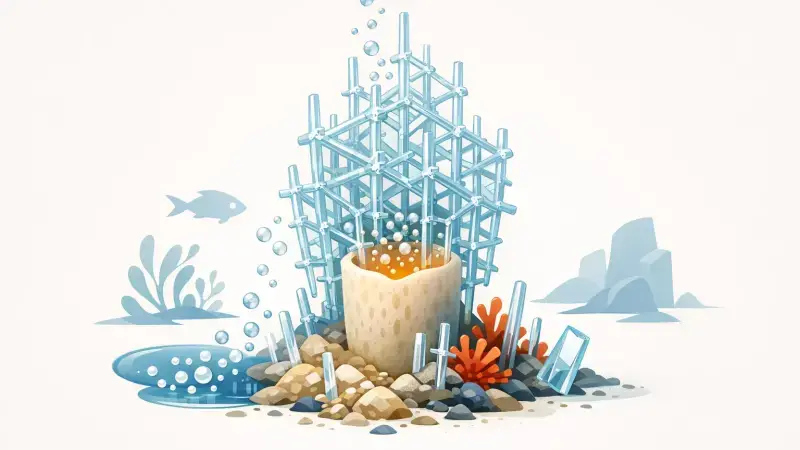
People tend to picture a sponge as soft, wet, and temporary. But on parts of the deep seafloor, some sponges make their bodies stiff with glass. This isn’t one single place. It shows up in several regions, including the North Pacific, the Southern Ocean near Antarctica, and parts of the North Atlantic. The basic trick is chemical: the sponge pulls dissolved silica out of seawater and turns it into solid silica. That silica becomes tiny rods and hooks, stacked and stitched into a framework. Over time, the framework can look like a fragile lattice, but it’s tough enough to hold shape in cold, dark water.
What “glass” means down there
The “glass” isn’t window glass. It’s hydrated silica, the same basic substance in things like opal. In seawater, silica exists as silicic acid, and the sponge concentrates it inside its tissues. Cells in the sponge make spicules, which are the little glass elements that act like scaffolding and defense at the same time. Spicules come in different shapes depending on the species, and that shape matters because it decides how the skeleton locks together instead of collapsing.
A detail people usually overlook is scale. Many of these spicules are microscopic, but they’re not random grit. They’re manufactured parts, often with layered growth. That layering is why a spicule can be both thin and resistant to snapping. You’re looking at something closer to a built structure than a pile of sand glued together.
How they get enough silica in the first place
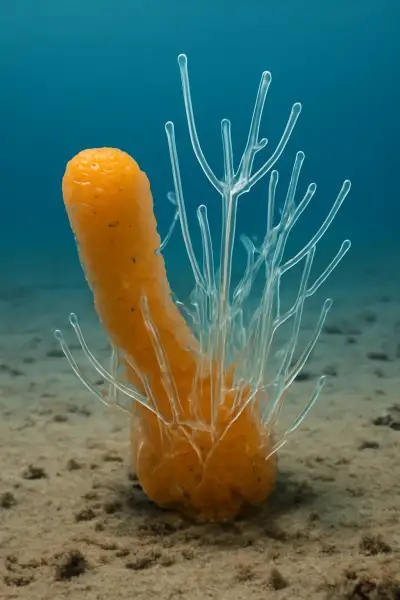
Seawater doesn’t always have much dissolved silica, especially compared to what a big skeleton would seem to require. So these sponges tend to do well where silica is more available. Cold water helps because silica dissolves and circulates differently than it does in warm surface waters, and deep currents can bring silica-rich water along the bottom. Another big source is recycling: when organisms like diatoms die and sink, their silica can dissolve back into the water column and eventually reach the seafloor again.
Even with that, it varies by location and season, and it isn’t always clear how tight the silica budget is for a given sponge community. Some species appear to be unusually efficient at scavenging tiny concentrations. They use specialized transport proteins to pull silicic acid into cells and then polymerize it into solid silica where the spicule is being formed.
What the skeleton does for the sponge
Deep-sea glass sponges are often found where water movement is low and food arrives as a slow “snow” of particles. A rigid skeleton gives the animal height and shape, which helps it position its filtering surfaces in the flow that does exist. It also helps resist predators that would have an easier time tearing apart soft-bodied animals. The glass elements can act like a deterrent because biting into a sponge full of spicules is a bad experience for many grazers.
Some species form large structures that change local habitat. On the continental shelf off British Columbia, for example, glass sponge reefs provide complex surfaces where other animals can shelter and feed. The sponge is just filtering water, but the skeleton changes the seafloor from mostly flat sediment into a three-dimensional place with ledges and crevices.
What happens when they die
The glass doesn’t disappear quickly. When a glass sponge dies, its soft tissue decays, but the spicules can remain and pile up. Currents can orient them and pack them into mats. Over long periods, layers of spicules can become thick enough to influence what grows next. New sponges may settle on top of old spicule layers because the hard, elevated surface is better than bare mud.
That afterlife is easy to miss because it doesn’t look dramatic in photos. It can just look like pale, fibrous debris. But those spicule beds can persist while the surrounding seafloor keeps shifting, and they quietly steer where the next generation of filter feeders ends up anchored.
Related reads
- Vending machines that sell live crabs
- How lead pipes changed ancient water chemistry—and modern corrosion science explains why
- The festival where people chase a rolling wheel of cheese
- How a beetle’s dramatic death pose fools both birds and ants
- Why mangrove roots trap carbon and hold back storm surge
- Antique toys discovered hidden inside a house wall
If you liked this, you might also enjoy: