
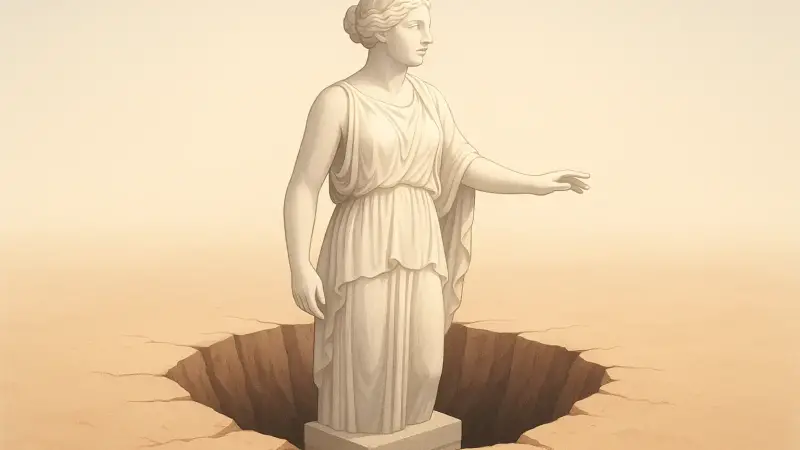
A statue disappears, then turns up again
People assume that when something drops into the ground, it’s gone for good. Sinkholes don’t feel like places that “give things back.” But there are cases where they do. One that gets repeated a lot is the 2013 sinkhole in St. Petersburg, Florida, where part of a residential neighborhood abruptly collapsed. Incidents like that make the basic mechanism easy to picture: a hidden void opens, gravity does the rest, and whatever was sitting on top gets swallowed. The part that surprises people is the reappearance. If a statue comes back intact days later, it usually isn’t because the earth neatly stored it. It’s because the hole behaved more like a temporary cavity than a bottomless pit.
How a sinkhole can “swallow” something without destroying it

Most sudden sinkholes are tied to water moving through soluble rock, often limestone. Water enlarges cracks underground, soil slowly migrates downward, and a roof of compacted material forms above a growing void. For a long time, the surface can look normal. Then a threshold is crossed and the roof fails in one moment. That kind of collapse can drop a statue straight down with surprisingly little lateral force. If the object is heavy and compact, it can fall as a single piece instead of tumbling. Damage depends on how far it falls, what it lands on, and whether it hits hard debris on the way down.
One detail people overlook is the role of the base. Many outdoor statues sit on a pedestal with bolts, rebar, or a footing. When a cavity opens, the base can break away in chunks and act like a sled. The statue may ride down with a slab of concrete under it. That can keep it upright and protect the most fragile parts. If the collapse is mostly vertical and the void is filled with loose soil, the landing can be more like settling into a pile than striking bedrock.
Why it can reappear days later
A sinkhole is not a stable “room.” After the initial collapse, the sides often keep sloughing off. Soil and broken pavement keep sliding in, sometimes for days, especially after rain or changes in groundwater. That movement can push buried objects upward or sideways as material rearranges. It’s not that the statue floats. It’s that the ground around it keeps changing shape. If the cavity partially fills and compacts, something that was deeper on day one can end up closer to the surface on day three.
The other mundane reason is that “reappeared” can mean “was located and pulled out.” In many reported stories, the statue isn’t discovered sitting neatly on the surface again. It’s found when crews widen the hole, remove debris, or probe with equipment. A heavy object is easier to detect than you’d think. Metal reinforcement, anchor bolts, or a steel armature can show up on a locator. And when the surrounding soil is excavated, the statue can come out looking far better than expected because it was cushioned by soft fill rather than smashed between rocks.
What “intact” really means in these stories
When people say a statue came back intact, it often means “still recognizable and in one piece.” Small chips, cracked joints, bent mounts, or scraped surfaces may not make it into the retelling. Statues are also tougher than they look, depending on material. Cast bronze can take a lot of abuse. Granite and some dense stones can survive a short fall if they land flat. Concrete is trickier. It can look fine while internal cracks form, especially around thin parts and connection points.
There’s also the timeline effect. The first day is chaos: a hole, barriers, emergency crews, and news coverage. A few days later, the site is calmer and better lit, with systematic work happening. That’s when objects “reappear,” because someone finally has access. It’s easy for the public memory to compress that into a near-miraculous sequence: swallowed whole, returned whole. The slower, messier middle step—stabilizing the rim, cutting away pavement, removing slumped soil—is the part that gets skipped.
Why statues are especially likely to be recovered
Statues tend to be installed in places with human-made layers: sidewalks, plazas, small landscaped beds, and buried utilities. Those layers matter. A void forming under a landscaped area can collapse into soil and mulch instead of jagged rock. And when the collapse happens near a street or walkway, the response is fast. The hole gets shored up, monitored, and excavated, because it’s a safety issue. That organized digging is exactly what makes recovery plausible.
It also helps that statues are discrete objects with known size and location. Nobody has to guess what fell in. That makes search and retrieval straightforward compared with, say, a missing section of fence or scattered debris. If the statue had a known pedestal footprint, crews know where to look first. If it had internal metal, there’s something to detect. A sinkhole can still destroy it, of course. But when one comes back looking oddly fine a few days later, the explanation is usually a mix of a vertical drop, soft fill, and deliberate excavation—plus a story that smooths out the rough parts.
Related reads
- The coastal town where hundreds of lost dentures wash ashore every year
- Why your face flushes before you realize you’re embarrassed
- The Georgian scandal where doctors believed a woman gave birth to rabbits
- Why elevator silence twists into awkwardness as a crowd grows
- The invisible muscle memory behind sloppy versus neat handwriting
- How tiny rituals like tapping or checking unlock a sense of control