

It feels like a joke until you see it: a temporary electric fence, a couple of handlers, and a tight cluster of goats stripping a patch of grass down to stubble. Several places do this on purpose, renting “goat crews” to manage vegetation where a mower is awkward, loud, or risky. In the U.S., California cities and agencies have used goats for brush control for decades, including around the Getty Center in Los Angeles. In Canada, some municipalities have trialed targeted grazing for park edges and steep slopes. Exactly which “town” started it first is unclear, because these are usually seasonal contracts, not permanent goat departments.
Why goats get the job
Goats are good at the parts of “mowing” that machines hate. They’ll work a hillside, a ditch, or a narrow traffic island where a ride-on mower might tip or where a trimmer would take hours. They also browse, not just graze, so they’ll take on weeds and woody plants that keep coming back after cutting. For roadside verges and roundabouts, that matters, because the problem is often tough regrowth and invasive plants, not a neat lawn.
Municipalities usually aren’t trying to make the grass look like a golf course. They’re trying to keep vegetation from getting tall enough to block sightlines, hide signs, or spill into walkways. Goats naturally create a patchy, uneven finish. That “imperfect” look is part of the deal, and it’s why the approach shows up more in parks, embankments, and buffer zones than in formal town squares.
How a goat “mowing” day actually runs
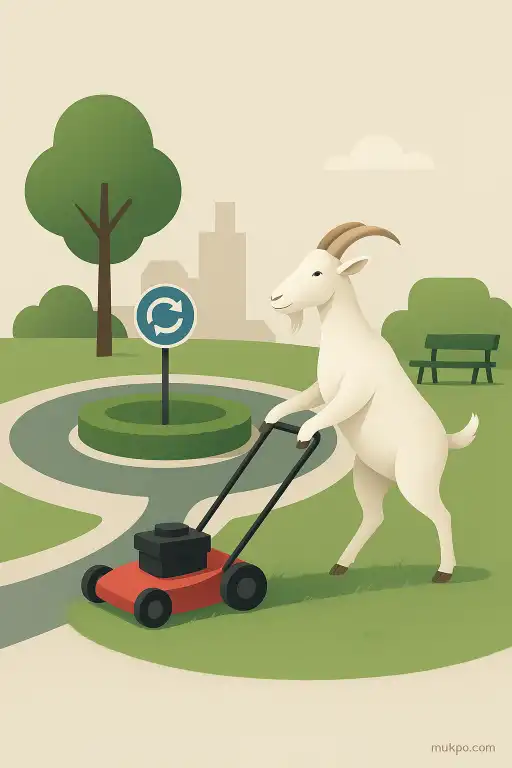
The setup is usually more infrastructure than people expect. The herd arrives with portable fencing, often electric, and sometimes with netting that can be moved as sections are finished. Water has to be on site or brought in. If the area is near traffic or a footpath, the crew places signs and keeps a close eye on gate points, because one open corner is all it takes for a curious goat to test the neighborhood.
A detail that gets overlooked is timing. Goats don’t “mow” like a machine that runs at a fixed pace for a fixed hour. They hit the tastiest plants first, then spread out. A contractor may rotate them through small paddocks to force more even browsing. The goal is targeted pressure on specific vegetation, not a uniform cut, so the work plan looks more like a map of moveable enclosures than a route for a mower.
Money, noise, and the parts that don’t show up in photos
Cost comparisons are slippery because the line items are different. A mower job is fuel, labor, and a machine. Goat grazing is animals, transport, fencing, supervision, and sometimes guard dogs. It can be competitive when the site is steep, brushy, or hard to access, because that’s where mechanical work gets slow and injury risk goes up. It can be less competitive for flat, open turf where a mower is fast and predictable.
Noise and emissions are part of why towns like the idea, but it’s not “maintenance without effort.” Goats can’t be left unattended in most public spaces. They attract attention. People try to feed them, pet them, or take photos at close range. The contractor’s day often includes crowd management, not just vegetation management, and that can be the hidden cost in busy parks or near schools.
Roundabouts and parks are tricky for machines
A roundabout looks simple until you maintain it. There’s traffic on all sides, limited safe parking for a crew, and a lot of edging. Even when the central island is mostly grass, it often has signs, plantings, or drainage features that turn mowing into a slow, careful job. A herd contained inside a fence can work that space while the handlers stay focused on the perimeter and public safety.
Parks have their own complications. There can be creek banks, erosion-control plantings, and “no-mow” areas meant for habitat. Goats fit best in those in-between strips that are too wild to manicure but too close to people and buildings to ignore. That’s why targeted grazing shows up along fence lines, behind sports fields, or on the backsides of berms where sightlines matter but foot traffic is light.
Limits: what goats won’t solve
Goats don’t replace everything. They can spread weed seeds in their coats, and their hooves can disturb soft ground if they stay too long, especially after rain. They also have preferences. If the goal is to remove one specific plant, success depends on whether that plant is actually palatable at that stage of growth. Some toxic ornamentals and certain invasive species need careful planning so the animals aren’t put at risk.
And goats create their own maintenance tasks. There’s manure, which is usually left to break down in place. There’s the need to keep them away from playgrounds and picnic lawns where people expect a different kind of cleanliness. When it works, it’s because the site is chosen carefully, the herd is moved on a schedule, and the “mowing” is treated like a managed job, not a novelty act that runs itself.
Related reads
- What organic molecules in a meteorite reveal about early solar chemistry
- How early balloon ascents revealed temperature layers in the atmosphere
- The spider that cartwheels to flee danger
- The house shaped like a giant shoe where a family still lives
- Why you can still ride a bike years later even if you haven’t tried
- How backyard pollinator losses shrink vegetable harvests