
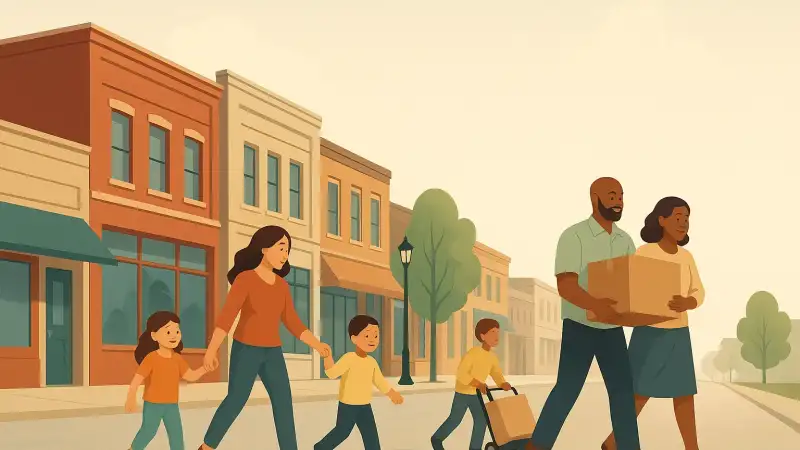
You drive through a lot of small towns where Main Street looks intact, but empty. The storefronts are there. The lights aren’t. A few places decided to tackle that problem from the most direct angle possible: they started paying people to move in. The best-known modern example is Tulsa, Oklahoma’s Tulsa Remote program, which offered cash incentives to remote workers who relocated. Other places have done versions of it too, like Topeka, Kansas with Choose Topeka, and several rural towns in Italy’s Calabria region with grants tied to opening a business. It isn’t one single “town” story. It’s a specific mechanism that keeps getting tried.
Why a town would pay for new neighbors
The math is usually simple, even when the politics aren’t. A shrinking population means fewer customers, fewer workers, and less tax revenue to keep basics running. Then the basics get worse, which makes it harder to keep anyone. Paying families or workers to move in is a way to interrupt that spiral fast, because it tries to add households first and lets everything else follow.
The overlooked detail is that the target often isn’t “a person,” it’s a whole balance sheet: a new lease, a school enrollment, a utility account that stays on, a mortgage that gets paid locally. Towns rarely say it this bluntly, but a single household can be the difference between a class staying open or being combined, or a small grocery keeping enough weekly volume to justify stocking fresh food.
How the offer is structured (and why it’s not just free money)
These programs tend to be conditional. Tulsa Remote, for example, has required applicants to meet income and work criteria and to relocate for a set period. Other programs tie money to buying a home, renovating an old one, or committing to a multi-year residency. Some Italian villages that made headlines for “€1 houses” weren’t simply selling property for pocket change. The cost was in the required renovations and deadlines, with deposits and paperwork that scared off casual interest.
There’s also a quiet reason for the fine print: towns are trying to avoid churn. A one-time payment can attract someone who leaves as soon as the check clears. So the incentive gets split up over time, or linked to proof of residence, employment, or business activity. That structure shapes who applies. It favors people who can handle bureaucracy and front-loaded costs, which is not the same as “any family who wants a fresh start.”
What brings Main Street back, when it works
Main Street doesn’t revive because newcomers “like local shops.” It revives because of routines. More people buying coffee on weekday mornings. More prescriptions filled monthly. More haircuts booked. More kids needing shoes. The boring repeat purchases are what keep a downtown alive, and they’re the first thing a declining town loses.
A concrete situational change shows up fast: hours. When there aren’t enough customers, shops shorten days and close midweek, which makes downtown feel even quieter. Add a few dozen reliable households and the first improvement is often simply staying open. That sounds small, but regular hours make it easier for other businesses to take the risk of opening too, because they’re not building a schedule around emptiness.
What tends to go wrong, even with a popular program
Sometimes the incentive works too well at the wrong scale. If housing is limited, a successful recruitment push can raise rents and prices in a place where wages were already tight. Then the people the town already had—clerks, mechanics, school staff—feel squeezed. A Main Street can look busier while the town’s core workforce gets priced out of it.
Another failure point is that the “new resident” and the “local job” don’t always match. Remote-worker programs can add spending without adding employers, which helps retail but doesn’t automatically build a long-term economic base. Family-focused programs can bring school enrollment up, but if childcare is scarce or healthcare is far away, daily life stays hard and the initial excitement fades.
The less obvious pieces towns have to rebuild alongside the cash
Money gets the headlines, but the quiet infrastructure decides whether people stay. Broadband that works on rainy days. A permitting office that answers the phone. A landlord who will actually fix a leak. In places trying to revive an old downtown, the unglamorous work is often about making upper-floor apartments habitable again, because a street full of shops needs people living close enough to walk to them.
And then there’s belonging, which is harder to budget for. Some programs build in coworking space, meetups, or introductions to local groups, like Tulsa Remote has done, because isolation is a predictable reason people leave. The incentive can get someone across the city limits. What keeps the lights on downtown, month after month, is whether daily life becomes easy enough—and connected enough—that moving feels less like a stunt and more like a normal place to be.
Related reads
- Why yawns spread across a room even when people are strangers
- The sudden phantom smell that isn’t there and how memory conjures scent
- Why rehearsing arguments feels more satisfying than actually apologizing
- The house that legally owns itself in Athens, Georgia
- Why do we wake up right before the alarm
- A boutique hotel made from a 19th century prison where guests sleep in cells