
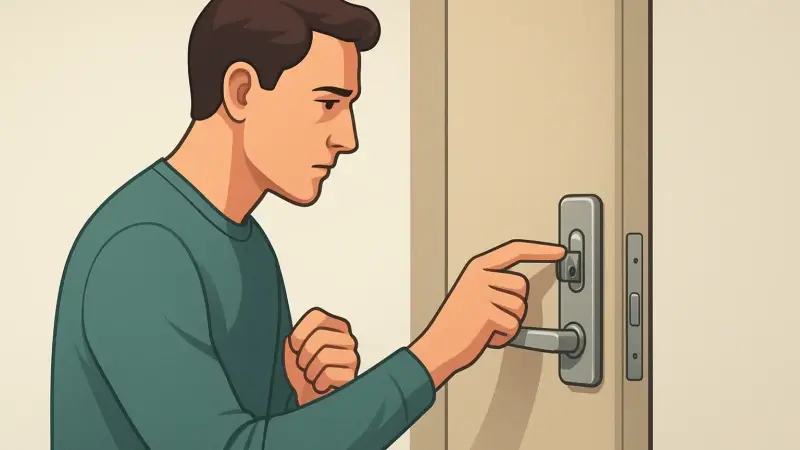
That moment after you pull the door closed
It’s not one single incident tied to one place. It shows up in apartments in New York, terraced houses in the UK, and high-rise flats in Singapore, and it often looks the same. A hand turns the deadbolt. The knob gets tested. Then, a few steps away, the brain throws up a second thought: did it actually happen, or did it only feel like it happened? The core mechanism is that the body can complete a familiar action on autopilot, while attention is already moving on. When the memory doesn’t “stick,” certainty feels missing, even if the lock is already set.
Autopilot actions don’t always form strong memories

Locking a door is usually routine. Routine actions are efficient because they use less conscious attention. But memory tends to record what attention actually lingered on. If the mind is already rehearsing the day, worrying about being late, or thinking about a noise from the hallway, the lock-turn can happen with very little awareness. Later, the person searches for a vivid snapshot and can’t find one. The missing snapshot gets interpreted as “maybe it didn’t happen.”
A detail people often overlook is how “thin” the evidence is. The hand feeling the click, the resistance of the bolt, the sound of the latch. Those are real cues, but they’re brief and repetitive. Because they feel the same every day, they’re hard to tell apart in memory. The brain can’t easily tag Tuesday’s click as different from Monday’s click, so it treats the moment as uncertain.
Certainty and safety don’t use the same signal
There’s a mismatch between “the lock is locked” and “I feel sure it’s locked.” The first is a physical state. The second is a feeling the brain generates when it thinks it has enough proof. With safety-related checks, the brain tends to demand a higher standard of proof, because the cost of being wrong feels large. A person can have accurate knowledge and still lack the felt certainty that would let the thought drop.
That’s why the urge can persist even when the person remembers doing it. The memory exists, but it doesn’t carry the right emotional stamp. The thought shows up as a “what if” rather than a recollection. And “what if” thoughts are designed to be sticky, especially around things like fire, stoves, and locks.
Checking can backfire by making the memory even fuzzier
When someone double checks, they often do it quickly. The second check can be even more automatic than the first, because it’s just a verification. After that, it becomes harder to remember which check was the last one. The mind ends up with multiple similar moments: hand on knob, slight shake, glance at the bolt. That pile of near-identical checks can blur into one vague impression.
A concrete example: someone locks their apartment door, walks toward the elevator, and turns back to test the handle. The handle doesn’t move. In the elevator, the same doubt returns, but now the brain has two nearly identical memories—locking and testing—and isn’t sure about their order. The overlooked piece is sequencing. The worry is often less “did I ever lock it?” and more “was the last thing I did the locking, or did I accidentally undo it after?”
Why it’s stronger for some people and situations
The urge tends to spike with stress, sleep loss, big transitions, or leaving for a trip. When mental load is high, attention gets fragmented, and fragmented attention produces weaker episodic memories. Environments matter too. A noisy hallway, a crying child, a buzzing phone, or a rushed exit can all steal the few seconds of focus that would make the moment feel “registered.”
It can also connect to traits like intolerance of uncertainty, or to clinical patterns like obsessive-compulsive disorder, where checking is driven by intrusive doubt and a strong need for relief. Not everyone who checks has OCD, and the line isn’t always clear from the outside. What’s visible is the same loop: the lock is secure, but the mind keeps requesting one more piece of proof before it will let the thought go.
Related reads
- How indoor plants change room microbes and alter airborne chemistry
- The sea slug that steals chloroplasts and runs on borrowed sunlight
- The village that still pays some workers with fresh fish hauled each morning
- The petrifying well that turns lost toys to stone
- How Mongol catapults allegedly hurled plague corpses into besieged cities
- A garage sale that turned up a trunk of handwritten novels no one claimed