
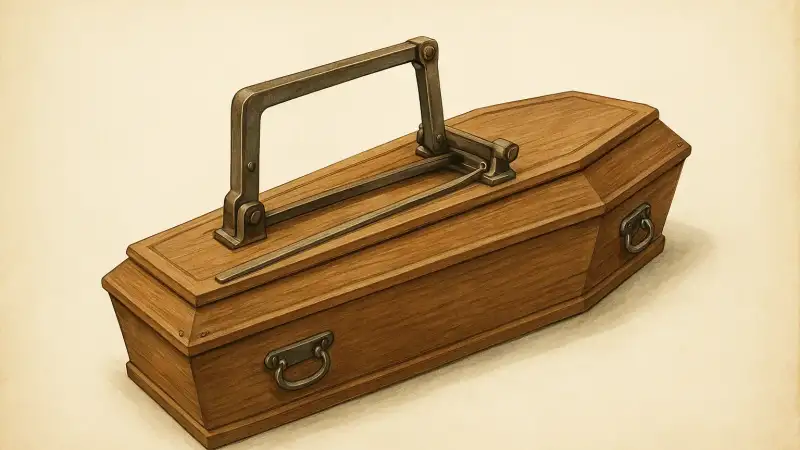
People don’t usually picture Victorian Londoners worrying about the mechanics of a coffin. But in the 1890s, that fear became specific. Not just dying, but being buried too soon. One man helped push it into public view: the engineer Franz Vester, whose patents described “safety coffins” with tubes for air, cords for bells, and ways for someone inside to signal the surface. You can see the idea clearly in the era’s newspapers and exhibitions, where a coffin could be treated like a piece of equipment. The panic wasn’t confined to one borough or one famous case, and the details of specific incidents vary. But the mechanism was easy to imagine, and that was the point.
A fear that fit the city
London had practical reasons to feel jumpy about burial. The city was huge, fast, and crowded. People died at home, in lodging houses, and in workhouses. Bodies could move quickly from deathbed to burial, especially for families with little money. Medical certification existed, but it wasn’t a single, foolproof system, and mistakes were part of the background noise of the age.
There was also the long shadow of earlier public health fights. The Burial Acts and the closure of inner-city graveyards were still within living memory, and the new “modern” cemeteries outside the center made death feel more organized and more industrial. That’s a weird mix: more order, but also more distance. It left room for a nagging question about what happened between the declaration of death and the moment the coffin disappeared underground.
What Vester actually patented
Vester’s safety-coffin designs were not vague “just in case” fantasies. They were engineering drawings aimed at solving a specific imagined failure: a living person sealed in a box. The proposed fixes were mechanical and external. An air tube to the surface. A rope or wire connected to a bell above ground. Sometimes a flag or other indicator meant to move if the person stirred. The coffin becomes a device with inputs and outputs, like a piece of street hardware.
A detail people usually overlook is how much of the system depended on someone outside paying attention for days. A bell that can ring is only useful if it can be heard, and if someone is tasked with listening. An air tube can be blocked by mud, water, or careless placement. Even the “signal” parts often assumed the cemetery was quiet enough for small noises to matter, which was not a safe assumption in a busy city with wind, traffic, and workers moving around.
How a patent can create a panic
A patent doesn’t prove a problem is common. It proves an inventor thinks a problem can be framed clearly enough to sell a solution. That distinction is easy to miss, and Victorians missed it too. When a safety coffin is described in print, it suggests that premature burial is not only possible but foreseeable. It turns a vague fear into a set of steps: here is the failure, here is how you would discover it, here is how you would survive it. That concreteness is persuasive.
London’s press and lecture culture helped. New devices were entertainment as well as reassurance. A coffin with a bell line is the kind of object that invites a demonstration, a sketch, and a story. It also travels well as a rumor. People might never see the patent, but they hear “they’ve invented coffins with alarms now,” and the existence of an invention starts doing emotional work all on its own.
The burial trade had to react
Even if most undertakers and cemetery managers thought premature burial was rare, they still had to operate in a market where families were anxious. That pressure can show up in small procedural choices. Longer “watching” periods before burial. More emphasis on visible signs of death. More talk about certification. A technological fix like Vester’s also offered a way to move the argument away from medical uncertainty and toward hardware: if you fear an error, buy a product.
There’s also a quieter tension here. Coffins were supposed to be final. A safety coffin, by design, keeps a line open between the dead and the living world above. That runs against the emotional purpose of burial, which is closure. Some families would find the idea comforting. Others would find it unbearable to think a bell might ring. Either reaction keeps the fear alive, because the scenario stays vivid.
Why the idea stuck around
The fear of being buried alive didn’t need constant new cases to persist. It only needed a believable chain of events, and Victorian life supplied one. Illnesses that mimicked death. Limited diagnostic tools compared to today. Social situations where a body could be handled quickly. Once an engineer publishes a design that treats the coffin as a survivable space, the mind starts testing it: what if it happened to me, in this cemetery, on this day?
And the story is portable. You can lift it out of London and drop it into Paris or New York without changing much, because it’s built from universal parts: uncertainty, hurry, and a box you can’t open from the inside. Vester’s patents didn’t invent the fear, but they gave it a diagram. That’s often enough to set a whole city talking.
Related reads
- The phantom buzz: why phones feel like they’re vibrating when they’re not
- Why we rehearse arguments long after they’re over
- How archerfish aim water jets to dislodge insects from branches
- Why fog clings to valley floors while nearby ridges stay clear
- Why some conversations make you forget time completely
- A café that brews espresso in cups stitched from old concert wristbands