
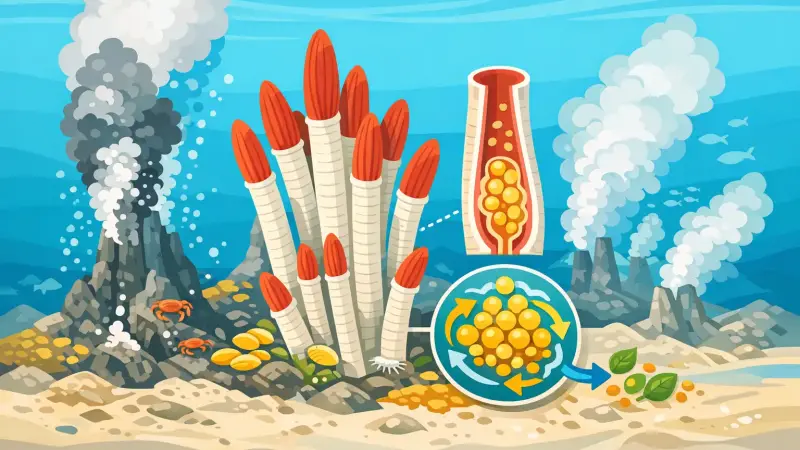
It feels odd to picture “farming” in the deep sea, where there’s no sunlight and the water can be near freezing. But at hydrothermal vents, animals do something close to it. Giant tube worms don’t eat in the normal sense. They host bacteria inside their bodies and feed those microbes with chemicals from vent water. This isn’t one single vent site, either. It shows up at places like the Galápagos Rift, the East Pacific Rise, and the Mid-Atlantic Ridge. The core mechanism is simple: the worm collects hydrogen sulfide and oxygen, delivers them to bacteria, and the bacteria turn that chemical energy into food.
Hydrothermal vents are chemical leaks, not warm ponds
A hydrothermal vent is basically seawater that has soaked into hot rock, picked up dissolved chemicals, and then pushed back out into the ocean. The water can be extremely hot right at the vent opening, but temperature changes fast over short distances. That sharp gradient matters because most vent animals aren’t sitting in boiling water. They live where the vent fluid mixes with cold seawater and becomes tolerable.
The key chemical is often hydrogen sulfide. It’s toxic to most familiar animals because it interferes with respiration. At vents it’s also fuel. When sulfide-rich vent water meets oxygen-rich seawater, there’s usable energy in that chemical difference. Tube worms are built around controlling that meeting point, without letting the chemistry poison them.
The “food” is made by bacteria using sulfide
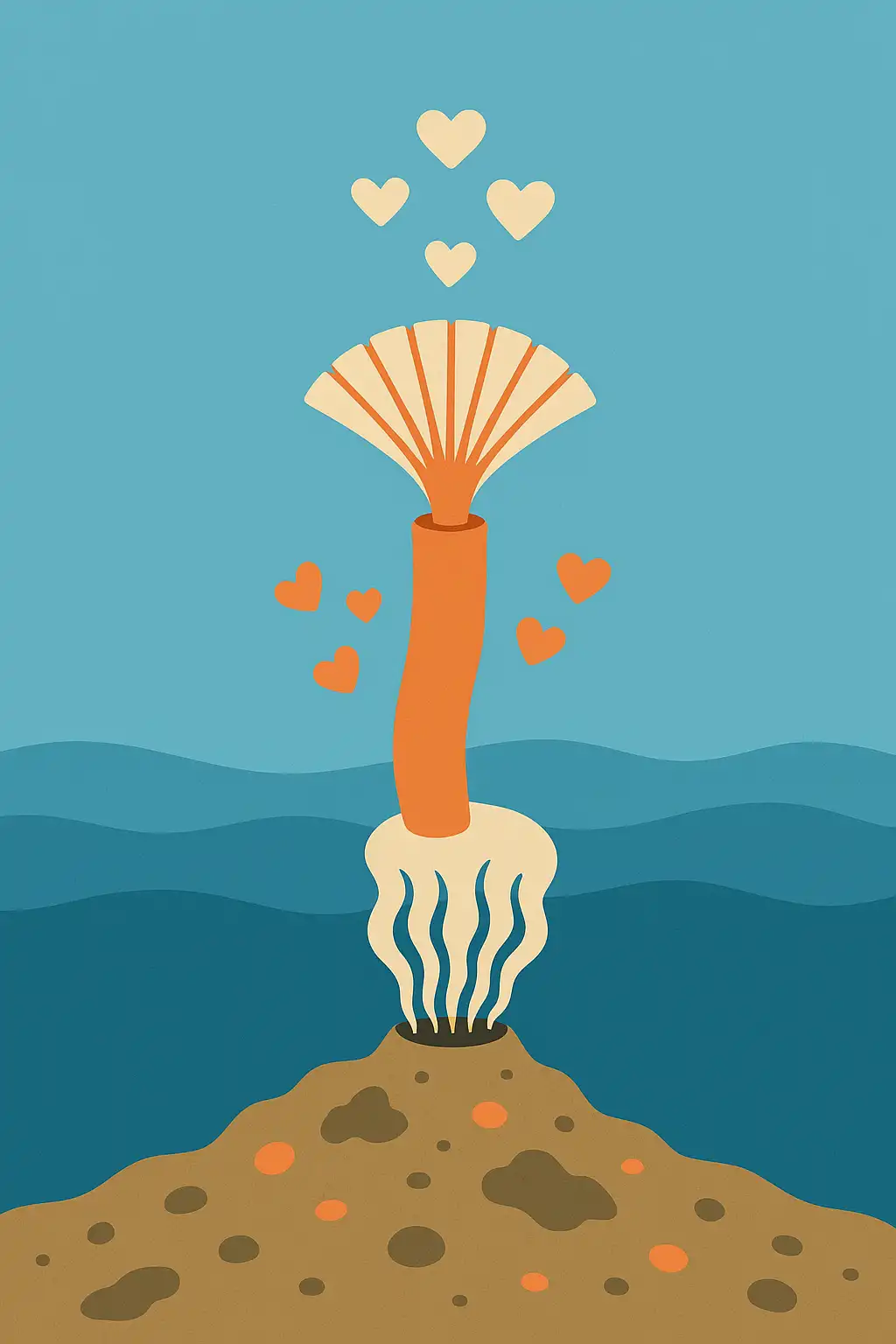
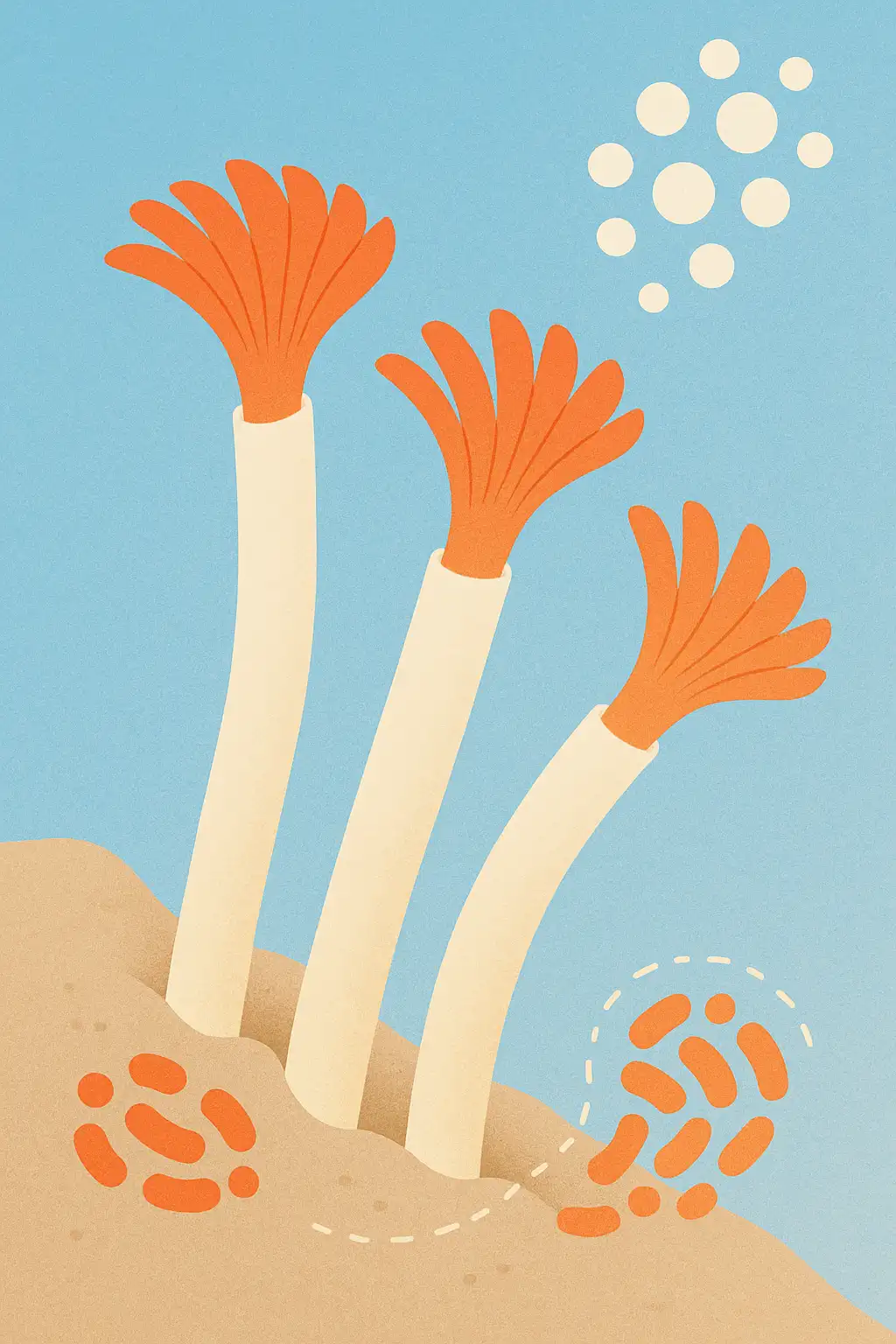
Tube worms like Riftia pachyptila don’t have a mouth or a gut. That’s not a quirky detail. It forces a different lifestyle. Inside the worm is an organ called a trophosome, packed with symbiotic bacteria. These microbes use chemical energy from sulfide (and sometimes other compounds, depending on the site) to build organic molecules from carbon dioxide. It’s a form of chemosynthesis.
The worm “pays” for this by acting like a delivery system. It provides the bacteria with a stable place to live and a steady supply of inputs: sulfide from vent water, oxygen from seawater, and CO₂. In return, the bacteria grow and produce compounds the worm can use as nutrition. The worm is less a predator or grazer and more a host keeping a very specific microbe culture running.
Tube worms function like plumbing for two incompatible waters
The red plume at the top of a giant tube worm looks like a flower, but it’s a respiratory surface. It pulls in dissolved gases from the water, including oxygen and carbon dioxide. The trick is that the worm also needs sulfide, which is dangerous in the same spaces where oxygen is handled. The worm keeps these chemicals managed and moved to the right place.
A specific detail people usually overlook is that the worm’s blood has unusual hemoglobin that can bind oxygen and sulfide at the same time. In most animals, sulfide would shut things down. Here, specialized binding helps transport sulfide safely to the internal bacteria. It’s not just “toughness.” It’s chemistry and compartment control, tuned to a habitat where the fuel source is also a toxin.
Why this is described as a self-sustaining farm
Calling it a farm isn’t about intention. It’s about the structure of the relationship. The worm creates living space, regulates inputs, and maintains conditions that let the bacteria keep producing biomass. The bacteria are not a casual coating on the outside. They are housed internally, protected from being washed away, and supplied continuously as long as the worm can access the chemical gradient at the vent.
The “self-sustaining” part comes from feedback. If the worm can keep its plume in oxygenated seawater while its body taps sulfide-rich flow, the bacteria can keep growing without the worm having to hunt or filter-feed. But it’s not guaranteed. Vent chemistry varies by location and over time. Vent flows can shift, shut down, or become too hot or too diluted, and then the whole system can fail quickly.
Vents host whole communities built on the same trick
Tube worms are the famous example, but vents support many animals that run on bacterial partners. Some clams and mussels host chemosynthetic bacteria in their gills. Certain shrimp graze on microbial growth around vent structures. The common theme is that bacteria turn vent chemistry into edible carbon, and larger animals organize their bodies and behaviors around keeping that conversion running.
These communities can look stable when photographed, but they’re sitting on a temporary foundation. Vent fields can be buried by eruptions, cut off by shifting rock, or re-routed underground. That’s why researchers often see patches of different ages and species mixes along the same ridge system. The “farm” works best when the plumbing stays open, and vents don’t promise that for long.
Related reads
- How desert ants use polarized light to find home
- A library book returned with a mouse still inside
- How trees and fungi swap carbon and signals through underground networks
- When soldiers and farmers clashed with emus in 1932 Western Australia and the birds won
- Why hearing your name in a crowd grabs your attention
- How a small change in posture instantly shifts confidence