

Seeing seafood in a place meant for snacks
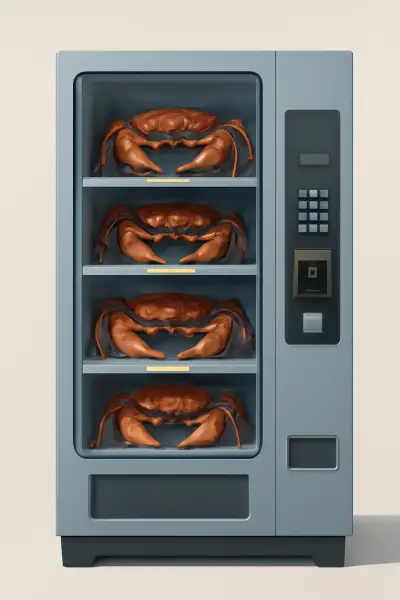
Most people picture a vending machine as chips behind glass. Then you walk past one and it’s holding something that can move. These machines aren’t one single local oddity. They’ve shown up in a few different places, including crab vending machines reported in China, and live seafood vending machines in Japan and South Korea. The basic mechanism is straightforward: the machine keeps animals in a cold, oxygenated holding system, and it dispenses a boxed order the way a drink machine drops a can. What varies is what’s inside, how long it can be kept, and how the seller handles restocking and losses.
How a machine can keep a crab alive
A crab doesn’t need “air” in the same way a mammal does, but it does need oxygen and moisture to survive. So these systems behave more like compact aquariums than like food lockers. Cold is the other big lever. Lower temperatures slow metabolism, which buys time, but they also create a narrow safe zone: too warm and animals deteriorate fast, too cold and you risk stress or death. That’s why you’ll often see machines described as refrigerated and circulating water, sometimes with filtration, and sometimes as holding the crab in damp packaging rather than fully submerged tanks.
A detail people overlook is that “alive” isn’t just a switch you flip. Crabs can survive short periods out of water if their gills stay moist, but they still accumulate stress. The longer they sit, the more sensitive they get to handling and temperature swings. A machine in a sunlit storefront has a harder job than one in a shaded indoor corridor, even with the same settings, because every door opening and heat load matters.
What customers are actually buying
The purchase is usually presented as a simple product, but it’s really a promise about condition at the moment the box drops. Some machines sell a single live crab. Others sell a “set” in sealed packaging. Labels may describe size grade, species, or origin, but those details can be inconsistent across operators and regions. The situational example that makes the concept click is seeing the box format: it’s often a handled carton or foam container that fits the machine’s chute, not a loose animal sliding down a ramp.
There’s also the question of what happens if something goes wrong. Sellers sometimes advertise guarantees, but the exact policy is not universal and can be unclear. Vending works best with predictable inventory. Live animals are unpredictable inventory. That mismatch is why these machines tend to appear in places with dense foot traffic and nearby staff support, rather than as fully unattended boxes sitting alone for days.
Why crabs, specifically, show up in machines
Crabs sit in a useful middle zone for vending. They’re valuable enough to justify the hardware and monitoring. They’re also hardy compared with many fish, and they tolerate cooler holding conditions reasonably well for short periods. That makes them easier to sell in a “ready for dinner” window, especially in regions where live seafood is a normal retail expectation and buyers want the reassurance of movement rather than a sell-by date.
They also solve a practical packaging problem. A crab can be immobilized safely with ties and placed in a rigid container. That reduces the risk of injury during dispensing. It’s a small mechanical detail, but it matters. A vending system can only be as gentle as its drop distance, chute angle, and the shape of what it releases.
The operational headaches no one sees
If you stand in front of the machine, you see a price tag. Behind it is a schedule. Live inventory needs frequent checks. Water needs maintenance. Filters clog. Temperature sensors drift. Power outages are a bigger deal than they are for candy. Operators also have to manage mortality, which isn’t just a financial loss. It’s a food safety issue and, depending on local rules and norms, an animal welfare issue too.
That’s why these machines are often more like automated storefronts than like set-and-forget gadgets. You’ll sometimes find them in or near seafood markets, transport hubs, or malls where staff can restock and respond quickly. The machine is doing the last step of the sale. Most of the work is still happening offstage, on a clock that doesn’t care whether anyone is walking by.
Related reads
- How lead pipes changed ancient water chemistry—and modern corrosion science explains why
- The festival where people chase a rolling wheel of cheese
- How a beetle’s dramatic death pose fools both birds and ants
- Why mangrove roots trap carbon and hold back storm surge
- Antique toys discovered hidden inside a house wall
- Why a yawn from someone else makes you yawn too
If you liked this, you might also enjoy: