
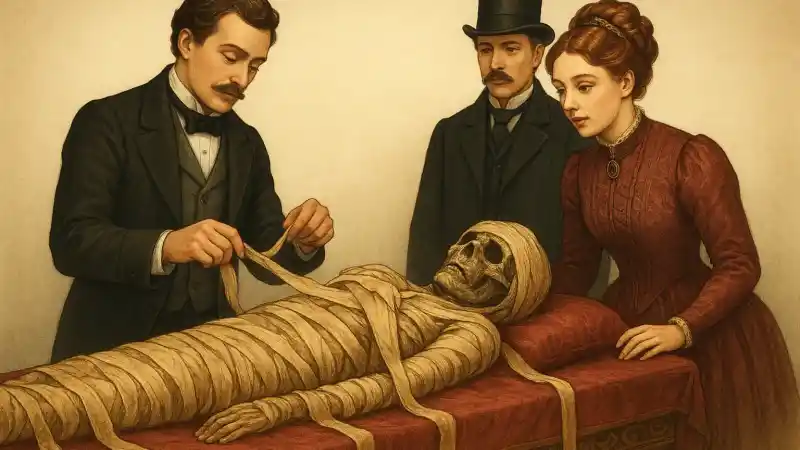
It’s strange to picture a dinner party where the entertainment is a corpse. But in early 1800s London, that was a real thing in some circles: a host would buy an Egyptian mummy and invite guests to watch it be unwrapped, layer by layer, as a paid spectacle. It wasn’t one single venue or one famous night. It popped up in drawing rooms, lecture halls, and private societies. One concrete example is the surgeon Thomas “Mummy” Pettigrew, who held unwrapping events in London in the 1830s and published accounts of what he found. Tickets, invitations, and curiosity did the rest.
Where the mummies came from
The supply chain started far away from London. British travelers, diplomats, soldiers, and collectors brought back mummies from Egypt as souvenirs, scientific specimens, or status objects. After Napoleon’s campaign and through the 19th century, Egypt became a fashionable obsession in Europe, and objects moved through dealers and auctions. Some bodies were taken from tombs that were already disturbed. Others were dug up specifically to be sold. The paperwork, when it existed at all, was often thin, and the identity of the person inside was usually unknown by the time the crate reached England.
There was also a bigger background pressure: the idea that ancient Egypt belonged to whoever could study it, display it, or buy it. Museums were building collections. Private collectors wanted rarities. A mummy sat right at the intersection of “artifact,” “specimen,” and “conversation piece,” which made it unusually easy to justify in polite company.
What an unwrapping party looked like
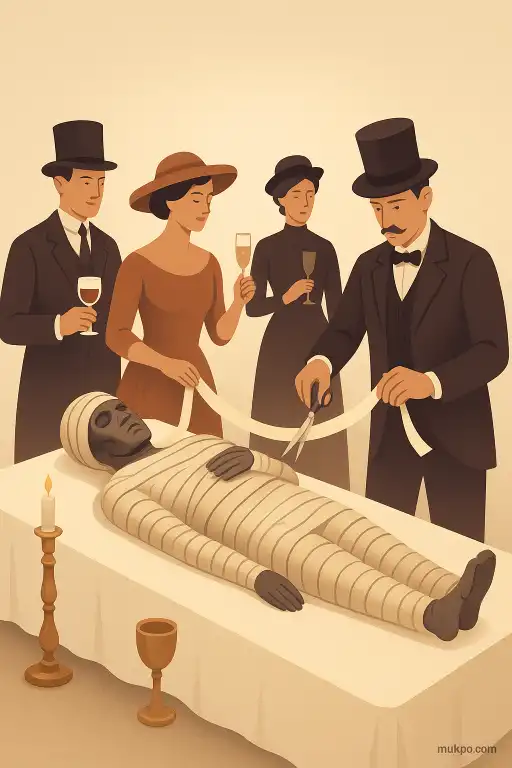
The scene varied. Sometimes it was staged like a lecture, with a table, bright lamps, and a speaker who knew anatomy. Other times it was closer to after-dinner entertainment, with the mummy brought out as the climax of the evening. Guests might pay directly for admission, or the cost could be folded into subscriptions and private invitations. Pettigrew’s events are often described as semi-scientific performances, mixing showmanship with measurement and note-taking.
A detail people tend to overlook is the mess and the smell. Old resins and oils used in embalming could be strong when warmed by crowded rooms and lamps. Linen strips didn’t come off neatly. They tore, stuck, and shed dust. The work was physical and fiddly. Someone had to cut through layers without shredding everything, and the remains could break as they were exposed.
Why people paid to watch
Part of the appeal was access. London audiences were hungry for anything “authentic” from Egypt, and a sealed mummy promised a reveal. Unwrapping turned the object into a sequence of surprises: painted cartonnage, amulets, rings, layers of linen, and finally a body. Even when the remains were poorly preserved, the suspense still worked. The event was also a kind of social proof. Being invited meant you had the right friends, the right taste, and enough money to treat an ancient burial like a night out.
There was also an intellectual excuse that made the whole thing easier to swallow. Hosts and speakers framed it as science. Phrenology and racial “classification” were popular and damaging ideas in the period, and human remains were dragged into that project. A mummy could be presented as evidence for theories about history, bodies, and “types,” even when the methods were shaky and the conclusions were biased from the start.
What got destroyed in the process
Unwrapping is irreversible. Once the linen is cut and pulled away, the burial is effectively dismantled. That meant information disappeared: how the layers were arranged, where objects sat against the body, which resins were used, what the original binding patterns looked like. A careful observer could take notes, but most of the context was lost in real time. Even well-meaning “investigators” were working in a room designed for spectators, not preservation.
It wasn’t only the mummy itself. Coffins, masks, and decorations could be broken to speed things up or make the contents visible. Small items were sometimes pocketed, gifted, or separated and sold later. When a mummy ended up in a museum after being unwrapped, it often arrived as parts: a body here, wrappings there, amulets in a different box, and little certainty about what belonged together.
How the practice faded
The fashion didn’t vanish overnight, but it became harder to defend. Tastes changed. Museums and universities pushed for less theatrical handling of remains, even if they didn’t always meet modern ethical standards. Better tools also arrived. X-rays and later CT scanning made it possible to “unwrap” a mummy without cutting a single strip of linen, which drained the main selling point of the live event.
By the time mummies were increasingly treated as human remains with a claim to dignity, the drawing-room unwrapping looked like exactly what it was: a paid night of curiosity built on someone else’s grave, with London’s bright lights doing the work of a tomb robber’s torch.
Related reads
- The odd comfort of rewatching movies you already know
- A Victorian suitcase that kept an entire tiny garden growing for a century
- The frontier uprising against whiskey taxes that tested the early American republic
- Why your name grabs attention in a crowded room
- How brief goodbye routines steady anxious minds
- The beach that sings when you walk on it