

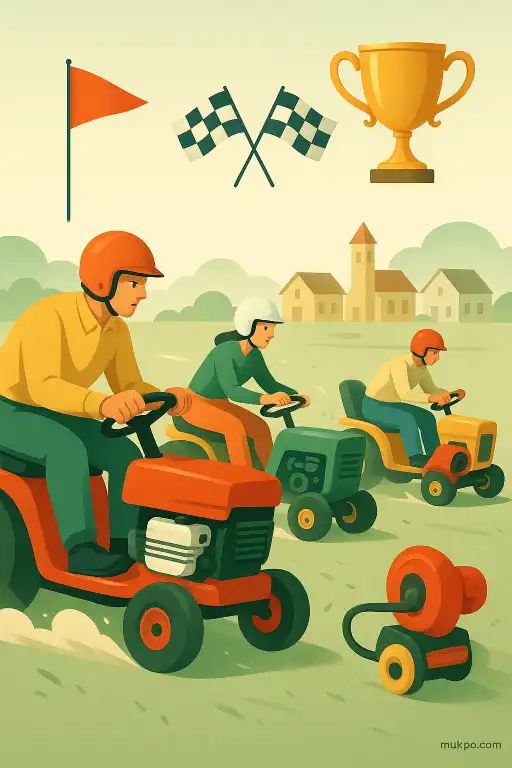
You don’t usually look at a lawnmower and think “motorsport.” Then you end up in a village field where someone has bolted on a louder engine, welded a roll bar, and lined up on a muddy track like it’s a serious grid. This isn’t one single place or one official event. It pops up wherever a local club, a pub committee, or a farm show wants one day of noise and spectacle. In the UK, the British Lawn Mower Racing Association has long been a reference point for organized racing. In the US, the U.S. Lawn Mower Racing Association does similar work. And in Australia, the sport has had its own local circuits too, though the details vary by region and year.
How a lawnmower turns into a race machine
The basic mechanism is simple: take a ride-on mower, remove the cutting deck or disable the blades, and build it for speed and durability instead of grass. Most races ban purpose-built racing engines and keep some link to “mower” parts, but the exact rules depend on the organizer. Some classes stay close to stock. Others allow bigger engines, modified pulleys, and aggressive gearing. The result looks familiar from far away and completely wrong up close.
A detail people overlook is how much of the build is about not flying apart. Frames get reinforced. Steering gets tightened because the original setup was meant for gentle turns around a yard. Brakes, too, are a bigger deal than spectators assume. On grass, the stopping distance can be surprising, especially once the track gets torn up and damp.
Why villages and small towns keep hosting it

It fits the shape of a local day out. You can hold it on a showground, a pasture, a fair site, or a rough oval carved into a field. The vehicles are cheap compared with most motorsports, at least at the entry end. And it’s easy for a crowd to understand within seconds. Things go around. Some go around well. Others don’t.
There’s also a social reason that’s easy to miss if you only see the racing. A lot of these days are tied to fundraising, club calendars, or community fairs. The racing is a centerpiece, but it’s rarely the only thing happening. You often see food tents, a raffle, maybe a dog show, maybe a tractor display. The mower race sits neatly in that mix because it’s loud, short, and repeatable.
What the day actually feels like trackside
The sound hits first. Even “modest” builds can be harsher than you expect, because the machines are open, close to the ground, and often run without anything like a car’s muffling. Then you notice how physical it is. Drivers bounce. Arms work constantly. A small rut can yank a front wheel sideways. The field changes hour by hour as tires dig grooves and loose clods get flung into the corners.
Races tend to be short heats rather than one long session. That makes the chaos feel concentrated. Someone spins and keeps going. Someone else clips a marker and drags it for half a lap. When there’s contact, it’s often low-speed but still messy, because a mower has lots of edges and not much bodywork. Marshals matter more than people realize, especially when a machine stalls in a blind spot or a belt snaps and tangles.
The rulebook problem: “safe,” “silly,” and still real machines
Organizers are always balancing the joke of the object with the seriousness of moving machinery. Most groups require blades removed or locked out, plus basic safety gear. Beyond that, rules split fast. Some events emphasize “run what you brung” spectacle. Others, like the BLMR and USLMRA styles, tend to push for consistent classes and clear limits so it doesn’t become an arms race of money and horsepower.
One practical issue is that lawnmowers were never designed for sustained lateral forces. That affects everything from fuel delivery to wheel hubs. It’s why you’ll see odd, homemade engineering choices that look overbuilt for the speed. People learn the hard way that the weak point isn’t always the engine. It’s the bits around it that were meant for weekend chores.
Why the crashes are rarely the point, but always part of the story
The appeal isn’t just seeing something crash. It’s watching how close it gets to not crashing. A good lap is impressive because the machine is twitchy, the surface is inconsistent, and the driver is perched on something that feels like a household object. When it goes wrong, it often goes wrong in small, cumulative ways: a slipping belt, a tire losing a bead, a steering link loosening, a chain jumping. The drama is mechanical as much as competitive.
And then, when a heat ends, the track turns into a workshop aisle. People lean over engines and point at parts with oily gloves. Someone borrows a tool. Someone offers a spare. The next race starts before the smell of hot grass and exhaust has really cleared.
Related reads
- Tiny houses carved inside walnut shells that collectors pay a surprising sum for
- How a stolen bucket set two medieval Italian city-states on a year-long bloody feud
- Why your stomach knots before speaking and what that sensation signals
- How your brain recognizes a familiar face in under a blink
- A startup that bottles Himalayan mountain air and sells it by the can
- How a 16th-century Ottoman gardener sparked a palace scandal