

Those colors aren’t just “pretty lights”
Auroras don’t belong to one single place or event. People see them in northern Norway, Alaska, Canada, and sometimes much farther south during big solar storms. In March 1989, for example, the aurora pushed unusually far toward the mid-latitudes during the geomagnetic disturbance linked with the Hydro‑Québec blackout. What looks like a smooth curtain from the ground is actually a busy collision zone high above Earth. Charged particles arrive along magnetic field lines. They slam into the thin upper atmosphere. The colors come from which gases get hit, how hard they get hit, and how high those collisions happen.
What “collision” means up there
The particles that matter most are electrons (and sometimes ions) that have been accelerated in near‑Earth space. They don’t light up the air by friction like a meteor. They excite atoms and molecules by transferring energy in a hit. After that, the excited oxygen or nitrogen relaxes back down and releases a photon. That photon is the color you see. The altitude matters because the atmosphere gets dramatically thinner with height. Higher up, atoms can stay excited longer before another collision disrupts them. Lower down, collisions happen so often that some emissions get “quenched” before they can glow.
Green and red tell you about oxygen and height
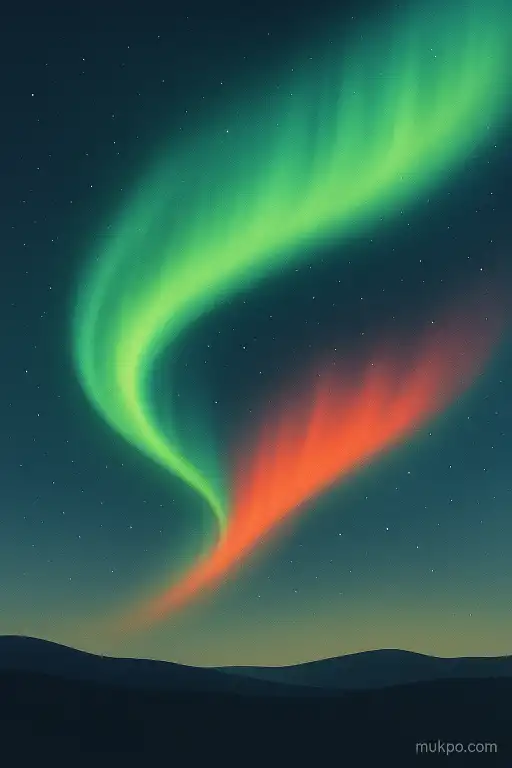
The most common aurora color is green, usually from atomic oxygen around roughly 100–150 km altitude. It tends to show up when incoming electrons are energetic enough to reach that region in large numbers, but not so energetic that the action is dominated deeper down. Red is also often oxygen, but it typically comes from higher altitudes, around 200 km and above, where the air is thin enough that oxygen’s red emission can happen without being interrupted so quickly. A specific detail people overlook is timing. Some red emissions involve “forbidden” transitions with longer lifetimes, so the glow can be more sensitive to how often collisions disrupt the excited state. That’s why red can appear more diffuse and high, while green often looks sharper and more structured.
Blue and purple are signs of nitrogen and harder impacts
When auroras show blue or purple fringes—often along the lower edge of a bright band—that’s commonly tied to nitrogen. Molecular nitrogen and its ion (N2 and N2+) produce emissions in the blue and violet part of the spectrum, and these tend to come from lower altitudes than the classic red oxygen glow. Lower altitude usually means the incoming electrons were more energetic, because they penetrated deeper before losing their energy. These colors also show up strongly in camera images because modern sensors pick up violet and near‑ultraviolet edges differently than the human eye does, especially in dim conditions. So a photo can look more purple than what an observer remembers seeing.
The patterns you see reflect magnetic funnels, not wind
Auroras don’t spread evenly across the sky because the particles are guided. Earth’s magnetic field lines act like rails that funnel charged particles into oval-shaped regions around the poles. That’s why the “auroral oval” is a real thing on space weather maps, and why it expands toward lower latitudes during stronger geomagnetic activity. The fine structure—thin rays, fast ripples, sudden brightenings—often comes from changes in how electrons are accelerated above the atmosphere, not from clouds or ordinary winds down below. An observer on the ground sees a curtain. What’s actually changing is the stream of particles arriving along slightly different field lines, hitting different altitudes, and switching which collisions dominate from one minute to the next.
Related reads
- The fish with transparent teeth that glow under red light
- The pause when two people start talking at once and who yields
- The town that held an election where a dog outpolled a human candidate
- The French adventurer who declared himself king of Araucania and Patagonia in the 1860s
- How prairie dogs shape rivers by digging
- The lichen that eats airborne metals in mining towns