
Seeing a hummingbird drink up close
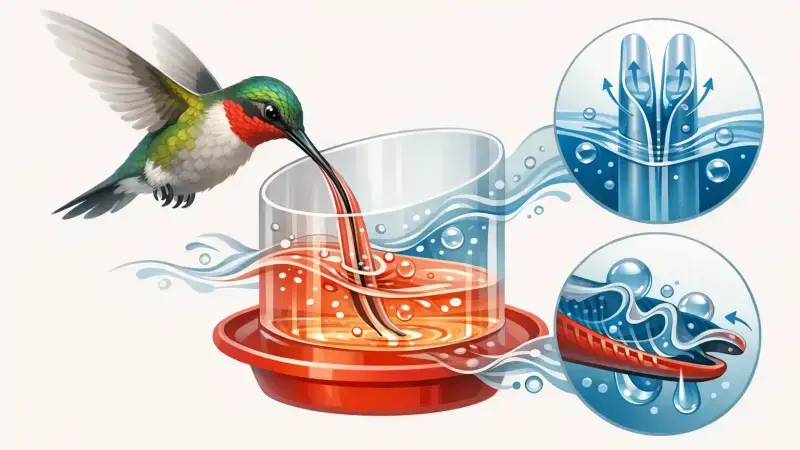
If you watch a hummingbird at a feeder, the motion looks simple. It hovers, dips its beak, and somehow keeps pulling sugar water up. There isn’t one single “place” where this happens. People notice it in gardens from California to Florida, and around flowers across Mexico and the Andes. The core mechanism is easy to miss because it’s hidden: the tongue doesn’t act like a straw. It spreads, folds, and reshapes as it touches liquid. At tiny scales, that reshaping matters as much as muscle does. It turns feeding into a small, repeatable fluid experiment.
The tongue isn’t a tube
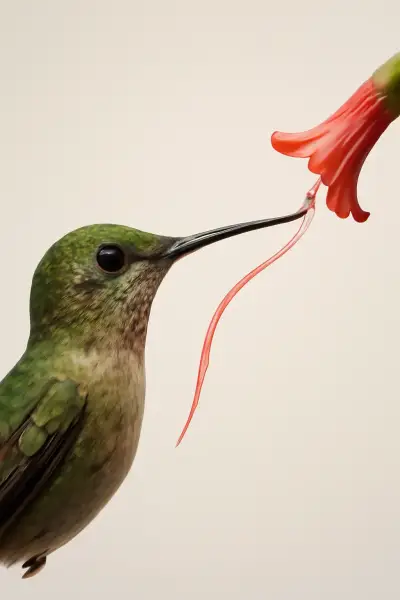
For a long time, the popular picture was “capillary action pulls nectar up a narrow tube.” But a hummingbird tongue is not a single tube. It has two grooves running along it, and the tip is split. The part people usually overlook is that the edges of those grooves can act like flexible flaps. When the tongue goes into nectar, those flaps can open and then close, changing the tongue’s cross-section without needing a big squeeze from the bird.
That matters because capillary flow in a rigid tube is slow for the kind of rapid lapping hummingbirds do. Their tongues can cycle in and out many times per second, and the geometry is changing each time. At this scale, shape is not a detail. It’s the main control knob for how much liquid gets captured per lick.
Small-scale fluid rules: surface tension dominates
At hummingbird scale, surface tension is a big deal. Gravity still exists, but the forces from the liquid’s surface can be comparable or larger over the tiny distances involved. That’s why droplets cling to a spoon and why thin films “stick” to surfaces. The tongue’s grooves present lots of edge and surface area. When the tongue touches nectar, the liquid wants to wet and wrap those edges, and that wetting can pull liquid into the groove quickly.
Viscosity also becomes obvious. Nectar isn’t always the same thickness. It varies by plant species, temperature, and concentration, and it’s not always clear what a given bird encounters minute to minute. Thicker nectar resists flow and changes how quickly a groove can fill. So the tongue has to work as a structure that can reliably load fluid even when the fluid properties shift.
Loading nectar by deformation and release
High-speed videos and close anatomical studies show an important sequence: when the tongue enters nectar, the grooves can flatten and open. Liquid rushes in. When the tongue leaves the nectar, the groove edges can spring back toward a more closed shape, trapping a column or ribbon of liquid inside. That’s less like sipping through a straw and more like a tiny elastic trap that resets every cycle.
The overlooked detail here is timing. The tongue doesn’t just “fill” and then “empty.” It fills during contact and then has to keep the load during the fraction of a second in air as the bird retracts the tongue into the beak. The tongue’s ability to hold liquid against shaking and airflow, even briefly, is part of the design problem. The beak then helps strip nectar off the tongue as it retracts, using contact and friction rather than suction alone.
What it suggests for tiny pumps and tiny channels
Hummingbird tongues are a reminder that at very small scales, the best “pump” might be a shape that flexes in the right way. Engineers working in microfluidics often struggle with moving liquids through microscopic channels without bulky pumps. A tongue-like groove that opens on contact and closes on release is a different strategy. It relies on surface tension and elastic deformation, not rotating parts.
It also underlines a constraint that shows up in labs as well as feeders: tiny channels clog, wet differently, and behave unpredictably if the surface is slightly rough or contaminated. A hummingbird is doing this while dealing with real nectar, pollen grains, and dust. The tongue still loads quickly. That suggests the geometry and materials are tuned to keep working even when the fluid and surfaces aren’t perfectly controlled.
Related reads
- An old statue began oozing oily residue in the heat
- A note tucked inside a wall shows up during renovations
- The invisible itch: why imagining an itch makes your skin crawl
- How underground rivers trigger sudden sinkholes in flat landscapes
- The algae that turns shorelines bright pink and how its bloom works
- When people reportedly burst into flame with no visible fire
If you liked this, you might also enjoy: