
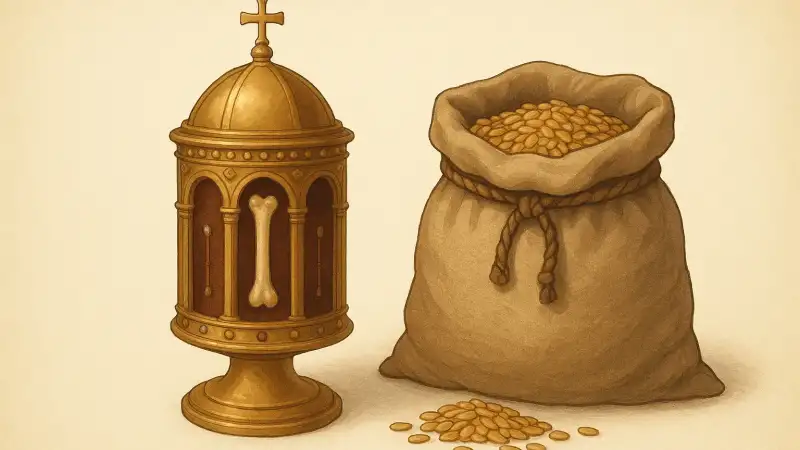
Food is bulky. Sacred objects aren’t. That simple mismatch sits under some of the strangest medieval “sales” you’ll ever read about. During a siege, a monastery might have valuables everyone recognized—relics, reliquaries, altar plate—but not enough grain to get through the next weeks. The trade could be brutally direct: hand over a saint’s bone, receive sacks of wheat. There isn’t one single famous, tidy case that survives with perfect paperwork. What we do have are patterns from places like besieged communities in the Low Countries during the Dutch Revolt and from French and German territories in the later Middle Ages, where churches pawned or surrendered treasures when supplies collapsed.
Why relics could function like emergency money
A relic was not just devotional. It was also a recognized store of value inside a Christian economy. People believed it carried status and protection. Pilgrims came to see it. Donations followed. That meant a relic could be turned into something else when the usual income streams failed.
Grain was the opposite kind of asset. It was life, but it spoiled, it attracted theft, and it was hard to transport in bulk when roads were watched. In a siege, you can’t easily “go earn” food. So monasteries reached for what they had that was portable and legible to buyers: objects that already had a price in people’s heads.
What “trading a relic” actually looked like
The exchange was often closer to pawning than selling. A reliquary might be deposited with a town council, a military commander, or a wealthy merchant in return for grain pulled from civic stores. Sometimes the paperwork framed it as a loan against collateral, because outright sale of holy goods sat uneasily with canon law and local custom.
One overlooked detail is how often the container mattered as much as the relic. Gold, silver, and gems in a reliquary could be weighed and priced quickly. The bone inside carried a different kind of value, but the metalwork was the part that could be melted tomorrow if the “loan” was never repaid. That practical option is part of why these deals could happen under pressure.
Who would accept the bargain during a siege
Inside a besieged town, the likely counterparty was a civic authority managing rationing. A monastery could leverage its treasure to access the grain that was being guarded for soldiers and civilians. The monastery gained calories. The town gained metal, prestige, and a hostage-like guarantee that the religious house would remain cooperative.
Outside the walls, the dynamic could flip. An attacker who controlled surrounding mills and fields might accept church treasure in exchange for letting carts through. Not every commander would risk the political backlash of being seen to starve nuns or monks. A controlled “sale” of food could be framed as orderly, even merciful, while still weakening the defenders.
The moral and legal discomfort was part of the negotiation
Relics were supposed to be kept, venerated, and protected. Turning them into bargaining chips created real anxiety. That tension sometimes made the deal more formal, not less. Monasteries and buyers wanted witnesses, inventories, seals, and written promises of return, because everyone knew they were stepping into a gray zone.
It also explains why the record can be thin or euphemistic. A chronicle might say “the treasure was pledged” or “the house was forced to part with ornaments,” without spelling out that grain was the immediate payoff. And in later recounting, communities had an incentive to present the choice as necessity, not preference, especially if the relic never came back.
What changed afterward, even if the abbey survived
If the relic was redeemed, it might return with a new story attached: how it “saved” the community, how it endured indignity, how it was recovered. If it wasn’t redeemed, the loss could permanently alter the abbey’s standing. Relics anchored pilgrimage traffic. Without them, a monastery could become quieter and poorer even in peacetime.
There’s another small, practical aftermath people miss. Once a reliquary has been weighed, listed, and priced during a crisis, it becomes easier to treat the rest of the church’s objects the same way. In later emergencies—another bad harvest, another levy, another siege—the mental barrier is lower. The treasury stops being untouchable and starts looking like reserves.

Related reads
- A neighborhood that replaced street names with emoji for a month
- Why familiar places trigger sudden vivid memories
- How hammerhead sharks detect electric fields
- How three lighthouse keepers vanished from a Scottish isle in 1900
- The 17th-century Ottoman court that negotiated with a nonexistent envoy
- An apartment block where every mirror vanished overnight