

Seeing a whole riverbank blink at once
If you stand near a mangrove-lined river in Malaysia, especially around Kuala Selangor, you can sometimes watch fireflies flash in a way that looks coordinated across whole trees. It isn’t one famous “firefly town,” and it doesn’t happen with every species. Synchronized displays are reported in parts of Southeast Asia, including Thailand and Indonesia, and also in a well-known U.S. case in Great Smoky Mountains National Park. The core mechanism is simple but weird: each insect has its own internal rhythm, and the flashes they see from neighbors nudge that rhythm forward or back until groups line up.
Not all fireflies can do it
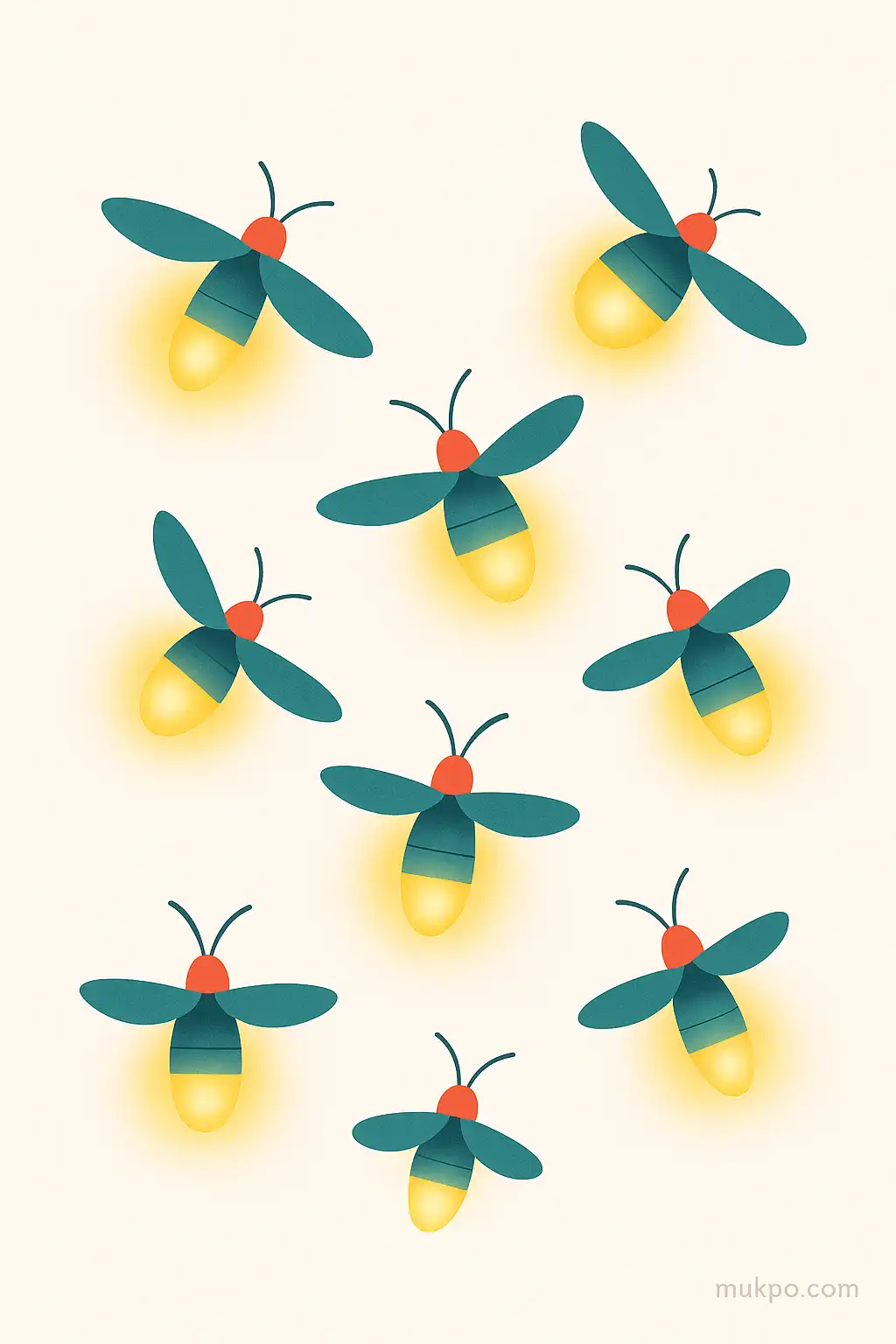
Fireflies are a big family with lots of signaling styles. Some species produce isolated, personal “advertising” flashes while flying. Others gather and display in dense groups. Synchrony is mostly associated with certain Pteroptyx species in Southeast Asia and Photinus carolinus in the Smokies, but the exact species involved can vary by location and the reports are not uniform everywhere.
The overlooked detail is that the group pattern is built from individual timing rules, not from a shared “group mind.” A male typically has a repeat interval—flash, wait, flash again. That interval is flexible. When he sees another flash at the right moment, he adjusts the timing of his next one. No single firefly is in charge, and no one needs to keep a count.
The physics idea: coupled oscillators
In physics terms, each firefly is an oscillator: a system that repeats a cycle. The flash is a visible marker for a particular point in that cycle. When oscillators influence each other, they become “coupled.” The coupling here is visual. A neighbor’s flash is a brief signal that shifts the timing of your own cycle. If the coupling is strong enough, the group falls into step.
This is the same kind of math used for other synchronization problems: metronomes on a shared surface, arrays of lasers, even simplified models of heart cells that need to beat together. The details differ, but the logic is similar. If you keep making small timing corrections based on what you detect, the spread in rhythms shrinks, and a common tempo can emerge.
Why synchrony comes and goes
Even in places known for it, synchrony is not guaranteed on any given night. The insects need to be close enough to see one another, and there need to be enough of them for the visual “pull” to matter. If the group thins out, the coupling weakens and the timing drifts. Obstacles matter too. Leaves, trunks, and bends in a riverbank can block lines of sight and break one coordinated cluster into several.
There’s also a speed limit set by biology. A firefly cannot flash continuously. It needs time to reset the chemistry that produces light, and that sets a minimum spacing between flashes. If you imagine each insect as a clock that can be nudged, it’s a clock with constraints: it can shift its next tick, but only within a workable range.
How a brief flash can move a “clock”
The nudge works because the flash is tied to a real internal cycle. A firefly’s light comes from a chemical reaction involving luciferin, the enzyme luciferase, and oxygen, powered by cellular energy. The nervous system controls when oxygen reaches the light-producing cells, which turns the light on and off in sharp pulses. That on-off control gives the insect a clean timing signal it can align with what it sees.
One specific thing people tend to miss is that “together” can mean different patterns. Some groups converge on near-perfect unison flashes. Others form waves where clusters lock together with a small delay, so the timing moves across the trees. From the outside it can look like one coordinated performance, but the underlying rule is still local: each firefly is reacting to whichever flashes it can actually see in that moment.
Related reads
- How desert varnish forms on sun-baked rocks
- Why hummingbird wings create tiny vortices that aid hovering
- A street whose lawns rearrange their stripes overnight
- How seawater ice traps air bubbles that record ancient storms
- A vending machine that always ejects a single antique spoon
- How your nose adapts so you can’t smell your own perfume