
A war that started as pest control
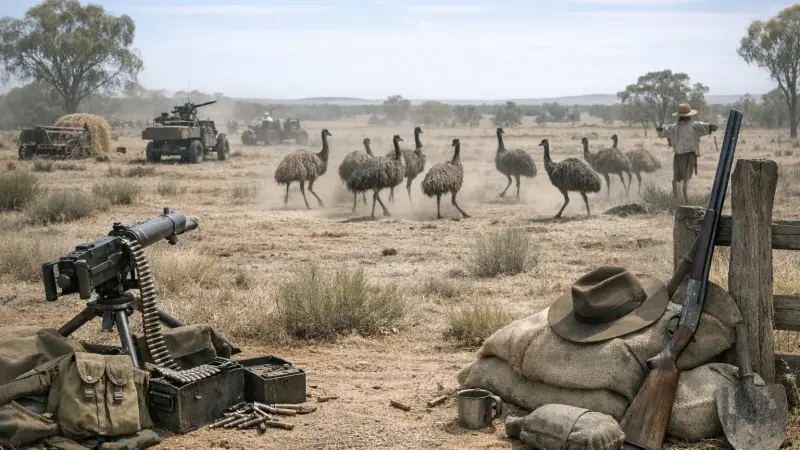
It’s odd how quickly a normal job can turn into a story that sounds made up. In late 1932, around the wheatbelt near Campion and Walgoolan in Western Australia, farmers asked the government for help with emus tearing through crops. The response wasn’t traps or bounties. It was soldiers. Men from the Australian Army brought Lewis machine guns and trucks, aiming to thin out large flocks moving through newly cleared farmland. It became known as the “Emu War,” partly because it looked like a military operation and partly because it didn’t go the way people expected.
Why emus were suddenly a farm problem

The emus weren’t “invading” in the way the headlines later implied. They were following seasonal patterns, looking for food and water after breeding, and the new agricultural landscape happened to provide both. Wheat farms created long, edible corridors. Dams and troughs provided reliable water in places that used to be harsher. When thousands of birds move the same way at the same time, even a small amount of damage per bird becomes a big number on a farmer’s ledger.
There was also a human pressure point that doesn’t always get mentioned. Many of the affected farmers were struggling in the Depression and some were returned soldiers on settlement blocks. Losing a crop wasn’t just annoying; it could be ruinous. That helps explain why the request escalated so quickly from “we need help” to “send the army.”
Machine guns meet a moving target
On paper, machine guns versus large birds sounds lopsided. On the ground, it wasn’t. Emus don’t bunch up neatly for long, and they don’t freeze when they hear shooting. They scatter, split, and keep running. The country there is open in places, but it’s not a billiard table. Low rises, scrub, and uneven ground break lines of sight. A gun team needs time, a stable position, and predictable movement. A flock that turns into five smaller groups takes those advantages away fast.
One detail people often overlook is how much of this depended on vehicles. Trucks were used to try to chase flocks and get guns into range. But early 1930s vehicles struggled off-road, and emus can run fast over rough ground. That gap mattered. If the truck can’t keep pace or can’t get close without bogging, the gun is basically anchored while the birds aren’t.
Why the “birds won” became the story
The idea that emus “defeated” the military is mostly shorthand for something more mundane: the operation didn’t achieve what was hoped for, and it became a public-relations mess. Reports at the time and later retellings vary on exact tallies, but the broad shape is consistent. A lot of ammunition was used. The number of emus killed was far lower than people expected from that amount of firepower. And the surviving birds kept moving through the same farming districts, so the immediate pressure didn’t lift in a satisfying way.
It also didn’t help that the job looked ridiculous from the outside. Soldiers firing at wildlife reads differently than soldiers training or defending territory. Newspapers could frame it as incompetence or farce, depending on their angle. Once that tone set in, every misfire, breakdown, or escaped flock landed as a punchline. The “win” wasn’t a triumphant emu strategy. It was the mismatch between expectations and reality.
What people did instead when the shooting stopped
When the military effort ended, the problem didn’t disappear. It shifted back into the usual, less cinematic tools of agriculture and wildlife management. Fences became a bigger part of the conversation, because they don’t require perfect timing the way a gun ambush does. Bounty schemes and coordinated culling efforts were also part of the wider history of how farmers and governments tried to limit damage, with results that tended to depend on funding, terrain, and how many people participated.
And the emus kept doing what they were always doing: moving with seasons and resources, crossing property lines that meant a lot to people and nothing to a bird. That’s the quiet engine under the whole episode. A modern state showed up with military hardware, but the situation was still a fast animal, open country, and a crop that can’t run away.

Related reads
- Why hearing your name in a crowd grabs your attention
- How a small change in posture instantly shifts confidence
- The shiver from a song: what causes musical goosebumps
- When a group all remembers the same detail that never happened
- Why your handwriting tightens when stress creeps in
- How snails rebuild cracked shells from the inside