
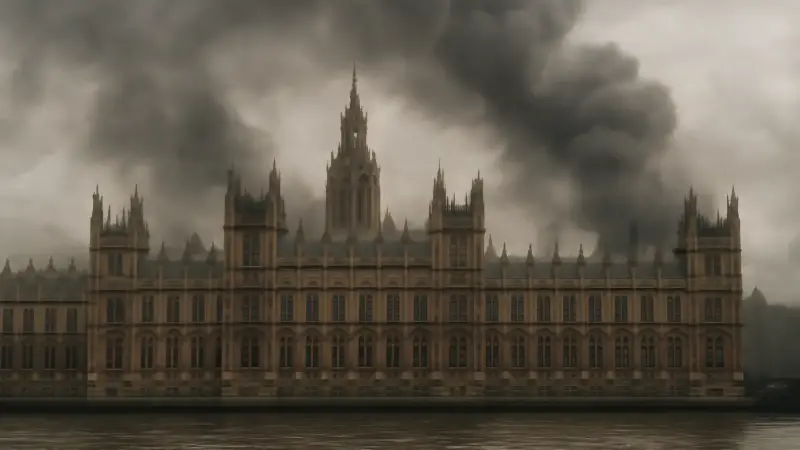
Why a river can shut down a government
People think of bad smells as a private problem. Something you endure on a street and then escape by turning a corner. In the summer of 1858, London couldn’t turn a corner. The River Thames itself became the source, and the smell pushed into everything near it, including the Palace of Westminster. Members of Parliament tried to keep working, but the building sat right on the river. The heat sped up decay. The wind carried it indoors. At a certain point, debate and procedure don’t matter much if the air makes you gag before you can sit down.
What made the Thames smell so intense in 1858
London had grown fast, and its waste handling hadn’t kept up. Large amounts of human sewage were being flushed into the Thames, along with industrial effluent from riverside businesses and runoff from crowded streets. Older assumptions had treated moving water as a kind of automatic cleanser. But by the mid-19th century, the Thames through central London was effectively a slow, tidal channel. That meant the same filth could slosh back and forth rather than being carried away.
A detail people overlook is how much the tide mattered to what MPs smelled. Twice a day, the tide could rework the same polluted water along the embankments near Westminster. It wasn’t just “downstream.” It returned. Add a hot spell, and the river exposed mud and rotting deposits along the banks. The worst air came from those shallows, not only from the middle of the channel.

What it was like inside Parliament
The problem wasn’t abstract. The Palace of Westminster drew air from the river side and sat close to the water. Contemporary accounts describe efforts to block the smell with heavy curtains and cloths soaked in disinfectants like chloride of lime. Windows were shut even in summer. That made the rooms hotter, which only made the air feel thicker. It’s the sort of feedback loop that turns “unpleasant” into “unworkable.”
At moments, MPs and staff tried to avoid the worst areas or shorten sittings. The phrase “fled” gets used because normal routines broke down. It wasn’t a formal evacuation with a single order and a timestamp. It was more like a building becoming hostile. The river dictated where people could stand, how long they could stay, and whether they could concentrate.
The public health theory that shaped the response
Mid-Victorian Britain still leaned heavily on the idea that “miasma” caused disease. Bad air was treated as a direct health threat, not just a warning sign. Even though cholera is waterborne, many decision-makers focused on smells as a primary danger. That mattered because the stench created political urgency. You didn’t need to understand microbes to believe something had to be fixed immediately.
This is one reason the episode had such force: it hit elites and ordinary residents at the same time, in the same sensory way. Working-class districts had dealt with foul conditions for years, but the river’s smell didn’t stay politely separated by neighborhood. When it invaded Parliament, it became harder to treat sanitation as a distant issue affecting someone else.
How the stink turned into brick, mortar, and new sewers
London already had sewage debates and partial reforms before 1858, but this crisis helped break the stalemate. The Metropolitan Board of Works, with engineer Joseph Bazalgette, pushed forward a massive system of intercepting sewers. The basic idea was simple: stop dumping waste into the central Thames. Carry it east, away from the dense core, using large underground tunnels and pumping stations.
It wasn’t a quick fix. The building sites were enormous, disruptive, and expensive. New embankments also reshaped parts of the river edge, which changed how London moved and looked. But the mechanism that forced action stayed very old-fashioned: the city’s waste had become impossible to ignore because it announced itself through the air, right where the country’s laws were being made.

Related reads
- Why awkward silences feel physically uncomfortable
- How a beetle survives being frozen by turning its blood into antifreeze
- A town that kept changing clocks so shops never opened the same hour
- What hummingbird tongues reveal about fluid dynamics at tiny scales
- An old statue began oozing oily residue in the heat
- A note tucked inside a wall shows up during renovations
If you liked this, you might also enjoy: