
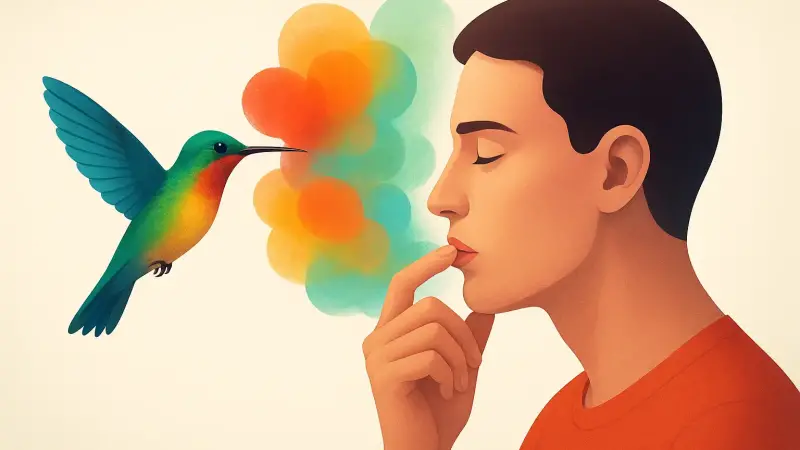
When a color suddenly makes you want something
You’re walking past a fast-food place and you catch a block of bright red and yellow. You weren’t hungry. Then, oddly, you are. This isn’t one single “town story” or a one-off event. It’s the kind of thing people report with brand colors in the U.S., Japan, and the U.K., and it varies a lot by person. The core mechanism is simple: the brain learns to link a visual cue with a reward. Later, that cue can pull up expectation, bodily readiness, and the urge to get the thing—sometimes before you’ve even consciously named what you saw.
How the brain learns color as a food cue
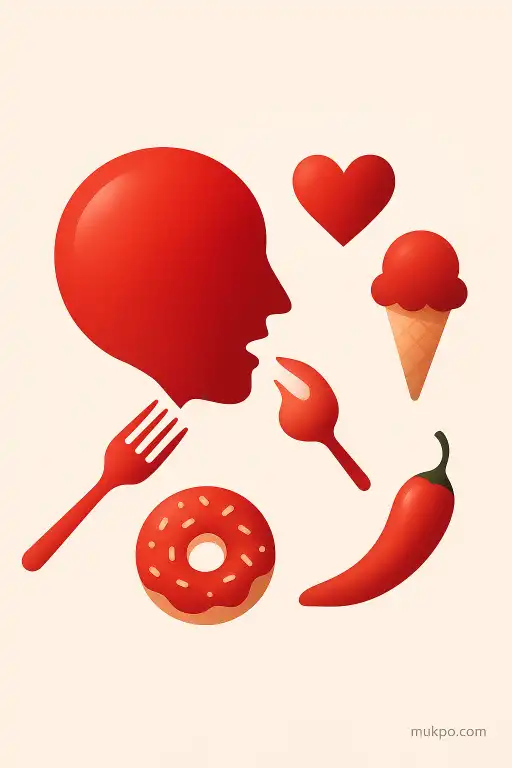
Color is one of the fastest features the visual system extracts. It’s “cheap” for the brain to notice from far away, in peripheral vision, or in low detail. When a color reliably appears around a specific food experience—packaging, storefront signs, app icons, a bowl on the counter—the association gets built through ordinary learning. The cue predicts the reward. That prediction matters because it can start the reward system ahead of the first bite, not after.
Over time, the cue doesn’t stay neutral. It can pick up emotional tone and urgency. A person might not think “that’s the snack brand,” yet still feel a pull. That split happens because some of the processing is automatic. The conscious label comes later, if it comes at all.
Why the craving can feel physical and immediate
A craving can show up as a body shift: salivation, a slight stomach “drop,” or a sudden sense that eating would feel relieving. That’s partly because predictive cues can recruit the same systems involved in preparing to eat. When the brain expects sugar, fat, or salt, it can nudge attention and motivation in that direction. The feeling doesn’t need hunger as a trigger. It needs expectation.
One detail people usually overlook is timing. The cue often hits before deliberate thought. It can happen while you’re still deciding what you’re looking at, or while the color is only in the corner of your vision. That early timing is why the urge can feel like it “came out of nowhere,” even though it followed a stimulus.
Context matters more than the color itself
There’s nothing magical about red, green, or any other hue on its own. The link depends on a person’s history and the setting. The same green that makes one person think of a mint candy might make someone else think of a salad they avoid. Even within the same culture, the learned pairings differ by household routines, favorite brands, and what was available growing up.
The situation also changes the strength of the response. A color on a billboard while driving might do little. The same color on a snack wrapper while you’re tired, stressed, or already slightly hungry can hit harder. The cue is meeting a brain that’s already more sensitive to reward, so the prediction lands with more force.
Why some people get hit harder than others
People differ in how strongly they react to cues in general. Some brains are more “cue-reactive,” meaning signals that predict reward grab attention quickly and feel motivating. Past dieting, irregular eating schedules, or repeated cycles of restriction and reward can also make cues more potent, because the predicted payoff carries extra weight. None of this is visible from the outside, so it can look random when it isn’t.
There’s also plain exposure. If a person sees a specific color scheme hundreds of times paired with a sweet drink—on an app, in a fridge, at a checkout line—the association gets rehearsed. Then one day the color shows up in an unrelated place, like a flyer or a piece of clothing, and it still pulls the memory and the urge along with it.
Related reads
- Why your hands pick up complex skills before you can explain how
- The lake that turns bright pink for just a few days each year
- Why coral polyps expel algae during warming
- How subtle timing makes or breaks a joke
- The split-second familiarity that tricks you into thinking you know someone
- Why a new password can vanish from memory by bedtime