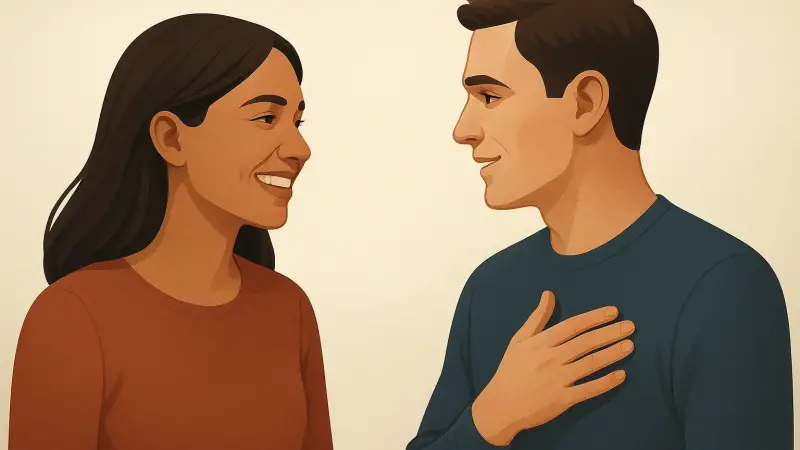
A smile flips a fast “safe or not” switch
It’s not one single place or event. You can see it on a New York City subway platform, in a London corner shop, or at a Tokyo train station. A stranger glances up, gives a quick smile, and the air changes. People stop bracing so hard. They stand a little closer. They share a few words they wouldn’t have offered a second earlier. The mechanism is plain: a smile reads like “I’m not a threat” before the brain has time to do a careful evaluation. It’s a shortcut, and it often works because it’s built into how humans read faces at speed.
Faces are processed faster than almost anything else
Humans are tuned to pick up facial signals quickly. The visual system doesn’t treat a face like a normal object. It pulls it forward in attention and starts extracting meaning immediately: mood, direction of gaze, intent. A smile is especially loud in that system because it is a clear configuration change around the mouth and eyes. Even when the smile is small, the brain can treat it as a low-cost promise of friendly intent and reduce “watchfulness” for a moment.
That doesn’t mean the judgment is accurate. People can smile while stressed, masking irritation, or performing politeness. But the early stage of processing doesn’t wait for context. It runs on pattern recognition. If the face matches “friendly,” the body often follows with a small drop in tension before any conscious thought catches up.
Smiles act like social proof in miniature
A stranger’s smile also hints that the situation is normal. Social settings are full of ambiguity, and people often scan others for cues about how worried to be. A relaxed expression can work like a tiny endorsement: the person looks unalarmed, so maybe there isn’t a reason to be on high alert. This is part of why a single friendly face can change the feel of a quiet hallway or an empty bus stop.
There’s a second layer: reciprocity. When someone smiles, many people reflexively mirror it, sometimes so subtly they don’t notice. That tiny muscular shift feeds back into emotion systems. It can soften the internal “threat posture” and make neutral details seem a bit more benign. The guard doesn’t drop because the situation has been verified. It drops because the body has already started acting like it’s safe.
What people overlook: the eyes and the timing matter
One detail people miss is that the eyes do a lot of the work. A mouth-only smile can read as polite, scripted, or even suspicious depending on context. A smile that engages the muscles around the eyes tends to be read as warmer. The timing matters too. A smile that arrives right after brief eye contact often feels like an acknowledgment. One that appears before any shared moment can feel like a sales move or a bid for attention, which doesn’t lower anyone’s guard in the same way.
Context changes the reading. In some cultures and situations, smiling at strangers is normal. In others it’s unusual, and unusual signals can raise alertness. Even within the same city, a commuter crowd at 8 a.m. may treat a grin differently than a line at a weekend market. The same facial expression can be processed as warmth, awkwardness, flirting, or a request, depending on what else is happening.
Lowered guard shows up as small behavioral shifts
When that “safe enough” signal lands, it shows up in tiny changes. People angle their bodies less defensively. Their voices soften. They stop clutching their phone so hard. They may offer information they normally keep tight, like where they’re headed, which stop they’re getting off at, or that they’re new to the area. In a simple situational example, someone struggling with a stroller at a station may accept help more readily after a brief friendly smile, even if the helper is still a stranger.
The shift is often so small it feels like nothing happened. That’s part of why it works. It doesn’t demand a decision. It just nudges the default setting from “hold back” to “maybe okay,” and conversation and cooperation become easier to start from there.