
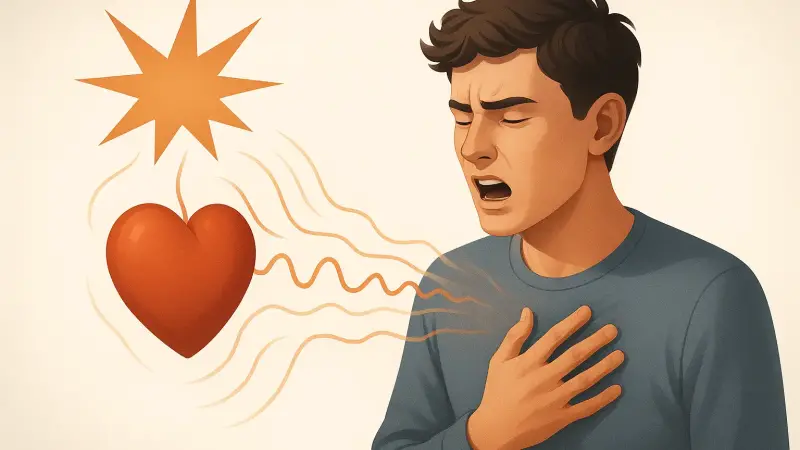
You can be calm, even happy, and still flinch hard when something bangs. A car door slams in a quiet parking garage. A balloon pops at a kid’s party. Someone drops a metal pan in the sink. This isn’t tied to one single event or place. It shows up after all kinds of “danger is over” situations, including after car crashes, after combat deployments, and after living through earthquakes or serious storms. The core mechanism is simple: the brain keeps a fast alarm system online because sudden sound is a reliable sign of trouble, and that system learns from earlier moments when being slow mattered. Even when life looks safe, that shortcut can keep firing.
The startle reflex is built to beat your thinking brain
A sudden noise can trigger the startle reflex before you’ve identified what the noise even was. That reflex runs through fast brainstem pathways that don’t wait for careful interpretation. It snaps the body into a protective posture, tightens muscles, and kicks the heart rate up. The jumpy feeling is often the cardiovascular system reacting to a burst of sympathetic activity, not a considered “I’m scared” judgment.
One overlooked detail is timing. People often assume they reacted after they recognized the sound. In reality, the first bodily jolt can happen in fractions of a second, and the label you give it (“That was just the door”) comes later. That mismatch is why it can feel confusing or embarrassing. Your body already moved before your story about the moment caught up.
Your brain stores “fast rules” about danger, not just memories
After a real threat, the brain doesn’t only save a narrative memory. It also updates prediction systems. The amygdala and related circuits become quicker to flag patterns that once preceded danger, including sharp, percussive sounds. Those patterns are crude on purpose. “Loud and sudden” is enough. The point is to interrupt what you’re doing and buy time.
This is why the reaction can persist even when someone knows, logically, that they’re safe. The “knowing” sits in slower cortical networks. The fast rule sits lower and fires automatically. It can also generalize. If a crash involved shattering glass and a slammed door has a similar acoustic punch, the alarm system may treat them as close relatives, even if the situations are unrelated.
Stress hormones change the threshold for weeks or longer
Threat doesn’t just leave a memory. It can leave the body in a different baseline state. After chronic stress or trauma, the stress-response system can stay more easily activated. Adrenaline and noradrenaline are part of the immediate jump, but longer-running systems like cortisol can shape how sensitive the alarm network remains. Exactly how long this lasts varies a lot by person and context, and it isn’t always clear where “normal recovery” ends and a more persistent pattern begins.
Sleep is an easy-to-miss part of this. Fragmented sleep makes the brain worse at filtering input and better at overreacting. In practical terms, someone can be “past” the event but still physiologically under-recovered. Then a sharp noise hits a system that’s already closer to the edge, and the heart jump feels disproportionate to the moment.
Sound is a special trigger because you can’t look away from it
Vision is selective. You can avert your eyes, focus on one point, or miss what’s in the periphery. Hearing is different. It’s always on, works in the dark, and covers 360 degrees. Sudden sound is also hard to predict because it arrives without a visible lead-up. That makes it a powerful input for an alarm system designed to catch ambush-style problems.
Acoustics matter more than people expect. A single “harmless” noise can hit harder in certain spaces. Parking garages, stairwells, kitchens with tile, and empty hallways amplify sharp sounds and add echo, which makes the brain’s quick-and-dirty source detection less certain. Uncertainty itself pushes threat circuits. If the brain can’t immediately place the sound, it tends to treat it as more important.
The body learns the reaction as a sequence, and it can replay it
Once the startle response happens, the body often runs a familiar chain: jolt, breath change, heart thump, scanning, then a gradual return. That chain can become a practiced routine. Not because someone chooses it, but because repeated pairings strengthen the pathway. Over time, the trigger can shrink. The noise doesn’t need to be as loud as the original danger sound. It just needs the right shape: a sharp onset, a certain pitch range, a particular reverberation.
Even after the mind recognizes safety, the heart may still take a moment to settle because the autonomic system doesn’t switch states instantly. The “all clear” signal is slower than the “something happened” signal. That lag is part of why people can stand there feeling fine and still notice their pulse racing, as if the body hasn’t gotten the update yet.
Related reads
- Why car tires squeal on hot asphalt from rubber chemistry
- How the Donner Party’s 1846 winter stranded a wagon train and forced unimaginable choices
- How some fungi collapse their caps to launch spores like tiny cannons
- A cafe that serves drinks in jars mailed from other countries
- How a small favor can quickly change someone’s impression of you
- The town where every street sign is painted by a stranger overnight