
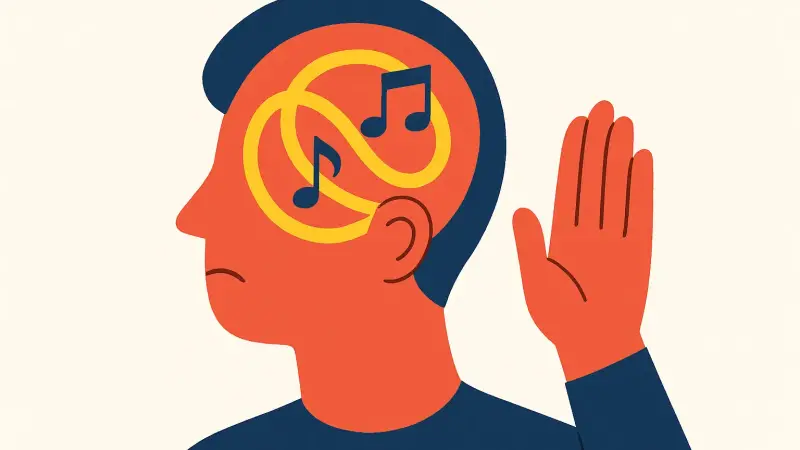
A normal moment, then the loop starts
You hear a few seconds of a song and it keeps replaying. It can happen after a café playlist, a TikTok clip, or a sports arena chant. There isn’t one single place or event behind it, and people report it across the U.S., the U.K., Japan, and basically anywhere music shows up in public life. The core mechanism is that the brain is good at predicting patterns and finishing what it started. A short musical phrase is an ideal target. It has structure, timing, and repetition built in, so it’s easy for the mind to “complete” it even when the sound is gone.
Why the brain keeps “rehearsing” music

When a tune loops, it’s usually using the same systems that support working memory. That’s the short-term mental space used for holding a phone number long enough to dial it, or keeping the start of a sentence in mind while finishing the end. Music fits that space well because it’s chunked into beats and phrases. Once a fragment gets loaded, the brain can run it again without much effort. That re-run can feel automatic, like a reflex, because it’s tied to prediction and timing rather than conscious decision-making.
A detail people often overlook is how small the trigger can be. It’s often not the chorus. It’s a 2–5 second hook, a rhythmic pattern, or even a single lyrical line with a strong stress pattern. If the snippet ends abruptly—like a clip that cuts off mid-phrase—the mind has a stronger reason to keep it active, because it never got a clean “ending” signal.
Catchy songs are built like good memory traps
Some tunes are simply engineered to be easy to replay. Repetition is the obvious part, but predictability matters too. A melody that mostly moves in small steps, lands on expected notes, and sits in a comfortable vocal range is easier for the brain to simulate. Clear rhythm helps as well. If you can tap it without thinking, your timing system can drive the loop with very little input.
Lyrics can strengthen the effect, but they don’t have to. A nonsense syllable, a brand jingle, or a chant can loop just as hard because the “sticky” part is often the contour and rhythm. Production choices contribute too. A bright, sharp sound or a very clean drum pattern is easier to pick out from background noise, which makes it more likely that the brain encoded it strongly in the first place.
Attention, emotion, and the timing of exposure
Whether a loop starts often depends on what else is going on. If attention is split—walking through a grocery store, answering messages, waiting at a gate—the brain may only register fragments. Those fragments can be the perfect size for a loop. The mind grabbed the hook but didn’t build a full “track” of the whole song, so the same bit keeps resurfacing.
Emotion and context matter too, even when the emotion is mild. A tune heard during a slightly stressful moment can become more persistent because the brain tags the moment as important. Excitement can do it as well. And sheer repetition counts: hearing the same snippet several times in a day, especially from short-form video, increases the odds that the hook becomes the default thing the brain plays when there’s a spare second.
When the loop is harmless, and when it isn’t
For most people, a looping tune is a normal byproduct of memory and prediction. It can show up more during fatigue, low-level stress, or boredom, because the brain has more idle cycles to fill. It also tends to be more common with recent exposure, which is why a catchy song heard once in the morning can still be running during an evening commute.
But the experience isn’t always neutral. Some people find the repetition intrusive, especially if it interferes with sleep or concentration. It can overlap with other kinds of repetitive mental content, like worry loops, and that’s one reason it can feel hard to “switch off.” The tune itself isn’t usually the problem. It’s the way the brain replays familiar patterns when attention is stretched and the mind keeps reaching for something simple, timed, and already learned.

Related reads
- How bioluminescent fungi light up forest floors
- Where microplastics go when dust lifts off the ocean
- Why some sands fluoresce under UV light
- The Renaissance codex that baffled royal libraries — the Voynich Manuscript’s mysterious path
- The night massive brewery vats burst and flooded a Victorian London neighborhood with beer
- An elevator that stops on unmarked floors and leaves sticky notes