
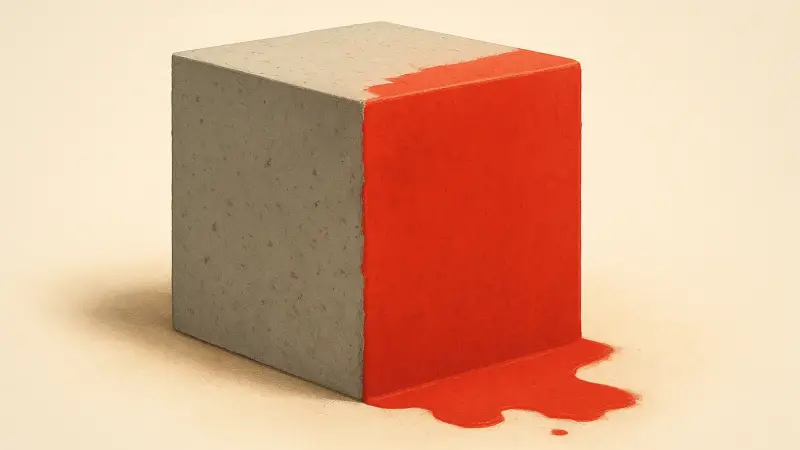
After a big storm, people sometimes step outside and swear the whole street “got repainted.” Siding that used to look mismatched suddenly matches. Old fences look like they were dipped in the same color. This isn’t one famous incident with one town. It pops up after storms in lots of places with wind-driven rain, including coastal Florida neighborhoods, parts of the UK during Atlantic systems, and hillside cities like San Francisco where fog and storms both play a role. The usual mechanism is simple: water changes how light moves through dirt, chalking, and porous paint. It also redistributes grime. For a day or two, surfaces can converge toward the same tone.
Wet surfaces lie to your eyes
The fastest version is pure optics. Many exterior paints are slightly porous and full of tiny air pockets, especially older matte finishes. When dry, those air pockets scatter light and make colors look lighter and “chalkier.” When rain soaks in, water replaces air. Water has a refractive index closer to the paint binder, so less light scatters back out. Colors look deeper and more uniform, and small differences between “almost the same” paints get harder to see.
A detail people usually overlook is viewing angle. After a storm, surfaces often stay damp in a gradient: the top dries first, shaded sides stay wet, and near-ground areas stay wet longest. If you’re looking down a block at the same time of day, you might be catching a whole row of façades at a similar wetness level. That alone can make them appear like they share the same paint, even if they don’t.
Storm water doesn’t clean evenly

Rain rarely washes a house the way a hose does. Wind pushes sheets of water hard against some faces and barely touches others. Overhangs and porch roofs shield bands of siding. Splashback from sidewalks and soil hits the bottom few feet. So when a storm “cleans,” it creates new patterns. Sometimes those patterns reduce contrast between neighboring homes because the same layers of pollen, dust, and soot get thinned in similar ways.
The same storm can also do the opposite on a smaller scale: it can deposit grime. Water running off asphalt and roofs carries fine black particles and oily residues. If the neighborhood has the same kind of roofing and the same kind of street traffic, the runoff can stain fences and lower siding to a similar gray-brown. For a short window, everything trends toward the same muted tone.
Chalky paint can “re-wet” into a closer match
Older exterior paint often chalks. The binder breaks down under UV light and leaves a loose powder on the surface. That chalk layer lightens color and exaggerates differences between batches and brands. During a soaking storm, that powder can partially dissolve, smear, or compact. When it dries again, the surface can temporarily look smoother and darker, which makes neighboring surfaces look more alike than they did the week before.
Sometimes the effect is strongest on trim and railings that get handled and rubbed. Those areas already have less chalk and a slightly burnished finish. After heavy rain, the rest of the surface briefly “catches up” visually. People notice it as a sudden matching, even though it’s really a shift in gloss and surface texture rather than pigment.
Shared materials make the illusion spread block-wide
A whole block tends to be built from the same catalog. Same siding profile. Same primer. Same builder-grade paint line in a few “neighborhood” colors. Even if homeowners later repaint, many choose close matches, or paint only one face at a time. That means a storm doesn’t need to create a big change to make everything look aligned. It just needs to compress small differences that were already near each other.
There’s also a timing factor. After the first sunny day post-storm, the wettest surfaces are often the shaded ones—north-facing walls, the side of the street with more trees, the houses with deeper eaves. If most of the block shares the same orientation, they dry at roughly the same rate. That synchronized drying can make the “matching” feel neighborhood-wide instead of spotty.
Why it fades after a day or two
As walls dry, air returns into those tiny pores. Scattering comes back. The lighter, chalkier look returns. Dust begins settling again, and it doesn’t land evenly. Sun exposure starts re-separating surfaces by age and wear. The block drifts back to its familiar mix of “close but not quite” colors.
If the storm also loosened chalk or shifted grime, the after-look can change again with the next light rain. A quick shower might darken everything without moving much dirt. A long, windy storm might strip one façade and streak another. So the moment when a street seems to match can be real, visible, and brief, even though nobody actually opened a paint can.
Related reads
- The streetlight turned time capsule: decades of lost items stuck in its base
- How morning light recalibrates your mood and sleep
- A 1920s wallpaper hiding a modern grocery receipt and a century of secrets
- Why basalt columns form hexagons
- The museum gallery where labels kept switching between exhibits
- Why compliments stick: the brain’s unexpected bias