
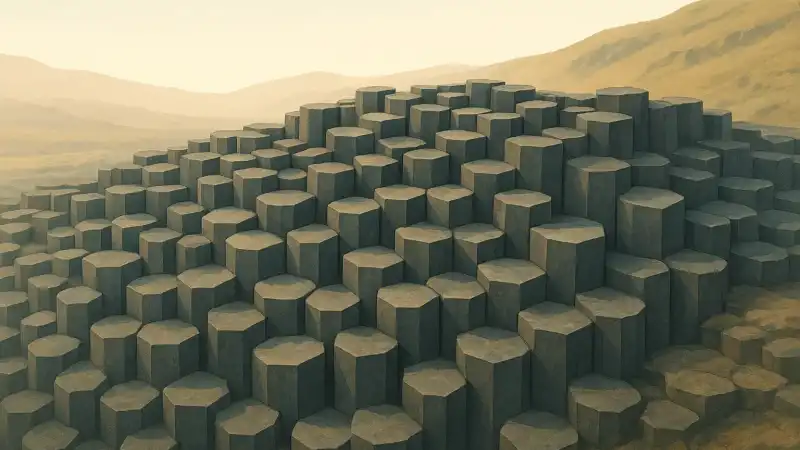
Not one place, but a repeating pattern
People notice the same strange neatness in very different landscapes. At Giant’s Causeway in Northern Ireland, at Fingal’s Cave in Scotland, and in the U.S. at Devils Postpile in California, cooled lava looks like it was cut into tidy blocks. The core mechanism is simple. Hot rock shrinks as it cools. Shrinking creates tension. When that tension gets too high, the rock cracks. The surprising part is that the cracking tends to organize itself into mostly hexagons, even though nothing is “measuring” the angles.
Cooling rock wants to shrink, but it can’t
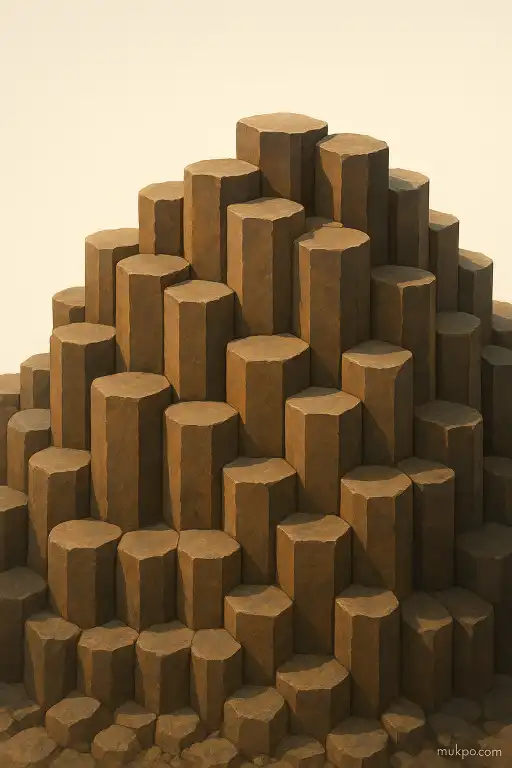
Basalt starts as a melt. As it loses heat, its volume drops. But a thick lava flow or a shallow intrusion can’t shrink freely, because neighboring rock is still hot, still bulky, and still in the way. That mismatch builds stress inside the cooling layer. Once the stress beats the strength of the rock, it fractures. This is the same basic reason mud cracks as it dries, just at much higher temperatures and with rock instead of clay.
The cracks don’t appear everywhere at once. They usually start at a cooling surface, like the top of a lava flow exposed to air or water, or the bottom where the flow sits against cooler ground. From there, the fracture network advances inward as the “cooling front” moves. That detail is easy to miss when looking at a finished cliff, but it matters because it controls the direction and regularity of the columns.
Hexagons are a natural way to share strain
Once cracking begins, each new crack changes the stress field around it. Cracks tend to grow where stress is highest, and they tend to space themselves out because an existing crack relieves stress nearby. Over time, that push-and-pull favors a layout where the distances between cracks are fairly even. If the spacing becomes roughly uniform, the shapes that fill the plane with minimal mismatch are limited. Hexagons are the common outcome because they tile efficiently while keeping edge lengths similar.
That doesn’t mean every column is a perfect six-sided pencil. Five- and seven-sided columns are common, and messy patches happen. What stays consistent is the tendency toward near-equal spacing between crack lines. The hexagon is a result of the system trying to distribute shrinking strain evenly, not a “preference” for the number six.
Columns grow as the cracking front steps downward
The “columns” are really the 3D result of a 2D crack pattern repeatedly copied as cooling progresses. As the rock below the surface reaches the right temperature range for brittle fracture, the existing cracks propagate downward (or upward), staying roughly aligned with the local direction of heat loss. That is why column axes are often close to perpendicular to the cooling surface. In a flat lava flow, they tend to be vertical. In a curved or irregular body, they can fan and bend.
A specific overlooked detail is the presence of little horizontal breaks along columns, sometimes called chisel marks. They form because the fracture front doesn’t move smoothly. It advances in small jumps. Each jump can leave a subtle step or ledge. On a hand sample it can look like the rock was worked, even though it’s just the physics of cracking keeping time with cooling.
Why some columns are huge and others are pencil-thin
Column width mostly tracks cooling rate. Faster cooling tends to produce more closely spaced cracks, which means thinner columns. Slower cooling gives the rock more time to relax between fracture events, so cracks space out and columns get wider. Conditions that change cooling—flow thickness, whether water was present, the temperature of the ground, even how long heat is retained—can all shift the final scale.
That’s why two basalt sites can look similar in pattern but different in size. The hexagon tendency is robust, but the details vary with the thermal history. In some places the columns also grade from one size to another within the same flow, reflecting a change in cooling conditions as the lava ponded, drained, or insulated itself over time.
Related reads
- The museum gallery where labels kept switching between exhibits
- Why compliments stick: the brain’s unexpected bias
- When a medieval abbey traded relics for grain to survive a siege
- A neighborhood that replaced street names with emoji for a month
- Why familiar places trigger sudden vivid memories
- How hammerhead sharks detect electric fields