
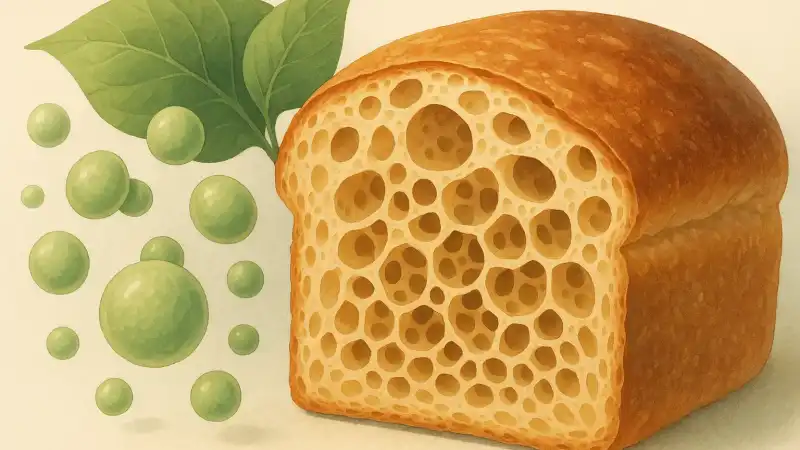
You slice into a loaf and there they are: little tunnels and round holes, sometimes even a lacy honeycomb. This isn’t one single local tradition. It shows up in airy ciabatta in Italy, open-crumb sourdough in San Francisco, and baguettes in France. The core mechanism is simple. Yeast makes gas while it eats sugars. That gas gets trapped inside dough, which is stretchy and sticky at the same time. As the dough warms and rises, those trapped pockets expand. Heat in the oven then fixes the shape. Some loaves end up tight and even. Others end up with big, irregular voids.
Yeast makes gas, but dough decides where it goes
Bread yeast metabolizes sugars and releases carbon dioxide and small amounts of other byproducts. The carbon dioxide is the part that inflates the dough. But the gas doesn’t automatically turn into neat bubbles everywhere. It gathers where it can. Tiny pockets form around flour particles, along smears of water, and in micro-gaps created during mixing. Dough is not a uniform gel. It is a crowded, uneven structure from the start.
Those first pockets matter because later growth tends to amplify what already exists. A spot with slightly less resistance becomes a spot where gas accumulates faster. Over time, you get fewer large bubbles instead of many tiny ones, or the opposite, depending on how the structure develops. Yeast supplies the pressure. The dough’s internal “terrain” steers it.
Gluten acts like a flexible net around each bubble

When flour and water mix, gluten-forming proteins link up into a network. That network can stretch without tearing, within limits. Each bubble is basically gas pushing outward while gluten and starch hold it in. If the network is strong and extensible, bubbles can grow larger before they rupture. If it’s weak or tight, bubbles stay small or pop, and gas escapes upward or out of the dough.
A specific detail people overlook is that gluten isn’t just “more or less.” It has two different traits that can pull against each other: elasticity (springing back) and extensibility (stretching out). A dough can be very elastic and still resist forming big open holes because it snaps back and squeezes bubbles smaller. Another dough can be less springy but more stretchable and end up with larger, uneven cavities.
Honeycomb holes come from bubble merging, not just bubble growth
Open, honeycomb-like crumb usually means bubbles didn’t stay isolated. They merged. As neighboring bubbles expand, the thin walls between them get stretched. Sometimes those walls thin until they break, and two bubbles become one larger bubble. This is why the holes can look connected and irregular, like a network rather than a set of separate balloons.
That merging is also why the biggest holes often sit next to tighter areas. Once a larger cavity forms, it can “steal” expansion from nearby zones because gas and stretch preferentially go to the easier space. So the crumb can look patchy: one big tunnel here, a cluster of medium holes there, then a denser strip where the structure resisted merging.
Fermentation time changes the dough’s ability to hold bubbles
While yeast is producing gas, enzymes are also quietly changing the dough. Some enzymes break starches into simpler sugars, feeding fermentation. Others gradually weaken parts of the gluten network. Over longer fermentation, the dough can become more extensible and more prone to bubble coalescence. That can encourage a more open interior, even if the same amount of gas is produced overall.
Acids also matter, especially in sourdough. As acidity rises, gluten behavior shifts, and the dough can hold gas differently. The exact effect varies with flour type and fermentation conditions, so it isn’t one predictable dial. But the general pattern is that time doesn’t just add more bubbles. It changes the walls around them.
The oven locks the pattern in place, and steam plays a quiet role
Right before and during the early bake, bubbles expand rapidly. Part of this is yeast activity continuing briefly, but a lot is physics: gases expand as they heat, and water turns to steam. Meanwhile, the dough is still soft enough to stretch, so the existing bubble pattern can inflate dramatically. Then starch gelatinizes and proteins set. At that point, the crumb stops moving and the holes become permanent.
One situational example is a loaf that looks modest in the proofing basket but springs open in the first minutes of baking. The crumb can end up with surprising internal voids because the oven phase amplified a few larger pockets that were already there. Steam is easy to miss because it’s invisible once absorbed, but it increases internal pressure and keeps the surface flexible a bit longer, which can allow those pockets to stretch instead of tearing early.

Related reads
- How glowworms choreograph light to catch flying insects
- The rock in a backyard that turned out to be a meteorite and what it revealed
- How touch-me-not plants fling seeds with a springy snap
- How gut microbes change after a course of antibiotics
- The bacteria discovered chewing plastic in ocean gyres
- How hummingbirds hover by twisting their wings