
A small contradiction you notice in photos
If you look at comet photos for long enough, one detail keeps nagging at you. The tail doesn’t trail behind like smoke behind a moving car. It points away from the Sun, even when the comet is leaving the inner solar system. That’s true for famous cases like Halley’s Comet, Comet NEOWISE in 2020, and Comet 67P/Churyumov–Gerasimenko that ESA’s Rosetta spacecraft orbited. There isn’t one single place or event tied to this. It’s a consistent pattern, and it happens because the Sun is actively pushing on material streaming off the comet.
The overlooked part is that a comet is not a tidy solid with a built-in “tail.” It’s constantly shedding gas and dust once sunlight warms it. That outflow would spread in all directions if nothing else acted on it. Near the Sun, two different solar forces grab that fresh material and sort it into tails that end up pointing anti-sunward.
The Sun is pushing, not the comet pulling

As a comet approaches the Sun, its ices heat up and release gas. That gas drags dust grains with it, forming a fuzzy atmosphere called the coma. Then the Sun’s radiation pressure starts to matter. Photons carry momentum, so sunlight can nudge small particles outward. It’s a gentle push, but it acts continuously and it always points away from the Sun.
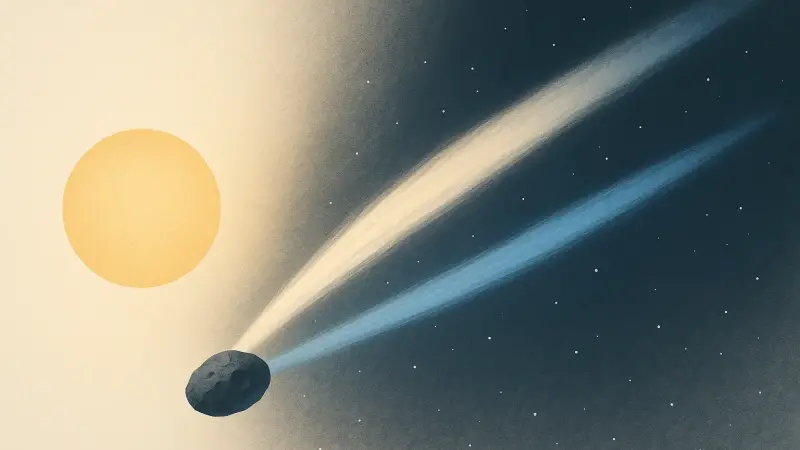
That’s why a dust tail tends to look broad and slightly curved. The dust particles still largely follow the comet’s orbital path at first, and then sunlight slowly blows them outward. Different grain sizes respond differently. Tiny grains get pushed more strongly than larger grains, so the dust tail can fan out instead of staying as a tight line.
There are usually two tails, and they behave differently
Many comets show a second, straighter tail that can look like a thin blue spike in images. That’s an ion (plasma) tail. It forms when ultraviolet light from the Sun and collisions with solar-wind particles ionize the comet’s gas. Once the gas becomes electrically charged, it stops behaving like drifting vapor and starts responding strongly to electromagnetic forces carried by the solar wind.
The ion tail aligns closely with the solar wind flow, which is outward from the Sun. It can point almost exactly in the anti-solar direction, even when the comet’s direction of travel is sideways or even “backward” relative to the tail. If you ever see a comet with a straight tail plus a curved one, you’re basically looking at two different kinds of material being pushed in two different ways.
Why the tail can swing fast, kink, or even “disconnect”
The solar wind isn’t steady. It varies with solar activity, and it carries changing magnetic fields. When those conditions shift, the ion tail can respond quickly. In some observations, the ion tail develops kinks or appears to snap and reform. These are called disconnection events, and they’re linked to changes in the solar wind and its embedded magnetic field sweeping past the comet.
This is one reason the “always away from the Sun” rule is a little messier in real life than in diagrams. The overall direction stays anti-solar, but the fine structure can look twisted, braided, or abruptly chopped. Dust tails change more slowly because dust grains aren’t locked to magnetic fields the way ions are.
What you’re seeing depends on geometry and the comet’s size mix
From Earth, the viewing angle matters. A tail that is truly pointing away from the Sun in space can look shortened, wider, or oddly offset when projected onto the sky. The apparent curve can also change as the comet moves and as Earth’s position changes. That can make it look like the tail is “behind” the comet in one photo and “to the side” in another, even if the physics hasn’t changed.
Comets also differ in what they shed. Some produce a lot of dust, which makes the curved dust tail dominate. Others show a more prominent ion tail. Near the Sun, a very small grain population can get pushed into a broad sheet, while larger grains stay closer to the orbit and brighten the coma instead of forming a long tail. So the direction is consistent, but the look varies with particle size, solar wind conditions, and the particular angle the observer happens to have that night.

Related reads
- How coral reefs time mass spawning with the moon
- Why pumice rafts let plants and insects colonize distant islands
- Why raindrops make different sounds on metal and wood
- The orchid that mimics a female moth down to the scent molecules
- How electric eels prevent self-shock while stacking thousands of volts
- The bacterium in subway tiles that glows under blue light