
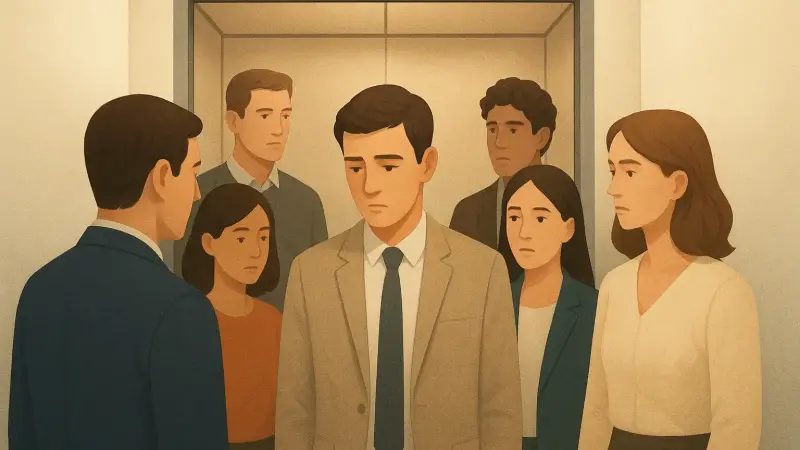
A familiar quiet that gets louder with every person
This isn’t about one specific building or city. It shows up in office towers in New York, apartment blocks in Seoul, and hospitals in London. Two people step into an elevator and silence can feel normal. Add four more, and the same silence starts to feel like a choice everyone is making at once. The core mechanism is simple: the more strangers share a tight space, the more each person’s “normal” behavior becomes something other people can judge. Suddenly even a neutral face, a throat clear, or where you look starts to feel like a message.
Elevators are tiny public rooms with no escape hatch
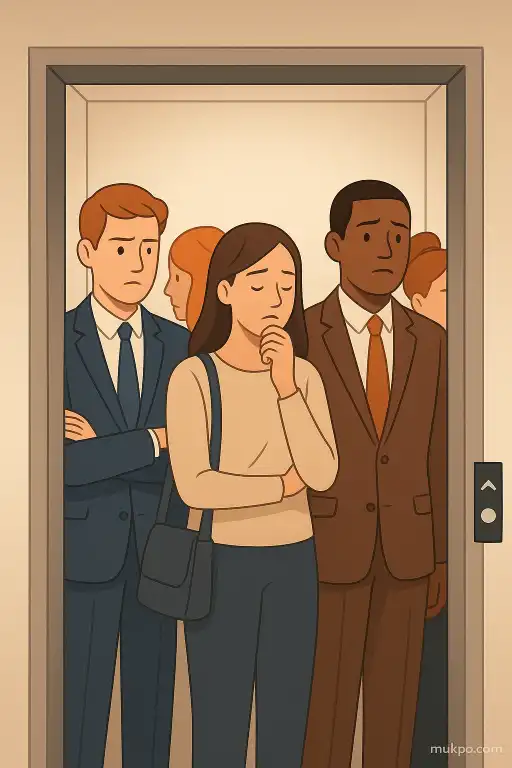
An elevator is public in the social sense, but private in the physical sense. People are close enough to hear breathing, phone vibrations, and fabric moving. Yet they’re expected to act like none of that is happening. As the crowd grows, the sense of being “on display” spikes because there’s no graceful way to step back, change position, or end an interaction. The doors won’t open just because a moment gets weird, so everyone becomes careful about starting anything they can’t neatly stop.
A concrete version: morning rush in an office building. Someone enters on the lobby level and realizes the elevator is already full, shoulder-to-shoulder. Nobody says “hi,” not because they’re unfriendly, but because any greeting could require a response from people who didn’t choose to join a conversation. The crowd makes even politeness feel like pressure.
Silence turns into coordination when there are more witnesses
With one or two other people, silence is just absence of speech. With a larger group, silence becomes a shared pattern that everyone is helping maintain. That flips a switch in the mind. Now a sound isn’t just a sound. It’s a disruption of a group agreement, even if nobody agreed out loud. The bigger the group, the more “witnesses” there are, and the more a small action can feel like it’s being evaluated.
This is why tiny noises can suddenly feel huge. A sniff, a zipper pull, a key jingle, a single word into a phone. Each one breaks the smooth surface the group is producing together. And because nobody can look away very far, the person who made the noise can feel briefly spotlighted, even if no one actually cares.
Where people put their eyes matters more than people admit
Eye behavior is one of the most overlooked details. In a crowded elevator there aren’t many “safe” places to look. Staring at another person is too direct. Staring at the floor can look like embarrassment. Staring at the door can look impatient. So people often choose the same targets: the floor indicator, the button panel, or an unfocused middle distance. As the crowd grows, these choices get more synchronized, which makes the silence feel more deliberate and more fragile.
The physical layout adds to it. People near the buttons become accidental operators. People facing outward get a different experience than people turned sideways. And when the car is packed, even micro-movements—shifting weight, adjusting a bag, taking a deeper breath—require negotiating space without speaking. That constant, quiet negotiation raises tension without anyone “doing” anything.
Conversation has a cost in a moving box
Small talk usually works when it can fade out naturally. In an elevator, there’s no easy fade. If someone starts a comment about the weather, the group has to decide—immediately—whether this is now a conversation for everyone, a conversation for two people, or an awkward one-sided performance. The larger the crowd, the harder that decision becomes, because multiple people might feel obligated to react while also wanting to stay neutral.
Time uncertainty makes it sharper. Sometimes it’s ten seconds. Sometimes the elevator stops at every floor and nobody knows how long they’ll be together. That uncertainty pushes people toward the safest social setting: minimal expression, minimal speech, predictable body posture. When the car is full, that shared caution can feel like awkwardness even if it’s just everyone avoiding a social risk they can’t manage mid-ride.
Related reads
- The invisible muscle memory behind sloppy versus neat handwriting
- How tiny rituals like tapping or checking unlock a sense of control
- The town that paid families to move in and brought its main street back to life
- Why yawns spread across a room even when people are strangers
- The sudden phantom smell that isn’t there and how memory conjures scent
- Why rehearsing arguments feels more satisfying than actually apologizing