
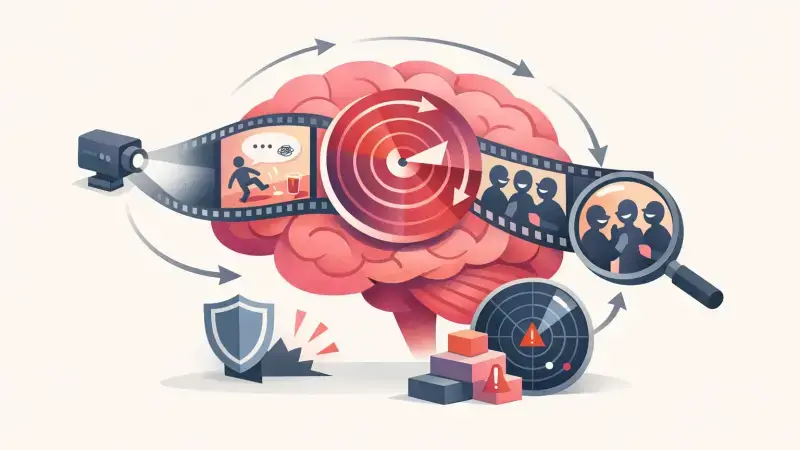
Most people can forget a whole conversation and still remember one awkward sentence from it for years. It isn’t one famous incident. It’s the everyday stuff: saying “you too” to a server, waving back at someone who wasn’t waving at you, or going blank during a presentation at work. The core mechanism is simple. The brain treats social mistakes like potential threats to belonging, and it keeps pulling them back up to check them again. The replay isn’t entertainment. It’s a kind of internal error review, driven by attention, emotion, and a memory system that tags “important” moments by how they felt, not by how much they mattered.
Social risk makes small mistakes feel big
Embarrassment is tied to status and acceptance, so the mind treats it differently than, say, misplacing keys. A social slip suggests, even briefly, “Other people might think less of me.” That possibility carries weight because humans are built to track reputation. In a meeting, a stumble over words can feel like a signal flare even if nobody else cares, because the brain is tuned to social evaluation more than factual accuracy.
One reason the replay is so sticky is that the moment often arrives with surprise. You didn’t plan to say the wrong name, laugh at the wrong time, or trip on a step. Surprise boosts attention, and attention is one of the main ingredients for durable memory. So the event gets filed as “watch this next time,” even when there is no real next time.
Your memory keeps the emotion and drops the context
Embarrassing memories tend to keep their emotional punch while losing surrounding details. People often remember the hot rush in the face, the sudden silence, the sense of being watched. They forget the ordinary context that would shrink the moment back down: the room was loud, others were distracted, someone else made a mistake five minutes later. That imbalance makes the memory feel more significant than it was.
A specific detail people overlook is how incomplete the original information was. In many awkward moments, you don’t actually know what others noticed. You see your own mistake from the inside, but you never get a full report of what everyone else perceived. That gap invites the brain to keep running the clip, trying to infer reactions that were never clearly observed in the first place.

The loop is a problem-solving mode that doesn’t resolve
Replaying an embarrassing moment can look like self-punishment, but it often behaves more like attempted learning. The mind searches for a better line, a better facial expression, a better escape route. It wants a clean ending, like a corrected version that can be stored for later. The trouble is that social situations don’t have fixed rules, so the “right” alternative is unclear.
That uncertainty keeps the loop alive. If you made a factual mistake and later learned the correct answer, the brain can close the file. With embarrassment, the question is usually social—how you came across, what people inferred, whether it changed anything. Those questions don’t have crisp solutions, so the brain revisits the scene as if another pass might finally settle it.
Attention sticks to imagined audiences
Embarrassing memories are rarely replayed as neutral footage. They are replayed with an audience. Even when no one is physically present, the mind supplies watchers, judges, and interpretations. That imagined social layer is powerful because it triggers the same monitoring systems used in real interactions: checking tone, timing, and whether you fit the group’s expectations.
A concrete example is a work call where someone’s audio echoes and they start talking over others. The moment is brief, but later the replay includes extra thoughts: the manager must have noticed, the team will remember, that pause sounded like incompetence. The memory expands, not because the event was long, but because the mind adds commentary that wasn’t actually spoken by anyone.
Stress chemistry makes the clip easy to retrieve
Embarrassment often comes with a shot of adrenaline and cortisol. Those chemicals can sharpen encoding and make a memory easier to call up later. It’s similar to why people remember where they were during scary moments, though the intensity is usually lower. The body reacts quickly, and the brain flags the situation as worth storing.
This also helps explain why the loop can show up at odd times. A quiet moment—showering, driving, trying to fall asleep—reduces incoming stimulation, and the brain’s default wandering can drift toward unresolved, emotionally tagged material. The embarrassing scene is already packaged for fast retrieval: vivid feeling, clear snapshot, uncertain social meaning. So it pops in, fully loaded, without needing an external reminder.

If you liked this, you might also enjoy: