

A familiar moment in a noisy place
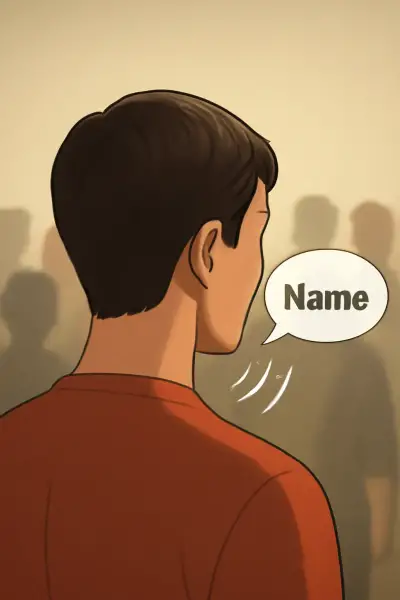
You can be in a loud room and feel like your brain has given up on understanding any of it. Then someone says your name and it cuts through. This isn’t tied to one famous event or one location. It shows up at a packed wedding in Mumbai, a commuter platform in London, or a sports bar in Chicago. The basic mechanism is simple: the sound pattern of your name has high personal value, so your attention system keeps scanning for it even when you’re focused elsewhere. The strange part is that this can happen without you noticing you were “listening” at all.
Your brain keeps a low-level watch on the background

When people talk about “tuning out,” it’s not total shutdown. The mind reduces detail from unattended sounds, but it often keeps a coarse track of what’s out there. Think of it like monitoring categories rather than sentences. That’s why a sudden change in voice, a sharp laugh, or a familiar rhythm can pop forward. Your name is an especially strong trigger because it’s learned early, repeated for years, and tightly linked to moments when a response was expected.
This sits close to what researchers call the cocktail party effect. The key idea is selective attention, not super-hearing. The auditory system can separate overlapping streams enough to let certain features compete for awareness. When the feature matches something highly relevant, it wins that competition fast, even if it’s physically quieter than other sounds nearby.
Names are treated as “self-relevant” signals
Your name isn’t just another word. It’s tied to identity, social standing, and possible demands. Over time, the brain learns that this particular sound pattern predicts interaction: being addressed, being evaluated, being included, being corrected. That history makes it emotionally and socially loaded even when the speaker’s tone is neutral. So when the pattern appears, attention shifts before you’ve decided anything consciously.
A detail people overlook is that this effect depends on how your name is usually said. Nicknames, pronunciations, and who tends to use which version matter. Someone who only ever hears “Alexandra” in formal situations may not react as strongly to “Alex” from a stranger, or may react differently depending on the setting. It’s not magic. It’s a learned map between sound and meaning.
The sound of your name is distinctive in the stream
Attention grabs aren’t only about meaning. They’re also about acoustics. Many names have a sharp onset, a stressed first syllable, or a vowel pattern that stands out against conversational mush. That helps the auditory system segment it from the jumble. If the first consonant is crisp and the stress lands early, the brain gets a clean “candidate” quickly. A mumbled name, or one buried at the end of a sentence, is less likely to break through.
This is why the situation can feel inconsistent. In one crowd you catch it instantly; in another you don’t. Room acoustics, distance, music, and competing voices change what parts of speech survive the noise. Sometimes only the first syllable is audible. If that first syllable matches your name, it can be enough to yank attention, even before you can confirm what you heard.
Expectation, emotion, and mistakes shape the reaction
Context changes the sensitivity of the system. If you’re waiting for someone to call you, your threshold drops and the background scan becomes more willing to interrupt. Stress can do something similar. In a tense environment, the brain prioritizes cues that might involve you directly, and your name is a direct cue. That can make the attention shift feel abrupt and physical, like a snap in the head or chest.
It also explains false alarms. People often “hear” their name when it wasn’t said, especially in dense chatter where similar syllables float by. The brain is matching fragments under uncertainty, and it would rather check a possible self-relevant call than miss a real one. You end up looking up, then realizing you caught a near-match or a name that rhymes, and the room noise closes back in.
Related reads
- How a small change in posture instantly shifts confidence
- The shiver from a song: what causes musical goosebumps
- When a group all remembers the same detail that never happened
- Why your handwriting tightens when stress creeps in
- How snails rebuild cracked shells from the inside
- The Boston molasses tsunami of 1919 that swept trains and toppled buildings