
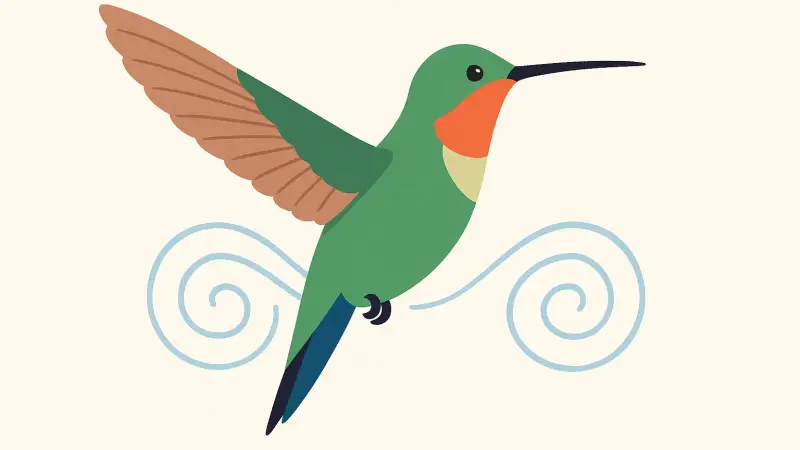
Watching a hummingbird hover at a feeder feels like watching something ignore gravity. This isn’t one single place or event, so it helps to picture a few familiar scenes: an Anna’s hummingbird at a backyard feeder in California, a ruby-throated hummingbird pausing at a garden in the eastern United States, or a bee hummingbird hovering near flowers in Cuba. The core trick is aerodynamics, not magic. Each wingbeat sheds tiny spinning swirls of air—vortices—that keep the flow attached and the pressure low where it needs to be. Those little swirls show up because the wing moves fast, at a steep angle, and reverses direction in a tight space.
Hovering needs lift on both halves of the wingbeat
Most birds get most of their lift on the downstroke, then recover on the upstroke. A hovering hummingbird can’t afford that. It has to support its weight almost continuously, so it produces lift on the downstroke and again on the upstroke. That’s why the wing doesn’t just flap up and down. It sweeps forward and back in a broad arc, with the wing rotating so the leading edge stays “in charge” of the airflow in both directions.
One overlooked detail is how much of the wing actually flips. The shoulder and wrist joints allow strong rotation, and the hand portion of the wing (the part supported by the longer bones) changes its angle quickly at the end of each half-stroke. That rapid flip is not just a reset. It sets up the next vortex and helps the wing meet the air at a useful angle right away.
The tiny vortices are a “leading-edge vortex” that stays attached
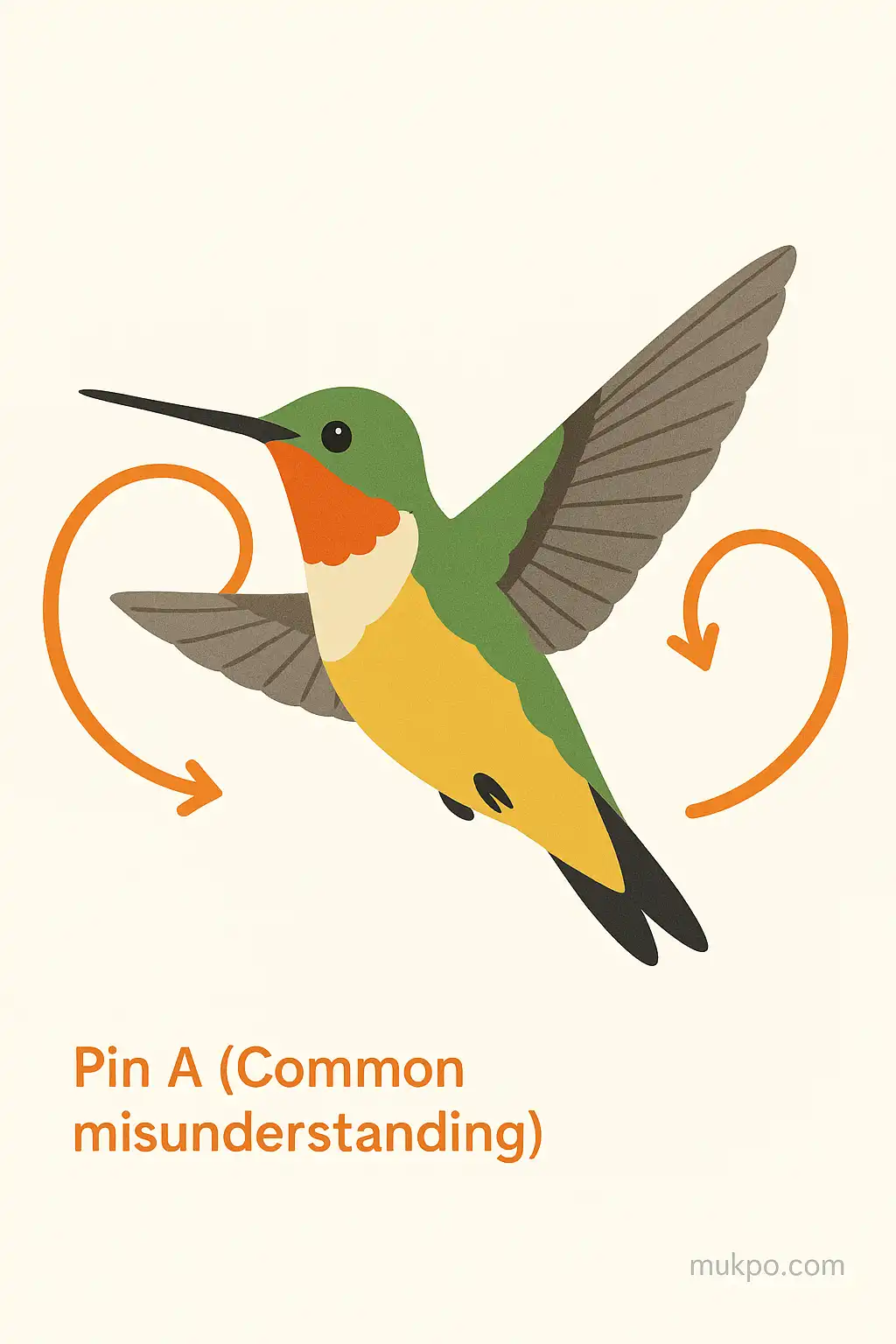
The most important swirl for hovering is the leading-edge vortex. When the wing moves at a high angle of attack, air can’t follow the sharp turn around the leading edge smoothly. Instead, it rolls into a tight vortex along the front of the wing. That vortex lowers pressure over the wing surface and boosts lift, even at angles that would normally cause a stall.
What makes hummingbird flight special is that this vortex can remain stable over much of the stroke instead of immediately breaking away. Stability depends on speed, wing shape, and how the wing accelerates. It also depends on scale. A hummingbird wing is small, and the bird operates at a different Reynolds number than larger birds, so the balance between inertia and viscosity in the air is different. That changes how easily the vortex forms and how long it can hang around without bursting into messy turbulence.
Stroke reversal creates extra lift from interacting wakes
Hovering isn’t just about what the wing does in the middle of a stroke. The ends matter. Each time the wing slows, flips, and accelerates in the other direction, it passes through air it disturbed a moment ago. That can add lift in short bursts through wake capture. The wing “catches” energy in its own shed vortices and uses that organized swirl to generate force quickly as the new stroke begins.
A concrete example is a hummingbird pausing at a sugar-water feeder port. The bird often holds position with tiny fore–aft adjustments. Those adjustments happen during stroke transitions. Small changes in timing and angle at reversal change how the wing meets the previously shed wake. That’s part of how hovering can look steady even though the forces are inherently pulsed and the air behind the bird is constantly being rearranged.
Why the wing’s path and twist matter as much as wing speed
Fast flapping is obvious, but the path of the wing is easy to miss. The wing sweeps in a tilted figure-eight-like motion, and that geometry helps keep the leading-edge vortex useful through a large portion of each half-stroke. The wing also twists from root to tip. That means the angle of attack is not the same everywhere along the wing at once. The tip can be doing something slightly different than the base, which helps manage vortex strength and delays flow separation where it would be costly.
Another overlooked detail is that the wing surface is not a rigid board. Feathers flex, and the wing can subtly cup. That changes the pressure distribution and can influence how the vortex sits over the wing. Small deformations can make the difference between a vortex that stays attached long enough to be useful and one that breaks down too early.
Those vortices also explain the downwash and the noise you can sometimes hear
If vortices are creating lift, the air has to go somewhere. In hovering, the net effect is a downwash: air pushed downward to provide an upward reaction force on the bird. The tiny vortices shed from the wing feed into a more complex wake below and behind the bird, and that wake is not a smooth column. It’s a chain of interacting swirls that form and dissipate rapidly.
That rapid formation and shedding can contribute to the audible hum people notice near a feeder, especially at close range. The exact pitch varies by species and by how hard the bird is working, and it isn’t always clear how much is pure wingbeat frequency versus additional aerodynamic sound from the wake. Either way, the same fast, high-angle strokes that keep the leading-edge vortex alive are also the strokes that keep the air constantly rolling into little spinning structures.
Related reads
- A street whose lawns rearrange their stripes overnight
- How seawater ice traps air bubbles that record ancient storms
- A vending machine that always ejects a single antique spoon
- How your nose adapts so you can’t smell your own perfume
- The apartment where each mirror shows a different hallway
- Why you walk into a room and forget your purpose