
A storm that refuses to smear out
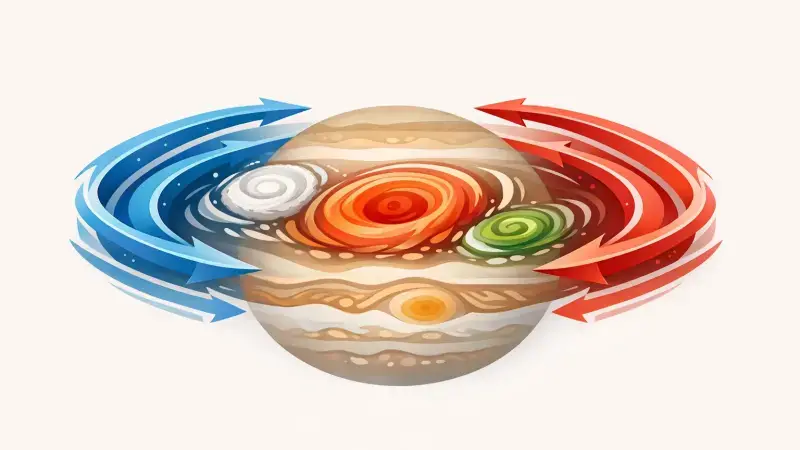
On Earth, a big storm is a short-lived thing. It stretches, breaks, and fades once the winds feeding it move on. Jupiter does not play by that rhythm. The Great Red Spot has been watched since at least the 1800s, and we’ve seen it keep a coherent oval shape even while it slowly shrinks. That persistence comes down to how Jupiter’s winds are arranged: fast, steady jet streams that act like guardrails, plus an atmosphere that can keep recycling energy without needing continents, seasons, or oceans to interrupt it.
Jet streams that pin storms in place
Jupiter’s visible clouds sit in bands that wrap all the way around the planet. Those bands are jet streams, and they alternate direction. A long-lived vortex can end up wedged between two jets moving opposite ways. That matters because the shear at the edges helps define the storm’s boundary. Instead of spreading outward until it loses its identity, the vortex gets “trimmed” by the surrounding flow and stays compact.
This is one reason the Great Red Spot holds an oval outline, and why other long-lived features show up in similar banded zones. The exact details vary from storm to storm, but the basic setup is stable: a fast-rotating planet with persistent east–west winds that don’t have to dodge mountain ranges or break over land.
Rotation favors wide, organized swirls
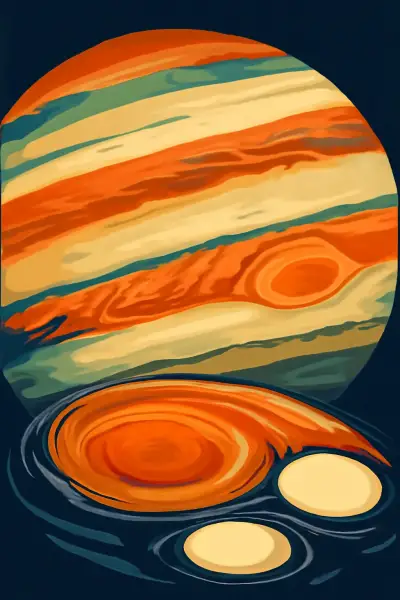
Jupiter spins in about 10 hours, so the Coriolis effect is strong. That pushes moving air into curved paths quickly and makes large-scale flow organize into jets and vortices. It also discourages the kind of messy, all-directions mixing that would blur a storm’s edges. The result is that once a vortex forms, it can behave like a long-running structure in the flow rather than a temporary pile-up of weather.
One overlooked detail is that on a fast rotator, it’s harder for air to cross those jet boundaries. The bands act like partial barriers. If outside air can’t easily leak in and out across the storm’s latitude, the storm’s “identity” lasts longer because it isn’t constantly being diluted by mixing from far away.
A deep energy supply, not a one-time burst
Earth’s strongest storms are usually limited by how long warm ocean water and moist air can keep feeding them. Jupiter’s big vortices are not powered by condensation the same way a hurricane is. They live in an atmosphere that is continually stirred from below. Jupiter gives off more heat than it receives from the Sun, and that internal heat drives convection: rising and sinking motions that can keep injecting energy into the weather layer.
That doesn’t mean a storm is a perpetual-motion machine. It still loses energy to turbulence and radiation. But the background system keeps replenishing the motions that create and maintain vortices. When smaller storms form, collide, or get shredded, their energy doesn’t just vanish. Some of it cascades into larger, more organized swirls, which is one way a big, long-lived feature can keep getting “topped up.”
Why the shapes look so clean from far away
What people usually picture is a storm as a blob in the sky. On Jupiter, the storm is embedded in layers, and what’s visible is only the cloud tops. The vertical structure helps the storm resist being torn apart. Winds can change with height, but a deep vortex can couple multiple layers together, making the whole system harder to disrupt with a single disturbance at one altitude.
There’s also the simple fact that Jupiter has no solid surface to break circulation. On Earth, friction with the ground, mountains, and land–sea contrasts add chaos and drain energy. Jupiter’s weather flows over gas, so the damping is different. The storm still evolves—Voyager, Hubble, Juno, and amateur observers have all tracked changes in the Great Red Spot’s size and color—but the surrounding environment makes “keeping a recognizable outline” a natural outcome rather than a lucky exception.
If you liked this, you might also enjoy: