
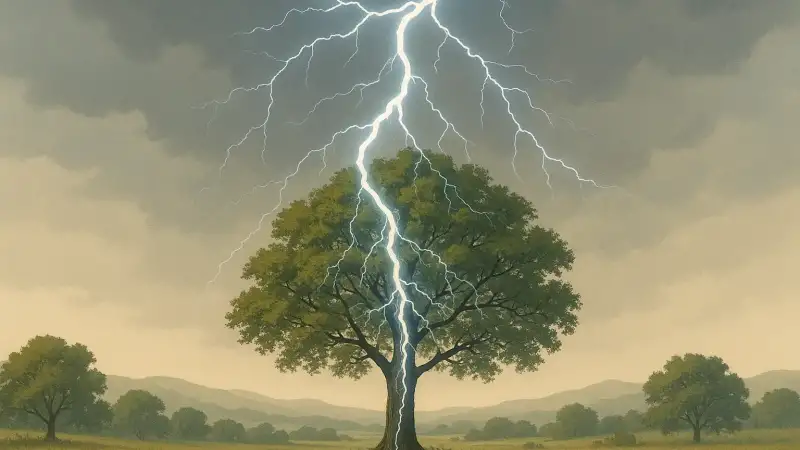
A lot of people learn the line “lightning never strikes the same place twice,” then notice a tree that looks like it’s been hit over and over. This isn’t one single famous case. It shows up in many storm-prone places, like Florida, the Great Plains in the United States, and parts of South Africa. The basic reason is simple. A lightning strike is not a random dart thrown at a forest. It follows the easiest electrical path it can find at that moment. If one tree keeps offering that path—because of where it stands, what it’s made of, and what’s under it—it can get picked again and again.
Lightning chooses paths, not targets
A cloud-to-ground strike starts as a stepped leader moving downward through air that is becoming more conductive in narrow channels. From the ground, objects launch upward streamers that try to connect. The “winner” is the connection that completes a conductive route first. That’s why tall, isolated things get hit more. It’s also why the same object can be favored repeatedly if it keeps being the easiest place for an upward streamer to form.
Once a particular route has worked, it does not permanently “train” the sky to use it. But it does reveal something about the local setup. Height relative to nearby objects, exposure on a ridge, and distance to other tall conductors all matter. A lone tree in an open field is not competing with much. A tree inside a dense, even canopy is.
Why one tree can be the easiest conductor
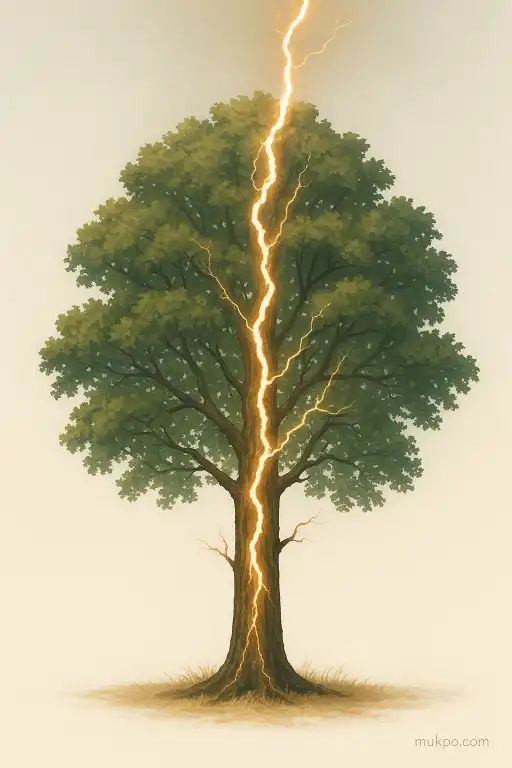
Tree species and condition change the odds. A tree with lots of moisture moving in its tissues can conduct better than a dry, resinous one, though real trees are complex and variability is big. If a trunk has a long wet scar from past damage, rainwater can run down that channel and raise conductivity right where it matters. Bark texture and how water sheets across it can also change where current prefers to travel.
A specific detail people overlook is the ground. Lightning is completing a circuit into the Earth, so soil resistivity counts. Wet soil, clay-rich soil, and areas with shallow groundwater often provide a lower-resistance path than rocky, dry ground. A tree whose roots sit in consistently damp soil can be part of a better overall electrical route, even if a nearby tree looks just as tall.
Damage from earlier strikes can make repeat strikes more likely
A strike can change a tree in ways that matter for the next storm. It can strip bark, split wood, and create long cracks that hold water. It can also kill sections of the crown, leaving dead, drier branches that break the tree’s shape and expose jagged points. Those points can intensify the electric field around the tree, which can help launch an upward streamer sooner.
Sometimes a strike doesn’t kill the tree but it does leave internal injury and decay. A hollow or decayed core can fill with moisture after rain. That can create a more conductive interior route compared with intact wood. None of this guarantees repeat strikes, but it can tilt the “easiest path” calculation toward the same trunk again.
Local terrain and nearby conductors steer the risk
Topography quietly organizes lightning. Hilltops, ridgelines, and the edges of plateaus tend to have stronger electric fields during storms. A tree on the highest point of a small rise can be a repeat receiver even if it isn’t especially tall in absolute terms. Open areas also matter. When a tall object is surrounded by shorter ones, the taller object has a better chance of producing the first successful upward connection.
Human-made conductors can reshape the pattern too. Power lines, fences, buried cables, and metal irrigation systems change how current can flow once a strike happens nearby. A tree next to a grounded fence line may effectively be connected to a good path into the Earth. That doesn’t “attract” lightning like a magnet, but it can make that location part of a lower-resistance route when the storm’s electric field is primed.
Why “dozens of times” can be true without being constant
Repeat strikes don’t need special physics. They just need repeated storms plus a stable local setup. In places with frequent thunderstorms—Florida is a common example—an exposed tree might be present through hundreds of storm days over decades. Even a small advantage in being the easiest connection point can add up to many hits across a lifetime.
It’s also worth separating “one tree” from “one exact spot.” Lightning can attach to different branches, different sides of the trunk, or even nearby ground while still looking like the same victim. A tree can survive multiple events, accumulate scars, then finally fail from a later strike that hits when the wood is already weakened and waterlogged.
Related reads
- The vending machine that dispenses live plants with tiny adoption cards
- How tardigrade proteins stop cells from drying out
- The bridge that plays a melody when cars drive over it
- The fungus that turns ants into trail-building automatons
- The parish that burned dozens in a single, frenzied 17th-century witch trial
- Why strangers sometimes seem familiar even when you haven’t met them