
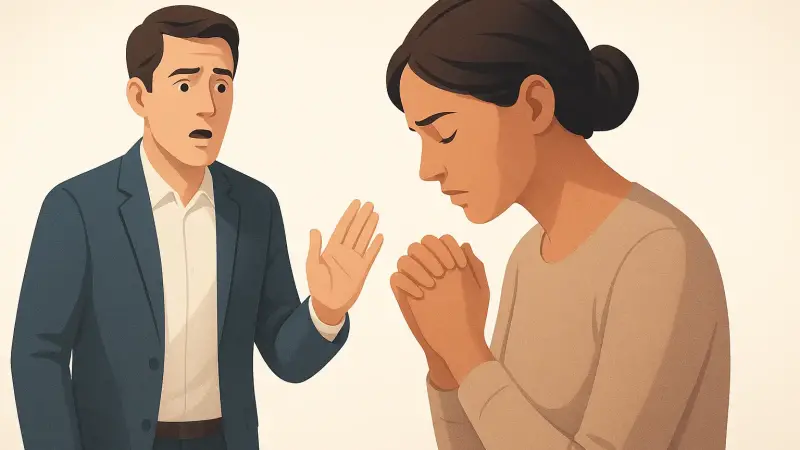
That quick “sorry” that comes out automatically
This isn’t one single incident or one famous law. It’s a small habit that shows up everywhere: on a crowded New York subway when someone bumps your bag, in an office in London when a meeting link won’t load, or in a Toronto coffee line when the card reader freezes. People apologize for tiny slip ups even when they didn’t cause the problem. The core mechanism is simple: “sorry” often works as a social tool, not a confession. It can mean “I noticed a disruption” or “I’m not trying to make this harder.” That’s why it pops out before the brain finishes sorting fault.
A concrete example: someone steps on your foot and you say “sorry” while pulling back. You’re not admitting you did anything wrong. You’re signaling cooperation in a moment where bodies and space have to re-coordinate fast. That speed matters more than accuracy.
“Sorry” is also a way of managing the other person’s feelings
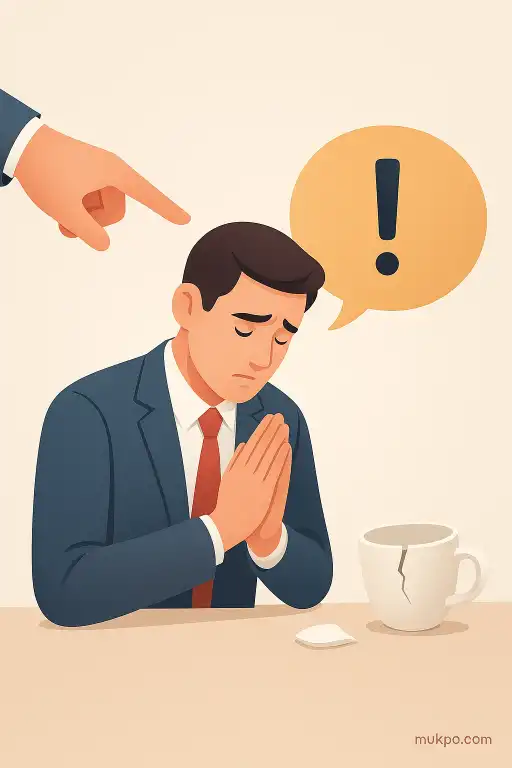
Small disruptions create tiny spikes of tension. Even when nobody is angry, there’s a split second of “are we okay?” An apology can smooth that out by acknowledging the other person’s experience. It’s close to saying “I see you” or “I get that this is annoying,” especially when the disruption is ambiguous. A dropped pen, a chair scraping, a delayed reply. These aren’t moral events, but they can still feel socially sharp.
There’s also a status component. People who feel lower-stakes power in a setting often apologize more. Not because they’re weaker as people, but because the cost of social friction feels higher for them. A customer service worker saying “sorry about the wait” didn’t create the staffing shortage. The phrase preemptively manages irritation that might otherwise land on them anyway.
Fault is often unclear in the moment
Many tiny mishaps don’t have a clean cause. A door swings back. Two people move the same direction. A file won’t attach. When cause is uncertain, the brain reaches for the fastest script that keeps things moving. “Sorry” is compact, widely understood, and rarely punished. People don’t pause to run an internal investigation because the social moment is already happening.
One detail people overlook is timing. The apology often comes before the person even fully perceives what happened. It’s a reflex tied to interruption, not guilt. You can hear it in the way it comes out half-formed, overlapping with the action: “sorr—” while stepping aside, “sorry!” while catching a falling cup. The body is already trying to restore flow.
Some cultures treat apologies as politeness more than admission
Apology habits vary a lot by place, and it’s not always about personality. In parts of Canada, “sorry” is commonly used as a softener or sympathy marker, including for things the speaker didn’t do. In the UK, it can work as a default politeness token in tight public spaces. In the US, people still do it, but there can be more suspicion that “sorry” equals “I’m responsible,” depending on the context and the person.
This is why the same phrase can be misread. Someone says “sorry” to mean “excuse me,” and the other person hears an admission. That mismatch shows up in mixed workplaces and tourist-heavy cities. Neither person is being irrational. They’re using different social dictionaries for the same word.
Apologizing can be a way to protect identity and keep the interaction small
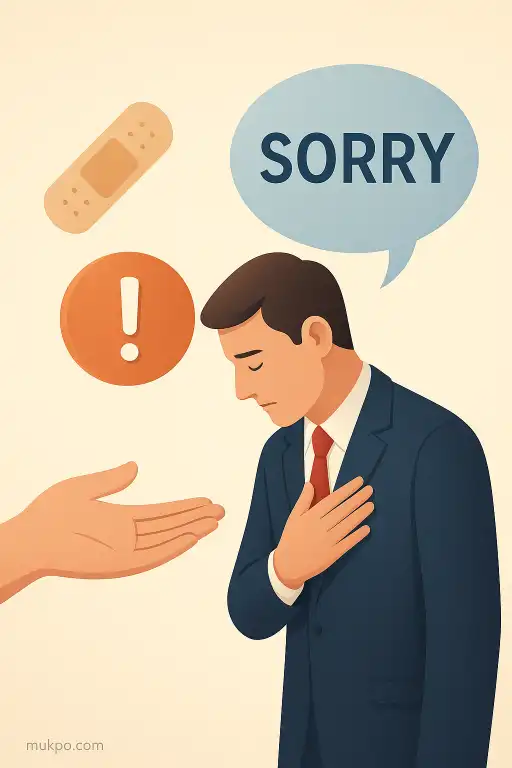
Tiny errors can feel bigger than they are because they brush against identity. People want to be seen as competent, considerate, and not a burden. A quick apology can keep the moment from expanding into commentary about who they are. “Sorry” closes the loop fast. It signals that the person is self-monitoring and aligned with shared norms, even if the event was random.
It also helps keep interactions from becoming negotiations about blame. If you say “that wasn’t my fault,” you’ve made fault the topic. If you say “sorry,” you can stay focused on coordination: moving past each other, restarting the call, picking up the papers. The point isn’t truth in a legal sense. It’s keeping the social surface smooth enough that everyone can move on.
Related reads
- How tiny ice crystals sculpt snowflakes in midair
- The elevator that waits for applause before moving up
- Why walking often clears the fog and helps you solve problems
- How peregrine falcons harness mountain winds to reach dive speeds
- Why your handwriting shifts when you write in a hurry
- Why a sudden noise can still make your heart jump long after the danger is gone