

Seeing “floating rock” in the real world
It sounds wrong at first. Rock shouldn’t drift across the ocean like driftwood. But after underwater eruptions, it sometimes does. In 2012, a huge pumice raft formed near the Havre Seamount north of New Zealand and spread out across the South Pacific. Pumice is full of tiny holes made by trapped volcanic gas, so it can float for a long time. While it’s floating, it acts like a moving platform. That platform can carry seeds, plant fragments, insects, and other small hitchhikers to islands they could never reach on their own.
How pumice stays afloat long enough to matter
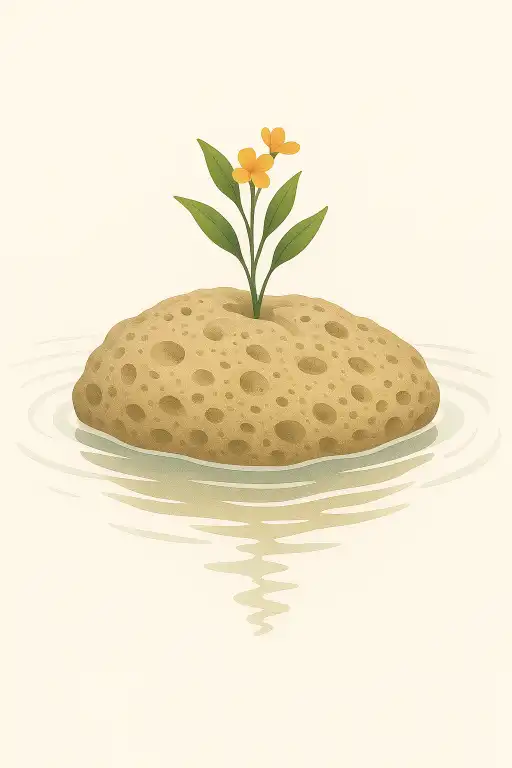
Pumice is basically volcanic froth that cooled fast. Its bubble-rich structure lowers its overall density, so ocean water can’t immediately sink it. Over time, the same holes that make it buoyant start filling with water. Some pieces waterlog and drop out quickly. Others stay afloat for months or even years, depending on how porous they are, how cracked they get, and whether organisms seal or roughen the surface.
A detail people often overlook is the size range. Rafts are not made of one big slab. They’re a mess of pieces from pebble-sized clasts to boulder-like chunks. That matters because small pieces can slip into sheltered coves and strand high on beaches, while larger pieces ride waves differently and can keep going. So the “delivery” isn’t one arrival. It can be a long series of landfalls.
Why plants and insects can survive the trip
Most seeds won’t sprout at sea, but they don’t need to. Many can handle long dry spells, salt spray, and temperature swings. They just need to avoid being soaked continuously. Pumice helps because it’s not a smooth, wet surface like a log. Its pits and crevices create tiny dry pockets, especially above the waterline. Seeds and bits of moss or lichen can lodge there and stay relatively protected.
Insects don’t have to be thriving to be transported. Eggs can be the main payload. Egg cases stuck to plant material can ride with the plant. Small arthropods can also tuck into the pumice texture and avoid being washed away. The rough surface gives grip, and the raft can carry bits of seaweed and debris that provide brief shelter and food. It’s a low-energy way to cross distances that would otherwise be fatal.
What makes a raft turn into a colonization event
Getting to an island is only the first filter. The raft has to land in the right place. A seed arriving on bare lava, a salt-burned cliff, or a wave-scoured beach may die quickly. But if the pumice strands near a stream mouth, behind a reef, or in a mangrove edge, it can end up in calmer water and then onto moist ground. Wind and tides can push pieces into wrack lines where organic material is already collecting.
Timing also matters. If arrival lines up with rainy season, seeds have a better chance of germinating and insects have more shelter. If it hits during drought or right before a storm season that grinds beaches, the same raft can leave almost nothing behind. That’s why these events can be important without being reliable. The ocean delivers a lot of attempts, and only a few become new populations.
Why pumice rafts reach remote islands so efficiently
Regular driftwood is common, but it tends to rot, waterlog, and break apart. Pumice doesn’t rot. It can also travel in huge numbers at once, which changes the odds. A single log might carry a few passengers. A raft spread over kilometers can carry millions of little “landing sites,” each with its own tiny cargo and microclimate. Even if most pieces sink or miss land, a small fraction arriving can still be a lot.
Ocean currents do the rest. In the Pacific, broad current systems can move floating material from eruption zones toward island chains over long periods. That’s why pumice from regions like Tonga and other parts of the southwest Pacific has been found washing up far away, including on Australian beaches, though each eruption and drift path varies. When the pieces finally grind against reefs and shorelines, the same abrasion that breaks the pumice can also release what was wedged inside it, right where an island’s first scrappy colonists need to end up.
Related reads
- Why raindrops make different sounds on metal and wood
- The orchid that mimics a female moth down to the scent molecules
- How electric eels prevent self-shock while stacking thousands of volts
- The bacterium in subway tiles that glows under blue light
- How electric fish create private radio channels underwater
- The ant species that farms aphid livestock across fields